


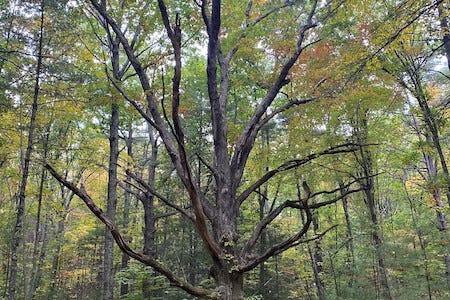
In Personalism, Emmanuel Mounier’s summary statement of his life’s philosophy, he writes:
To be conscious of the tree is to be over there, amongst its leaves and branches: it is even in some sense, as the Hindus and certain romantics have said, to be that tree, palpitating with it in the sweet fever of spring, feeling its century-old boughs in my own limbs, breaking out into joy with its budding—and yet to remain myself, distinct from it.
It is curious to come across such a statement in a book defining personalism, which, as a philosophical concept and mode of being, and as its very name implies, is centered on the idea of the uniqueness of the human subject. Dorothy Day was a proponent of personalism, as was the Romanian theologian Dumitru Staniloae. Nicholas Berdyaev and Charles Péguy are two of its inspiratory lights. It is deeply anthropocentric, articulating relationships between human and human, human and collective, human and time. Its influence on the theology of the Second Vatican Council is well documented; just look at the similarity of the language between Lumen Gentium—
the laity, by their very vocation, seek the kingdom of God by engaging in temporal affairs and by ordering them according to the plan of God. They live in the world, that is, in each and in all of the secular professions and occupations. They live in the ordinary circumstances of family and social life, from which the very web of their existence is woven (31)—
and Rufus William Rauch Jr.’s gloss on Mounier’s thought:
He believed that although man’s [sic] goal is beyond the temporal and beyond human history, man must, with all of his frailties, seek this goal within the changing materials of history. . . . Man must bear witness to the eternal verities by committing himself in the temporal affairs of his time.
Mounier spoke of the personalist doctrine as “an open adventure” and his faith—he was a practicing Catholic—as “a Christianity of the open air.” This latter phrase adds another shade to the personalist ethic and makes it so that the notion of arboreal merging evoked so beautifully in the quotation above is part and parcel of becoming fully human. My sense of myself, in other words, is dependent upon my ability to feel at one with my surroundings, and the unity of humankind is subtended by the unity of nature that each of us mirrors in microcosm.
This points to something our synodal church needs to assimilate: the idea of an interspecies synodality that moves freely between the human and the nonhuman in a kind of choral conversation in the spirit. We know we must hear the cry of the earth and the cry of the poor, that plaintive keynote of Francis’s Laudato Si’, but how do we begin to develop that frequency, to receive, register, and respond to those cries that are so often silent—to understand nature, as Sr. Elizabeth Johnson has suggested, as the “new poor” whose degradation only flows back to ourselves? As synodal subjects, we aim to refine our ability to listen even more so than to speak. This means tending to those preverbal cues that are nature’s tools of communication—the soughing wind and the lash of water on rock, but also the sounds of destruction and lament: the felled tree, the rising tide, the choking off of open space. Along with his unitive vision, Mounier left us a warning:
The distractions of our civilization are eating away the sense of leisure, the respect for the flight of time, the patience that waits for good work to come to maturity: they are drowning that voice of the silence which, it is to be feared, no one except the poet and the man [sic] of religion will much longer be able to hear.
Michael Centore
Editor, Today’s American Catholic
Nice job. Thanks for sharing that. A lot to reflect on.