


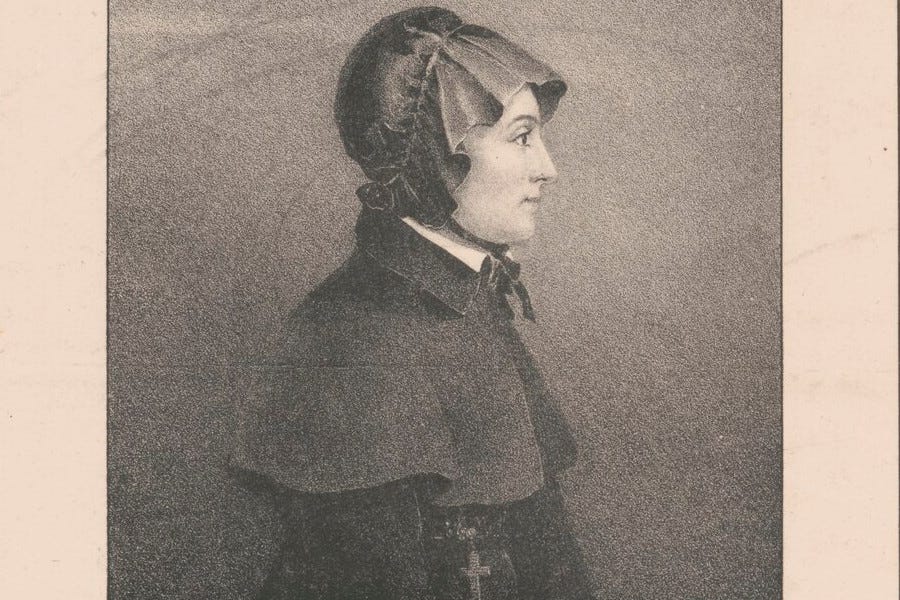
Saint Elizabeth Ann Seton established herself as a leading figure in American Catholic history through her canonization in 1975. Her life of loss, spiritual growth, and perseverance continues to inspire believers who view her as someone who faced challenges and doubts while maintaining her faith. Seton wanted believers to understand that holiness exists as a daily commitment to serving others even when life becomes unpredictable. She demonstrated that faith is foremost a physical practice that people experience in their everyday activities, connections with others, and routine decisions.
In her book Elizabeth Seton, American Saint, author Catherine O’Donnell explores the very human way that Seton lived out her faith. She developed her spiritual beliefs through ordinary life experiences rather than receiving extraordinary divine revelations. In a detailed analysis of Seton’s written correspondence, O’Donnell demonstrates how Seton frequently discovered her faith through activities such as childcare, visits to terminally ill people, navigating financial concerns, and seeking God through ongoing life changes. We come to understand her as a contemporary guide who leads us toward living with bravery, empathy, and optimism.
Elizabeth Ann Bayley Seton was born into a prominent and devoted Episcopalian family in New York City in 1774. America had experienced its first major historical crisis with the collapse of colonial-British relations following the Intolerable Acts, which resulted in the First Continental Congress triggering the American Revolution. Elizabeth married William Seton at age 19 and gave birth to 5 children, but the young couple faced financial difficulties due to the collapse of the Seton family’s shipping business. After William passed away in 1803, Elizabeth needed to support her children without any financial or social resources. Her spiritual search for meaning began during this time of grief, displacement, and helplessness.
She converted to Catholicism in 1805—a decision that would prove to be transformative in every way. The social consequences of her conversion separated her from others and her financial situation continued to deteriorate. Through all of this, however, her spiritual experience brought her stability. As O’Donnell makes clear in her book, Seton struggled to connect her spiritual pursuits with her responsibilities as a single mother caring for her children.
After a period overseeing an academy for young women as a means of earning her livelihood, Seton established the Sisters of Charity in Emmitsburg, Maryland, in 1809. She established America’s first free Catholic educational institution soon thereafter. Her actions created a template for other Catholic educational institutions spreading throughout the United States. Alongside her educational efforts, Seton founded a new religious community under her leadership. Through her service activities she taught children, visited the sick, and provided comfort to the poor because she believed that love required physical expression.
“A lover of clarity felt the stir of mystery,” O’Donnell writes, asserting that Seton’s spiritual path emerged from her authentic emotional expression. Seton vocalized her genuine feelings about fear, doubt, exhaustion, and loneliness through her numerous letters to family and friends. She used these emotions as the basis for prayer instead of attempting to conceal them. Through her authentic nature, Seton shows us that faith starts from the point of uncertainty, and does not simply bypass it.
This year’s 50th anniversary of Seton’s canonization has brought renewed attention to the first American-born saint. The anniversary has not gone unnoticed by Seton Hall University (SHU) in New Jersey, an institution blessed to bear her name. In the fall of 2025, a special exhibition honoring Seton’s path to sainthood opened at the university’s art gallery. The exhibit draws connections between Seton’s life and witness and the turbulent atmosphere of America during the year of her canonization.
The exhibition space itself is set up like a quaint 1970s American living room, with an orange-and-brown-colored theme. In the center is placed a table, chairs, and a video of SHU faculty, staff, and students speaking about the saint. On the table are magazines and newspapers dating to 1975, with articles announcing Seton’s soon-to-be-canonization on September 14. The gallery walls are adorned with posters on “The Making of an American Saint,” and a timeline shows key events in history from the date of her death (January 4, 1821) through her canonization. Scrapbooks and photos highlight the events of her outdoor canonization Mass, bringing us back in time as eyewitnesses of this once-in-a-lifetime event.
This was a momentous time for the university as well as for students in the present. Many students and faculty identify with Seton’s life experiences because they face similar challenges in their daily lives. In addition, many working parents, people dealing with financial struggles, and those seeking spiritual direction during difficult times can identify with her.
Seton’s leadership abilities created a lasting impact on Catholic women who followed her path. She fostered a religious community while handling financial matters, building educational systems, and leading younger women on the path of spiritual growth. Through her leadership, she demonstrated both strength and compassion because she led with humility while taking full responsibility for everyone in her life. According to O’Donnell, she transformed selfless actions into acts of empowerment, especially on behalf of the women she served.
We know how much Seton wanted full autonomy for the women of her time, as she freely expressed her own desires for ordination in the American Catholic Church. She should be applauded as one of our early female advocates. She was clearly part of the dialogue for women striving to obtain a clerical position. One of the poster boards in the exhibit informs us that her papal Mass featured the first female lector. This unprecedented honor would have brought Seton great joy. Many women fighting for ordination in the Catholic Church today feel empathy for Seton’s sentiment as she approached her later years: “If I was a man all the world should not stop me.”
As she began to mature into a spiritual mother and member of the Catholic Church, Seton held a strong influence not only over those in her community but from all walks of life, including her children. “Openly acknowledging the constraints of her role seemed to reconcile her to them,” O’Donnell writes, adding, “she had wished to become a priest.” She saw the priesthood as the most desirable role for any person, and she stretched its boundaries to the farthest possible extreme within her capacity as a woman in the church. In the exhibit video, Dr. Nancy Enright, SHU’s director of the University Core and a professor of English, quotes the famous words of the 19th-century Archbishop of Baltimore, Francis Patrick Kenrick, when he stated that Mother Seton “had more impact on the church in America than all of us bishops put together.”
Through her personal and spiritual development and eventual canonization, Seton proved that holiness exists everywhere and that people achieve it through different life paths. Her story is proof that God’s love reaches everyone who seeks him with complete sincerity and openness. Seton proved herself as a powerful leader who defied social norms to create positive change for others during a period when women received little respect for their efforts or opinions. Through her example, we should recognize the value of all church members’ contributions and establish environments that enable women to participate fully in evangelization, service, and spiritual leadership. ♦
Angelina M. Medina is a first-year student at Seton Hall University. She is studying chemistry on a pre-med track in a 3+2 program with the Stevens Institute of Technology’s chemical engineering department. She hopes that her love for chemistry guides her into medical school to pursue being a neurosurgeon/anesthesiologist or chemical engineer. She writes this article to acknowledge all her peers at Seton Hall University and to celebrate the 50th anniversary of Elizabeth Ann Seton’s sainthood.
Dr. Sarita Melkon Maldjian is a professor of the Core and the English departments at Seton Hall University in South Orange, New Jersey. She is an advocate for Catholic school education and ordaining women in the Catholic, Orthodox, and Apostolic churches. She and her family are active members in the Armenian Apostolic Church, and all of her children have attended Catholic schools from pre-K through grade 12. She and her family are professional classical musicians and have performed all over the tri-state area. She holds her master’s degree in theology and doctorate degree in Biblical studies and music pedagogy from Drew University, Madison, New Jersey.