


Readers are invited to listen to our latest podcast episode with Sergio Lopez, National Director for Mission and Leadership Formation for Catholics in Communion, released in tandem with this article—Ed.
Earlier this year, Catholics began gathering outside detention centers, in parish halls, on sidewalks, after Masses, and in neighborhood streets across the country with a shared question: What does faithful witness look like in this moment?
For many communities, the question emerged from lived reality. Families were navigating fear and uncertainty. Immigrant communities were experiencing instability and separation. Parishioners were exhausted by polarization and division. Many Catholics felt caught between two unsatisfying options: reducing faith to private spirituality or reducing it to partisan conflict.
At the same time, there was also a growing sense that the church had something deeper to offer.
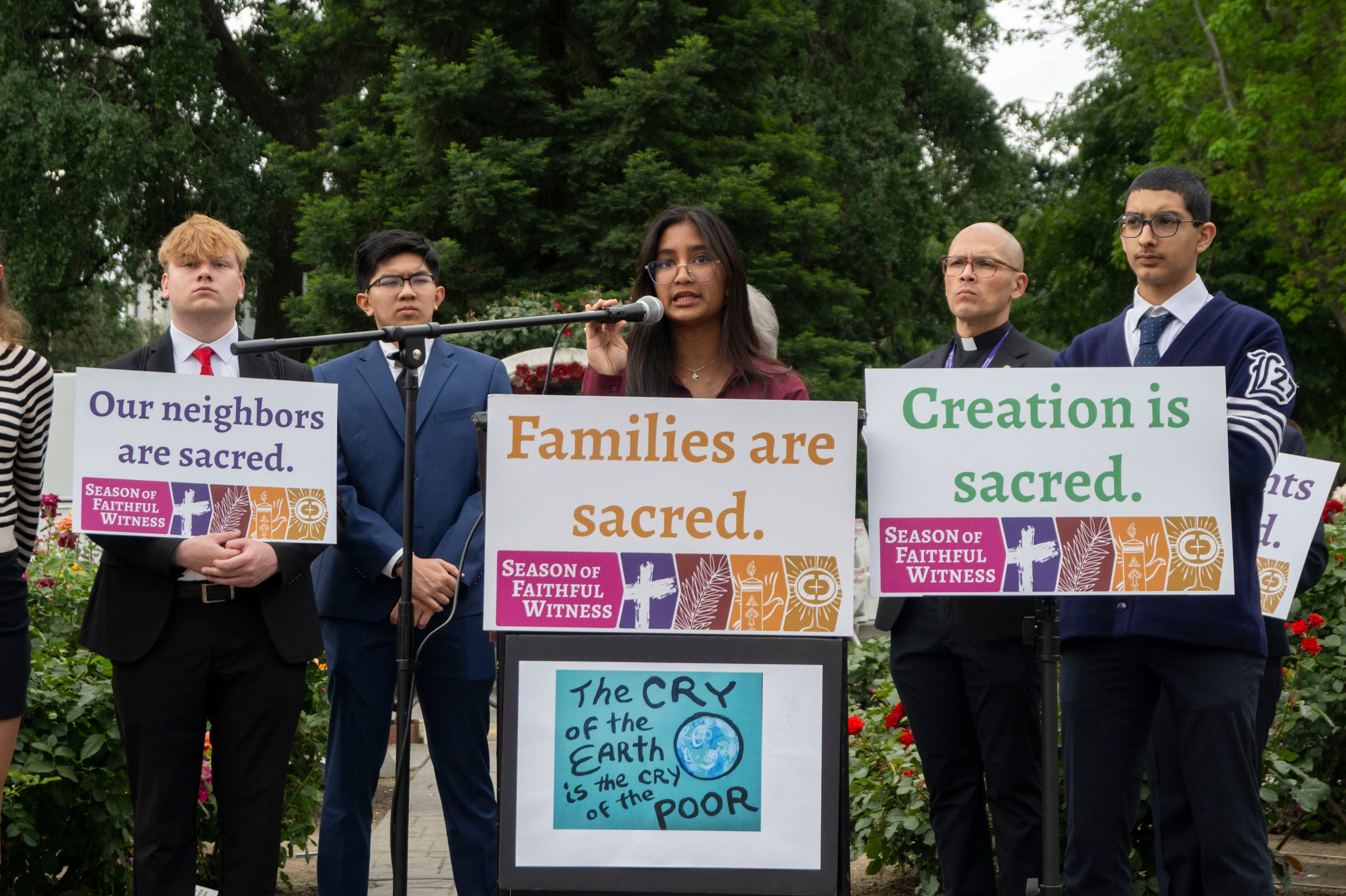
Out of that moment emerged the Season of Faithful Witness, a national initiative of Catholics in Communion inviting Catholics to gather in prayer, discernment, and peaceful public witness between Ash Wednesday and the Feast of Corpus Christi.
At its heart is a simple conviction: faithful witness is not meant to be carried alone.
“We kept hearing the same questions from people across the country,” said Sergio Lopez, National Director of Mission and Leadership Formation for Catholics in Communion. “People were asking how to respond as Catholics in a way that is rooted in prayer, rooted in the Gospel, rooted in human dignity, and rooted in communion with one another.”
What followed was not a centralized campaign or a single national event. Instead, local Catholic communities began responding in ways that were deeply pastoral, visible, and rooted in ordinary Catholic life.
Some communities organized prayer vigils outside detention centers. Others hosted ministry reflection nights or post-Mass hospitality gatherings. Some organized Eucharistic processions through neighborhoods. Others gathered parishioners for listening circles and conversations about fear, solidarity, and the church’s public witness.
Many of these actions were intentionally simple. And that simplicity became part of the movement’s strength.
“A Pastoral Emergency of Hope”
One phrase quickly emerged throughout the movement’s gatherings and parish materials: “a pastoral emergency of hope.”
The phrase resonated because it named something many Catholics instinctively recognized. Beyond political polarization or social fragmentation, many communities were also experiencing profound isolation.
People were carrying grief privately. Parishioners felt overwhelmed and disconnected. Many Catholics no longer knew where to bring their fears, hopes, or questions together as church.
“We wanted to create spaces where people could gather again not first around ideology or argument, but around prayer, listening, and discernment,” Lopez said.
That emphasis shaped the character of the Season of Faithful Witness.
Rather than encouraging communities to replicate a single model, Catholics in Communion invited local leaders to discern what faithful witness might look like within their own context. One parish might organize a public procession. Another might host a bilingual prayer vigil or a ministry conversation. Another might simply invite parishioners to stay after Mass to pray together and reflect on the signs of the times.
The movement’s organizing materials repeatedly encouraged communities to focus on actions that were “simple, prayerful, and doable.”
That tone mattered.
The goal was never spectacle. It was to help people rediscover practices of public faith that felt recognizably Catholic: prayerful, communal, sacramental, and rooted in human dignity.
Why Corpus Christi Became Central
As the movement grew, many communities began focusing especially on the Feast of Corpus Christi that falls this year on June 7.
For Catholics in Communion, Corpus Christi became more than a liturgical feast celebrating Christ’s presence in the Eucharist. It became an opportunity to reflect publicly on what it means to become the Body of Christ together in a wounded world.
In the movement’s parish toolkit, organizers wrote: “Corpus Christi is not only a celebration of Christ’s presence in the Eucharist. It is also an invitation to remember who we become when we receive the Eucharist.”
That theological connection shaped many of the season’s public witnesses.
Across the country, Catholics organized processions through neighborhoods, public prayer gatherings, listening circles, and acts of solidarity rooted in the connection between Eucharistic faith and human dignity.
Some of the most powerful moments unfolded outside immigration detention facilities.
During Holy Week and throughout the spring, Catholics and ecumenical partners gathered outside detention centers in states including Florida, Illinois, Indiana, and California to pray publicly with and for detainees and immigrant families. In one particularly moving moment outside the Baker detention facility in Florida, participants praying outside the fences heard whistles and greetings from detained immigrants inside responding to hymns and prayers being sung outdoors.
Elsewhere, clergy and faith leaders successfully advocated for expanded pastoral access to detention facilities so detainees could receive prayer, accompaniment, and sacramental ministry.
For many participants, these moments revealed something important: public prayer still matters.
“We are rediscovering that Catholic faith is not only something practiced privately,” Lopez said. “It is also something we carry into the world together—in prayer, in procession, and in solidarity with one another.”
Rediscovering Public Catholic Life
One of the reasons the Season of Faithful Witness has resonated so widely is because it taps into something ancient within Catholic life.
Catholicism has never been solely private. The church has always processed through streets, gathered publicly in prayer, accompanied vulnerable communities, and proclaimed human dignity through visible communal practices.
What feels new today is not the tradition itself, but the rediscovery of it.
Many participants have described feeling moved simply by seeing Catholics pray publicly together again—not as performance or culture war, but as an act of hope.
That hope has become especially meaningful in a moment when many Catholics feel exhausted by ideological conflict and hungry for forms of public engagement that feel genuinely rooted in the Gospel.
The movement has intentionally tried to remain grounded in that spirit.
Its materials consistently encourage communities to keep public witness rooted in faith rather than partisan politics. Organizers are reminded to create spaces that are welcoming, prayerful, and non-anxious. Meetings begin with listening and prayer rather than strategy alone.
Again and again, participants return to one simple realization: they are not alone.
From Isolation to Communion
Near the conclusion of one of the movement’s Corpus Christi resources appears a line that has become, for many participants, a summary of the entire season:
“We hope these faithful witnesses will make possible that parishioners move from concern to courage, from isolation to communion, from private faith to public witness.”
That movement—from isolation to communion—may ultimately be the deepest significance of the Season of Faithful Witness.
Not every gathering has been large. Not every witness has received media attention. Some have involved only a handful of parishioners gathered after Mass. Others have brought together clergy, families, ministry leaders, and local communities in public spaces across the country.
But together, these acts of prayer and witness are revealing something important about this moment in the church.
Many Catholics are searching not simply for new programs or political answers, but for renewed ways of walking together as church in a fragmented and fearful world.
And across the country, communities are beginning to rediscover that path together. ♦
Four Ways to Get Involved
1. Join the Movement
Commit to working alongside Catholics across the country to engage in prayerful discernment and public expressions of faithful, nonviolent, and prophetic witness. Complete the sign-up form and you’ll receive:
invitations to national events and calls to action
timely resources and trainings to respond to the moment direct to your inbox
ongoing support for you and your community
2. Unlock Your Toolkit
Attend one of the upcoming trainings and access the library of previous sessions. They include designing events rooted in Catholic tradition, outreach and building your team, media training, and more. Multiply your impact by signing up or watching with others.
Catholics in Communion creates toolkits and resources to provide step-by-step guidance and planning tools and templates. It also provides a library of resources from its partnering organizations.
3. Start a Conversation
Catholics in Communion produces toolkits to support your next steps. The “Called to Courage: A Conversation on Pope Leo’s Leadership” Toolkit invites parishes into a guided conversation on Pope Leo’s leadership and the church’s call to live out our faith in today’s world. It includes a facilitator guide for prayerful dialogue and utilizes a recent 60 Minutes video segment with three US cardinals. In just 90 minutes, this conversation can support your community in taking a small but meaningful step toward what the church calls us to be: a people who listen, discern, and respond together.
4. Get Connected
Find people in your local community and invite others to join you in faithful witness. Visit the Catholics in Communion website to find local actions and leaders near you and to sign up for upcoming welcome and training calls.
This is the hope that action in communion will make possible: that parishioners move from concern to courage, from isolation to communion, from private faith to public witness. Whether you bring together 5 people or 500, public faithful witness allows the wider church to see Catholics across the country responding not with fear, division, or despair, but with prayer, solidarity, and moral courage.