


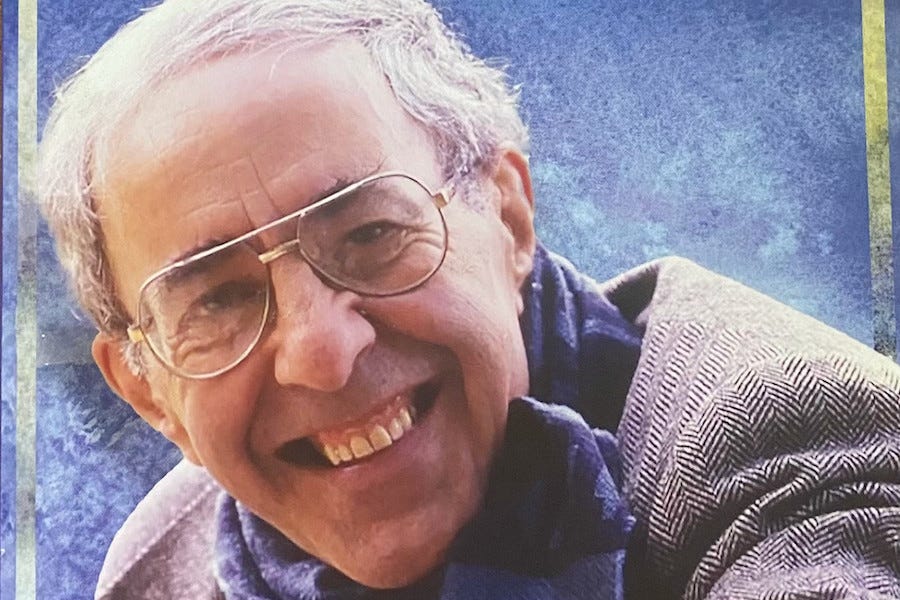
Despite the scores of books and articles written by and about him, the figure of Henri Nouwen remains something of an enigma. This is in part due to his shape-shifting spiritual path: always on the move, he had an uncanny ability to seize on the materials of each new direction in his life and transform them into stories of religious awakening. Whatever the latest subject, situation, or encounter—the immersion in Trappist monasticism recounted in Genesee Diary, a famed painting by Rembrandt in The Return of the Prodigal Son, the experience of accompanying the disabled in Adam: God’s Beloved—Nouwen threw his whole being into extracting its essential teachings and reformulating them as lessons to pass on through his writing. He was a kind of virtuoso of the phases and stages of one’s growth in God.
That very virtuosity, however, can make the “real” Nouwen difficult to pinpoint. He can slip between the cracks of his various selves or disappear behind the mask of a current preoccupation. Encountering Henri: The Living Legacy of Henri Nouwen, published earlier this year by Orbis Books to coincide with the thirtieth anniversary of his death, fills in some of these cracks and peers behind these masks to give us a fuller accounting of the man and his capacity for connection. Editor Stephen Lazarus, who serves as the literary manager of the Nouwen Legacy Trust, has assembled a diverse array of voices to reflect on their relationship with Nouwen and how his presence affected them personally. The effect is one of sitting around a convivial table as friends, colleagues, and former students reminisce about this seeker and “wounded healer” who gave so much of himself to so many.
In his essay “Henri and the Facets of Friendship,” Michael W. Higgins quotes Nathan Ball, the associate of L’Arche who first met Nouwen at the movement’s founding community in France: “Henri’s desire to know you and to relate to you overrode the normal process by which people determine and manage their relationships. His overwhelming need to connect at the level of the heart bypassed the normal process.” As becomes clear throughout the book, the intensity with which he lived and pursued and developed these relationships—Lazarus records an astounding sixteen thousand letters to Nouwen in his archive, and Michael J. Christensen, citing Nouwen biographer Michael Ford, notes that he tallied some fifteen hundred personal friends—was both his strength and his struggle, his grace and his wound. As former student Michael O’Laughlin writes of Nouwen’s time at Harvard Divinity School, “[H]e quickly interwove his life into the lives of everyone around him, and never went anywhere alone or even sat down to eat a meal by himself.”
This interweaving of self and others was at the heart of his priestly vocation; he seems to have had the pastor’s gift to reveal a person to herself, as much through his presence as his ability to abjure that presence to allow the Holy Spirit room to move. “Drawn by Henri Nouwen’s profound love of community, deep faith, ability to accept things he could not change, childlike love of celebration, and desire to stay connected and be faithful to his friends, I’ve discovered a kindred spirit in Henri and, in turn, discovered the woman I want to be,” Christiana Crook attests in her piece, “My Year with Henri.” It’s a sentiment that recurs throughout the volume. In “Finding Henri and a New Path,” Cistercian monk Brother Ambrose speaks of how, despite never having met Nouwen on the earthly plane, the author’s books set him on a course that would culminate in his monastic profession. “Even though the monastery was not his own vocation, he was a finger pointing the way for me. I would not have encountered the Cistercian way that I am living today if it wasn’t for Henri,” he writes. Gabrielle Earnshaw expresses a similar gratitude succinctly: “Henry Nouwen ennobled people.”
Like all writers, Nouwen’s books afforded him a sort of second life, an emissary of his embodied existence that could venture out and meet people across divides of space and time. This is another theme that crops up repeatedly in these reflections—the line between writing and life, and the way they mutually reinforce or rework each other into a hard-won form of personhood. “His ability to explore essential elements of our humanity, not only through his writing but through how he lived, was one of the reasons he became one of the most read and beloved spiritual writers of our time,” Michelle O’Rourke observes in the appositely titled “Henri’s Spirit Alive in My Life and Work.” Carolyn Whitney-Brown, a friend of Nouwen’s from their time together at L’Arche Daybreak in Ontario, suggests “that one aspect of Henri’s enduring power seems to be not so much in his thinking or his writing but in Henri as a person, as he described himself, and as others experienced him.” For O’Laughlin, “[Nouwen’s] lifestyle was a gospel teaching in itself”—a comment that closes the gap between the written and the unwritten self, fused in the Word of God. One almost gets the sense that, through this lifelong process of integration, he began to achieve in this world what O’Rourke reports he had hoped for in the next: “[W]hen he died, he wanted his spirit to be available to those who he loved and those who loved him.”
But the process of integration does not come without its shadow side, and Nouwen certainly had his. Contributors speak of his neediness, his tetchiness, his hunger for attention and affirmation. In a sensitively drawn portrait, his editor at Orbis, Robert Ellsberg, retraces the evolution of their personal and professional friendship that begins with a misunderstanding but blossoms over time into a rich creative partnership—a development that parallels, in Ellsberg’s telling, both Nouwen’s own “radical conversion” of “growing into the ideas he had explored in his earlier writings” and Ellsberg’s deepening spiritual maturity. In the end, we learn, Nouwen’s life “came into harmonious focus” as his restlessness abated. Author and apostle of nonviolence John Dear credits this to Nouwen’s “spirituality of peacemaking [that] connected everything,” interior and exterior, church and world—so much so, in fact, that even his funeral becomes for Dear a catalyst of peace as it brings together a wide range of people all touched by his witness. A final brushstroke in Ellsberg’s portrait serves as a beautiful epitaph: “Through the broken pieces of his own complex humanity he managed to reveal an aspect of the divine image.” ♦
Michael Centore is the editor of Tomorrow’s American Catholic.