


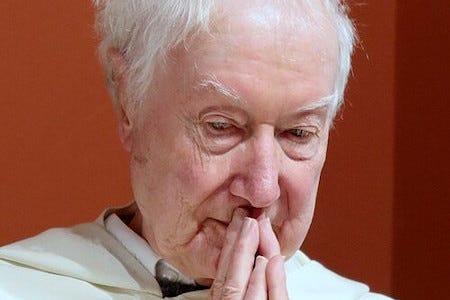
On June 5, Timothy Cardinal Radcliffe, OP, joined Liturgical Press editor Justin Huyck in conversation for a program titled “Synodal Hope: The Vision of Pope Francis and the Future with Pope Leo.” Along with Mother Maria Ignazia Angelini, Radcliffe was spiritual advisor and retreat master of the Synod’s 2023 and 2024 pre-Synod assemblies.
Following an introduction by Liturgical Press director Therese Ratliff, Huyck opened with a question about Radcliffe’s relationship with Pope Francis. “We got on very happily and easily together from the beginning,” the cardinal replied. “When you were in his presence, all his attention was on you.”
As for his experience of the recent papal conclave, Radcliffe described it as “paradoxical” in that it was “both solemn but also very joyful.”
“We were somehow there together, as brothers,” he said, though the fact that there were no “sisters” present “weighed on many of us.”
As spiritual advisors to the Synod, Radcliffe and Mother Angelini did not participate directly in the roundtable discussions. Instead, they watched from the sidelines for subtle shifts in tone, such as the “softening” of people’s faces that “slowly transformed the atmosphere,” Radcliffe said.
Huyck spoke of how synodality can sometimes seem “like a buzzword” within the church, and how many people feel they either don’t understand the concept or else are excluded from it.
“Quite a few cardinals don’t understand it, either,” Radcliffe responded. “It’s a problem for the whole church.” He offered the following “motto” for synodality to make it more accessible: “Jesus said, where two or three are gathered together, there I am in the midst of them.”
Describing Catholicism as a “religion of encounter” that is “about opening your being to all women and men,” he said that the focus of synodality is on “encountering the Lord as we encounter each other.”
Rather than defend our personal identities, synodality calls us to “stop worrying about who you are,” he explained. “God knows who you are. Open yourself to others—that’s the adventure as you go into the deepest mystery of life and love and God.”
Radcliffe affirmed that Pope Leo XIV will continue the work of synodality begun under Pope Francis. He said that the new pope will excel in encouraging those who might be afraid or skeptical of a more synodal church “because he is a very still, peaceful person” who is “not combative.”
“When you’re in his presence, you know in a way he transcends oppositions between left and right,” he said, adding that Leo “embodies that invitation to climb out of war.”
Radcliffe also noted that when Leo was Prefect for the Dicastery for Bishops, he had a reputation for inviting more women into that dicastery than any other cardinal. This is proof that he understands the issue of women’s participation as “one of the most important questions” facing the church today, Radcliffe said.
In response to a question about how laypeople can “navigate paths of authority” in the church, Radcliffe reminded listeners that “there are many forms of authority,” including the fundamental forms of “beauty, truth, and goodness.” He explained how every person is an authority in one of these forms.
“We underestimate the authority of beauty,” he said, sharing how artists, musicians, and filmmakers furnish us with a vision of truth. He referenced Michelangelo’s painting of the Last Judgment that hung over the conclave as one such example, as well as the work of Australian songwriter Nick Cave.
In his closing remarks, Radcliffe said that “our world suffers from a deficit of attention. We get distracted and we don’t attend.”
On the contrary, the beginning of holiness “is to pay attention to the other, to open our mind and heart to them, especially if we disagree.” He concluded, “We need to learn that profound quiet which enables us to hear another, to hear their truth, to hear their fear, to be alert to their hope.”
Michael Centore
Editor, Today’s American Catholic