


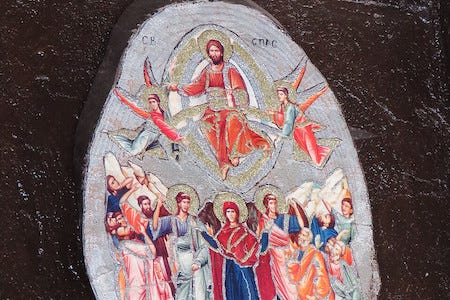
The Ascension is a feast with great personal significance for me. Sixteen years ago I was moved to attend Mass that day for the first time since childhood, marking the beginning of a return to the church that had been seeded by a period of reading Merton and Rowan Williams, Dostoevsky and Dorothy Day.
It wasn’t just the literature that had brought be back, but the liturgy as well—specifically, the connection of the liturgical cycles to the calendar year, like the overlapping of two kinds of time. It was a stabilizing force that didn’t demand a tradeoff of freedom. In fact, its regularity, its cyclical return, was itself a source of freedom, a way of opening out the day in hope and expectation. There was always something on the horizon, something to look forward to.
The theme of time was on my mind this week as I studied the opening reading for the Ascension, taken from the first chapter of Acts. The post-resurrection Christ appears to the disciples, who ask him, “Lord, are you at this time going to restore the kingdom to Israel?” He answers, “It is not for you to know the times or seasons that the Father has established by his own authority. But you will receive power when the Holy Spirit comes upon you.”
Our small Christian communities this week discussed a discrepancy in time found between the ascension account in Luke versus the one found in Acts. Though both books were written by the same author, in the gospel the resurrection and ascension are said to occur on the same day, whereas in Acts they are separated by a forty-day period in which Jesus presents himself to the disciples “by many proofs” and instructs them in the ways of the Spirit.
The forty days in the Acts account captivated my imagination. I am sure there are exegetical and theological texts explicating this period of which I am not aware, but my general sense is that it is underexplored in our Christology. What does it mean for the resurrected Christ to have walked the earth? As the incarnation fundamentally changed our human nature, did the resurrection do the same for our experience of time? There is a clue that Peter’s chonometric consciousness was altered when he writes in his second letter, “With the Lord a day is like a thousand years, and a thousand years are like a day” (3:8). I hear in his words a connection to William Blake’s “eternity in a grain of sand”: the day as the granular moment through which we grasp the whole, the “thousand years” that Christ, by touching the earth with the transfigured time of his resurrection, has made present to us.
“If in the apparent and phenomenal world it is the totality of time that seems one, and the moments a simply fragmentary reality, in the spiritual world on the contrary, it is time that is fragmentary, and the moment that possesses unity and even totality,” Georges Poulet writes in his Studies in Human Time. In his ascension, Christ is “taken up” to the realm where our lectionary cycles and liturgical practices point; he establishes a link between the phenomenal and the spiritual and the ways by which we measure each. “The seasons and all their changes are in me,” Poulet says, quoting Thoreau, and offers us a way of living into this new rhythm:
But the seasons are not in time; they are in eternity; they are eternity. An eternity of changing colors, a perpetual cycle. He who apprehends it lives in another time, a time that has nothing to do with chronology or clocks; he lives in a seasonal time, where, to the phases of nature, the phases of human life exactly correspond.
Michael Centore
Editor, Today’s American Catholic