


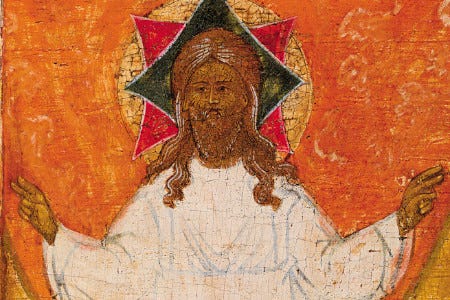
Lord Jesus Christ, Son of God, have mercy on me, a sinner
– The Jesus Prayer
Our readings for this week take up the theme of prayer. In the first reading, from Genesis, we watch the almost comical scene of Abraham petitioning God to save Sodom from destruction for the sake of a handful of innocent people. The humor comes in the way Abraham continually excuses himself for badgering God and then immediately resumes with his petitions. We can almost hear the awkward pause between each one, before God responds again with the merciful refrain of “I will not destroy it.”
Abraham’s persistence is a model for Jesus’s teaching in the Gospel of Luke: “And I tell you, ask and you will receive; seek and you will find; knock and the door will be opened to you.” There is something to be said for prayer as an act of repetition. Without even a specific request in mind, we can still offer ourselves, our acts, as prayer, in the midst of our ordinary lives. Here is Nadejda Gorodetzky, quoted in a book on the Jesus Prayer by the author known as A Monk of the Eastern Church:
The name of Jesus may become a mystical key to the world, an instrument of the hidden offering of everything and everyone, setting the divine seal on the world. One might perhaps speak here of the priesthood of all believers. In union with our High Priest, we implore the Spirit: Make my prayer into a sacrament.
The connection between prayer, sacrament, and the universal priesthood is a profound one, further enriched when we consider that that priesthood is rooted in what the Synod’s Final Document calls our “shared baptismal identity.” The English translators of the Philokalia, an eighteenth-century compendium of texts on prayer, offer a related insight in their introduction to the writings of St. Gregory of Sinai:
Of particular interest is the way St. Gregory connects the Jesus Prayer with the sacrament of baptism. Prayer, he states, is “baptism made manifest.” The aim of the Jesus Prayer, as of all prayer, is to reveal in a conscious and dynamically active way “the energy of the Holy Spirit, which we have already mystically received in baptism.”
Baptism is a sacrament of inauguration: we pass through the water into new life, cleansed, as Gregory reminds us, for the reception of the Spirit. To pray, then, as a “baptism made manifest” is to return always to our point of origin that is also our point of departure. It is a kind of standing-still that not only implies but presumes a forward motion, a perpetual beginning that sounds in the tender counsel of Metropolitan Anthony Bloom in his book Learning to Pray: “As I am a beginner myself [in prayer], I will assume that you are also beginners, and we will try to begin together.” What is the sacramental life if not this trying to “begin together” to reconsecrate, reoffer, and renew the world each day?
Prayer is the invisible thread that binds these efforts, and us to each other. Perhaps this is why Jesus selected an image of neighborliness—the one friend asking another for three loaves of bread, not for himself, but because he is hosting a third friend and needs to feed him—to illustrate the art of prayer: we persist so that we might have something to share with others. The three friends in the image could even point us to the Trinity, with the Son pleading with the Father through the door of his heart for the eucharistic bread with which he might feed the world.
Michael Centore
Editor, Today’s American Catholic