


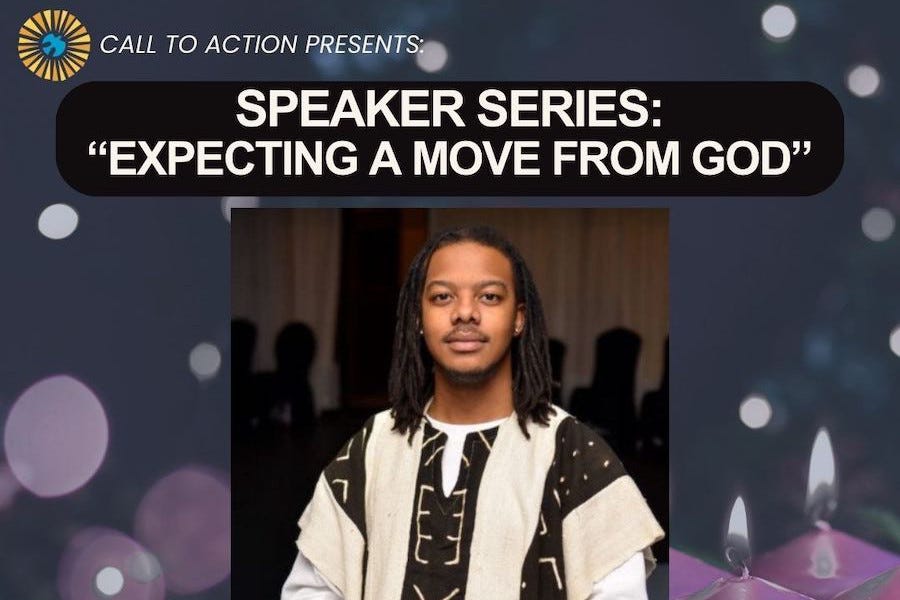
Building on its theme for the Advent season, “expecting a move from God,” the Catholic organization Call to Action (CTA) presented a reflective conversation with executive director Black Moses Rankins on Thursday evening.
Christopher Ortiz, program director for CTA, introduced the event as part of a “speaker series” where people from “across the spectrum of CTA” are invited to present on issues pertinent to the organization. On its website, CTA defines its mission as “to educate, inspire, and activate Catholics to act for justice and build inclusive communities through a lens of anti-racism and anti-oppression principles.”
Rankins opened by saying that the motivation for his presentation was to “talk about what’s been hopeful” this Advent season. CTA staff, he said, decided “to do Advent differently” this year by “uplift[ing] each other’s voices” and renewing their routines.
Rankins spoke first about the lectionary, particularly the genealogies of Jesus that are read during the Advent season. He pointed to “nuggets that people often overlook,” such as the fact that Matthew’s gospel divides Jesus’s lineage into three segments of fourteen generations.
Jesus’s royal lineage has been used as justification for “social Darwinism,” Rankins said, as the faithful internalize the idea that “if you don’t come from this righteous line, you must not be important or not needed.”
He noted how the inclusion of Tamar, the daughter-in-law of Judah (Gen 38), in Matthew’s genealogy of Jesus proves that no one comes from an exclusively royal lineage, but “that does not mean that we’re not holy” and part of the “collective body known as Christ.”
Matthew “identifies individuals we might see as flawed” such as Tamar and points out their importance, Rankins added.
Rankins next addressed the subject of women deacons—a timely issue, given news on December 4 that a papal commission established to study the topic voted 7 to 1 against the possibility of admitting women to the diaconate.
Rankins set forth a four-pointed framework for theological reflection sometimes referred to as the “Wesleyan Quadrilateral.” The framework uses Scripture, tradition, science and reason, and human experience as the main interpretative lenses for understanding and developing the Christian faith.
Rankins hypothetically asked the papal commission whether they “used all four sources” of the quadrilateral to come to their decision on the women’s diaconate. He suggested that one of the roles of women deacons in the early church was the application of oils during baptism, “a substantial role that was a part of the liturgy itself.”
“We have to continue to push [the commission] to say, what is the scientific reason” for denying women access to the diaconate, he continued.
Rankins also noted how “women are seen as wisdom keepers” and leaders within the African American community. He underscored how groups have been “historically and institutionally removed” both from the church and the nation. The sources used to create religious and cultural traditions have been impoverished by the exclusion of these groups, he said.
Pivoting to the threat of Immigration and Customs Enforcement (ICE) raids across the country this Advent, Rankins said, “Our sisters and brothers are hiding.”
“As dark as the world is getting,” both clergy and laypeople are “showing up” for immigrants and other marginalized communities, he said. He referenced CTA members who are making “care packages” for immigrants, saying, “There are efforts to make the world a better place.”
“I’m praying for transformation for all our American brothers and sisters,” he added.
Though our efforts may not always be perfect or complete, he said by way of a prayer that it is important to “take the long view” and understand that “the kingdom is beyond our vision.”
The realization that “we cannot do everything” gives us a beginning, “an opportunity for the Lord’s grace to enter and do the rest.”
“We are the workers,” his prayer concluded, “ministers, not messiahs.”
Rankins ended his presentation by reflecting on the young pontificate of Pope Leo XIV. He acknowledged feelings of sadness and uncertainty when Pope Francis passed, so “I challenged myself to look into the words of Pope Leo,” he said.
He quoted from Leo’s homily for the Jubilee of the Poor last month: “There can be no peace without justice, and the poor remind us of this in many ways.” He cited another line from the homily for the Mass for the Care of Creation in July: “Only a contemplative gaze can change our relationship to creation.”
“That’s what’s been giving me hope,” he continued. “We do have a leader that is talking differently. He’s calling out some of the people that have not been called out previously.”
During a brief Q&A portion following the presentation, Ortiz and Rankins shared news of a conference scheduled for November 2026 to mark the 50th anniversary of CTA’s founding. ♦
Michael Centore is the editor of Tomorrow’s American Catholic.