


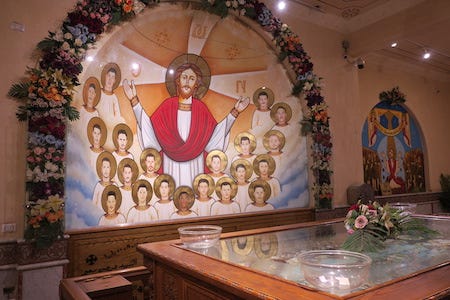
My Passion Week reading this year was The 21, Martin Mosebach’s account of the twenty Coptic Christian migrant workers (and one West African) who were beheaded on a Libyan beach by ISIS militants in 2015.
Mosebach is trained as a poet and novelist, and he tells the story with an attentiveness to atmosphere and character befitting of both vocations. As he writes at one point, in an assessment of his own professional methods:
I’m not much of a reporter. Professional journalists enjoy a lack of restraint I find hard to muster up. I gave myself over to the surroundings and mood I encountered in the homes of the martyrs’ families and didn’t feel I had the right to disturb them with probing questions.
The concept of martyrdom is a complicated one in a post-Enlightenment age. It can be seen as a glorification of violence, a means of spiritualizing that which should not be passively accepted. In an era of “clash of civilizations” discourse, an extreme event such as what befell the Coptic martyrs can be used to mischaracterize the whole of Islam and fuel further conflict.
Mosebach is attentive to these pitfalls, and devotes part of an early chapter to an imagined conversation between two interlocutors he dubs “The Doubter” and “The Believer.” The Doubter is a man of the world, an Egyptian raised in England who believes that “Celebrating a martyr’s holiness is one way of ensuring that violence is ever-present.” The Believer expresses reverence for “the sheer steadfastness” of the twenty-one and reminds the Doubter that the spread of Christianity was dependent on “the people who, from the very start, were ready to die for their love of Jesus: martyrs.”
The part of the book that moved me most is when Mosebach admits that “Language alone could not do justice to the events” before introducing the threadbare martyrology released by the archdiocese to which the twenty-one belonged. Reading these brief biographical descriptions was a humbling reminder of how God delineates our lives from within, distilling them to their essential goodness. A few examples:
“He was quick to forgive, argued with no one, and was faithful and honorable.”
“His peaceful smile showed how close he was to God.”
“He was a quiet man, even when criticized.”
“He was discreet, respectful, and calm.”
“He was calm, obedient, and quick to confess.”
The unifying qualities of calmness and discretion displayed by the martyrs touched me to the core. I began thinking about these qualities, so often out of reach in a frenzied world that thrives on conflict and demands an instant opinion about everything. Calmness and discretion are linked. To be discreet is not to be tactically secretive, but to hew close to the soft whisper of the Spirit. Calmness flows from this always returning to the Spirit that speaks simplicity, patiently guiding us, quieting us as we learn not to talk over its promptings.
Clearly the twenty-one drew tremendous resources of strength from the Spirit, but how did they train themselves to be so open in their most harrowing final moments to its reception? Mosebach gives us a clue when he describes them as homines liturgi, “men of the liturgy,” which, he says, “in the Western world is now a very rare mode of being human.”
I was struck by this phrase, “a very rare mode of being human.” We speak so often of the “sacramental imagination,” but what about the liturgical mind, the forms of what Mosebach calls “ritual existence” that give shape and substance to our blessing of the day? In this way the liturgy is a kind of metaphysical architecture that directs the way we move through space and time. Through a slow, repetitive process of assimilation and internalization, it gives new shading to our spiritual temperament and our approach to even the most rudimentary tasks. The twenty-one, these homines liturgi, exemplified for us a “rare mode of being human” by retaining their humanity—their composure, their calmness and discretion—to the point of death, even death on a cross.
Michael Centore
Editor, Today’s American Catholic