


Author, Episcopal priest, and wisdom teacher Cynthia Bourgeault described incarnation as a “synonym for involution,” or the movement from a higher unbounded state to a lower, in conversation with her friend, fellow author, and Franciscan theologian Ilia Delio on Monday evening.
Referencing German mystic Jacob Boehme, Bourgeault said that “in order to make something flow, you have to constrict it.” God put the divine will “under tension as yearning” for something outside itself, she explained. Incarnation happens “when the divine in its deep love” realizes that one must move to a lower state in order to “participate in the creation of the new thrust.”
This desire or yearning, therefore, is “the primordial first move that the divine ineffable makes” toward creation, she said.
Bourgeault and Delio’s exchange, billed as “Cosmos, Chaos and the Complexities of Consciousness,” was convened by the Center for Christogenesis. The organization describes its mission as deepening the integration of science and religion, reflecting on the human person as an integral member of the cosmic whole, and enkindling an awareness of love as the core energy of the universe and impulse of evolution.
Last month, the Center announced that it is transitioning to becoming the World Institute for Science, Religion and Culture (WISR), “an educational platform dedicated to forming the human person on the level of the Noosphere—the sphere of shared mind and meaning that [Jesuit scientist and theologian] Teilhard [de Chardin] saw emerging across the planet.”
Monday’s Zoom-based conversation began with a moment of prayer led by the Center’s executive director, Robert Nicastro, who attuned over 550 participants “to the deeper currents of life moving through us.”
Delio introduced Bourgeault as a “mystical theologian” and presented the evening’s framing question as “how do we navigate as human knowers in this world today,” particularly in light of the challenges of “political mayhem” and “runaway AI.”
Delio opened by asking Bourgeault what consciousness and thought meant for her in the present moment, given that “evolution is the rise of thought” and thought is fundamental to what it means to be a human person.
Speaking from her home in Maine, Bourgeault identified the two issues that are most pressing to her as the “runaway collective insanity” of our current political situation and the crisis of global warming.
She described how the Western mind has long understood consciousness as “a natural entitled right” and presumed it was static. She identified the “earliest roadmap of the transformation of consciousness in the West” as chapter 8 of the 14th-century Christian mystical text The Cloud of Unknowing.
In the 20th century, a group of thinkers including Chardin, George Gurdjieff, and Jean Gebser set forth the idea that “consciousness itself is an evolution,” she explained. Yet even today organized Christianity has not adequately attended to the idea of evolutionary consciousness, which has been developed “on the extremities,” she said.
Delio responded by pointing out how integrated thinkers perceived consciousness as a “holistic field of unification” and questioning why institutional religion has not placed an emphasis on consciousness.
She hypothesized that the church “redirected” consciousness away from the self to a transcendent divinity. Institutional religion, therefore, believed the wholeness of life was contained in canons and dogmas rather than in human consciousness “open to infinite depth or infinite divinity.”
Many of the problems of our age “can be traced back to institutional religion” because the mystical dimension “was truncated [and] constrained,” Delio continued. This “managed mysticism by the church” meant that individuals did not have the “freedom to explore [consciousness] experientially on our own.”
Bourgeault elaborated on this insight, observing that we are presently dealing with “a failure of an epistemology of consciousness,” or a way of knowing how we know.
She offered Gurdjieff’s “useful heuristic” of “human beings [as] three-brained creatures”: intellectual, emotional, and kinesthetic. The latter is the “moving center,” a mode of consciousness rooted in the body’s rhythmic motions and adaptations.
The problem of the Western mind and the institutional church is that they privilege the intellectual center of consciousness but disregard the other two, Bourgeault said. She described the intellectual center as tending toward abstraction and dialectic—“it loves either/ors”—as well as being the “slowest moving” of the three brains.
“All three brains have to be on line and in communication,” she explained, so that something can emerge out of their “interweaving” that is conscious of its own consciousness and can begin to access its “evolutionary dimension.”
Delio picked up on this theme, noting how St. Francis of Assisi was “a very, very simple man, but a mystic.” His mystical orientation began with “the experience of the self open to something beyond the self,” she said. She described this form of mysticism as “horizontally ecstatic.”
Francis developed into integrated personhood through “a circular movement of ever-deepening awareness,” she continued. He moved into the world, assimilated it into himself by reflecting on it in light of the presence of God, and gave it back to the world, all the while “growing in the awareness of love.”
Bourgeault observed that with his well-developed centers of awareness, Francis “can wield and sort and attract energy and deflect it,” she said.
“There’s nothing he experiences that he hasn’t experienced absolutely in his body,” she added.
Bourgeault turned to another Gurdjieffian concept, that of the “law of three”: the idea that every action arises not just as a conflict between two opposing forces, but contains a third “reconciling force” that allows for the opening of a new horizon.
Our world today is “third-force blind” in that we don’t recognize this reconciling power, she said. We become entrapped in a “polarizing brain” that ends in disintegration, dialectical absolutism, and siloed thinking.
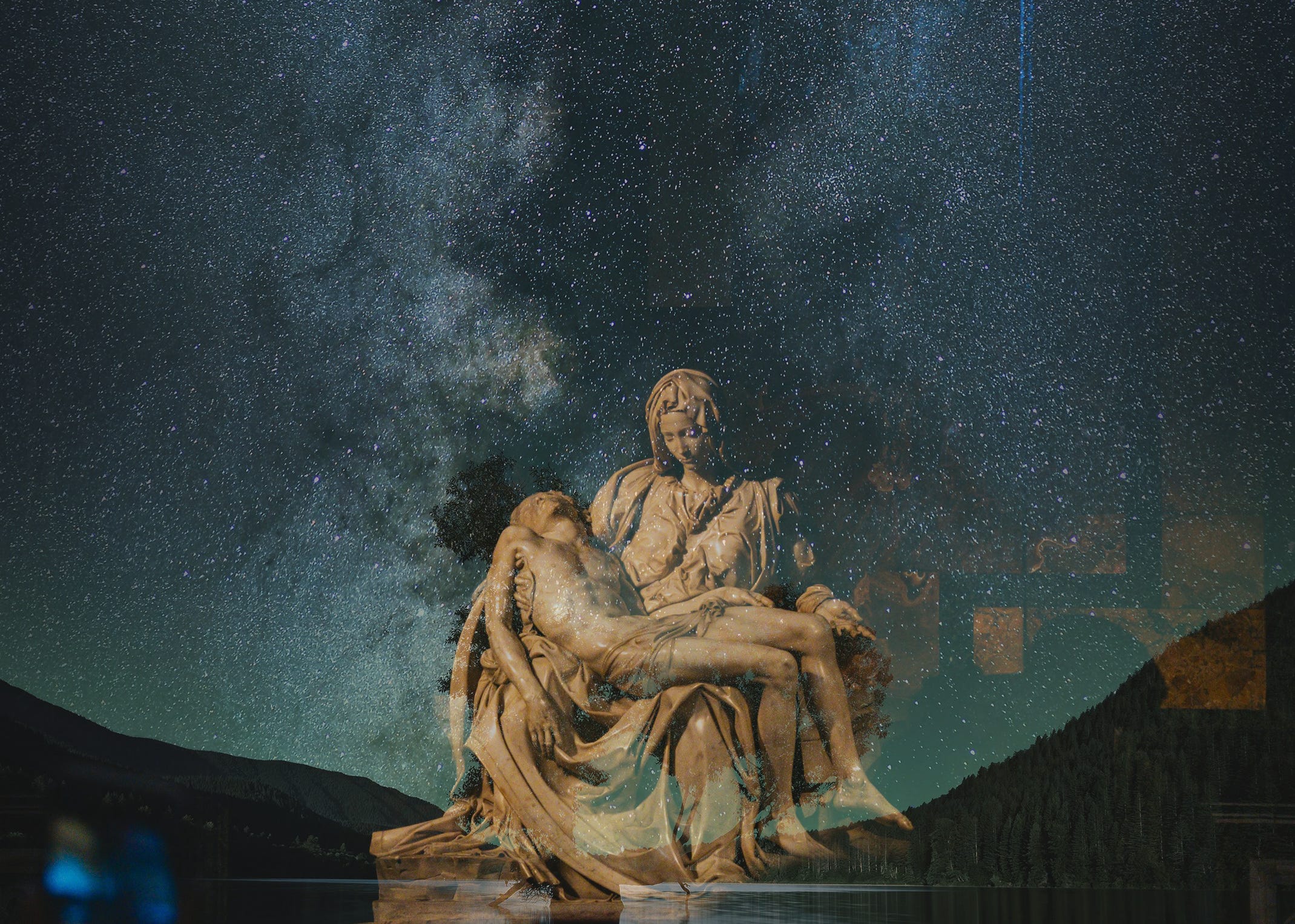
The way through such polarized situations is “just bringing a certain kind of consciousness” that doesn’t judge but simply holds the chaos and tension of opposing forces. She drew a parallel to Michelangelo’s Pietà, where Mary holds the “groaning and travailing of the cosmos” in the form of Christ, her son.
Delio added that when knowledge has “lost its eros” it devolves into “a war of words”—purely fact-laden, logical arguments and theorems.
“There’s no air in [these arguments], there’s no life in them,” she said. The mystic, to the contrary, is “impassioned by something more” that pulls her into wholeness and greater unity.
Mysticism “is a way of being that makes doing possible,” she continued. “Reclaiming the mystical dimension of life may be fundamental to the 21st century.”
In the process of reclaiming a core of love and thinking beyond binaries, “the middle may be the most important area to consider,” she said. This gives special value to experiences of ambiguity, unknowability, and tenuousness.
Bourgeault and Delio turned to the need to learn to let go, to surrender the structures of selfhood and ego in order to enter into new levels of consciousness, awareness, and human community.
Describing the process of letting go as “an opening up” and “a matter of freedom,” Delio referenced the counsel of St. Francis’s companion St. Clare of Assisi: “May you go forth with swift pace and light feet.”
“The most important thing is what’s arriving from the future,” she reminded listeners. She suggested that “the Catholic Church needs to let go” and open up to a new future, one in which it might reimagine and rethink its doctrines “as core values for life.”
Bourgeault said that individuals are “held back” by institutional and epistemological binaries that suppress “a tremendous need to break free of our boundedness.”
She identified “our big question” as “how we live in our mystical beingness” and asked, “Can we find our way forward together as a humanity?”
Letting go requires a strength of inner being to survive it, she continued. It is not just an intellectual process, but one that must emerge of out “three-centered awareness.”
Bourgeault spoke of her practice of Centering Prayer, based on the teachings of Trappist monk Thomas Keating, as an act of generosity of freedom. In Centering Prayer, the focus is on letting thoughts go as a way of “repatterning the brain” so as not to grasp at them in fear.
“If you can’t let go [of something] at the object end, let go at the subject end,” she advised. “Let go of the self that needs it.”
She returned to the theme of passion and yearning as being at the origin of God’s participation in the universe. The only way we can relieve the tension of yearning and anguish is through surrender as a pure act of will and self-survival, she said.
In letting anguish play out “without giving into the temptation of dialectics,” individuals and the world as a whole become freer, she continued. One begins to act in the world “with unconflicted action” and “the beauty and elegance of the right motion.” This has planet-altering effects as more and more individuals acquire the trust and lived experience of a “higher synergy” that collects and holds them and in which they can participate together.
Added Delio, “We are much more together than we are alone.” ♦
Michael Centore
Editor, Tomorrow’s American Catholic
Michael ! What a wonderfully inspiring article !!!! Two of my favorite people in dialogue. Thank you !!!!