


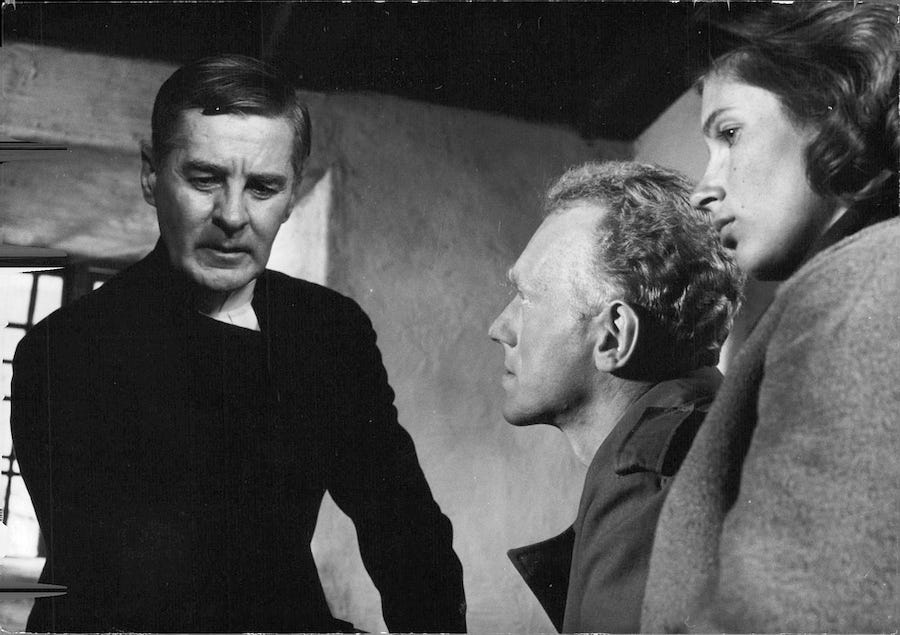
Even when they are no longer shiny and new, films, like other forms of literature, can age well in terms of appreciation. Time creates a kind of distance, a reframing of the film’s storyline due to changes in cultural perspectives. As such, movie night can become a source of spiritual growth and nourishment both for an individual well as a family. Watching an older film can be especially impactful when it coincides with a liturgical season.
St. Ignatius of Loyola proposed what he called contemplative prayer with the Scriptures, which can be applied to a film meditation. This method can help a person engage with a film better when one identifies with a character and how that person might have felt.
If you are interested in using St. Ignatius’s prayer method to enrich your response to a film, consider incorporating these suggestions. First, set aside ample time for reflection. Second, read a synopsis of the film before you watch it. This will give you an overview of the plotline, thus making it easier to follow. Third, when you do pray, ask for the grace to see what God wants you to see. As the movie unfolds, be aware of the one or two characters that stand out for you. After the movie ends, sit with your character. Ask yourself: What is God saying to me through this character? Continue to sit for the allotted time. When you are finished, thank God for time you spent in his presence and for any insights you may have received.
I have included two alternative prayer methods for the recommended films below: suggested intercessory prayers for two of the films, and questions and comments for meditation. For viewing, check YouTube or other streaming services or your local library for a copy.
Advent
The Thanksgiving Visitor (1986) 45 mins | NR
Focus on the scene where Buddy accuses Odd Henderson of stealing a cameo. What were the consequences? Fast forward 15 years. How has Buddy dealt with his decision? What happened to Odd Henderson? Change the age of the characters where both are adults in this scene. How does this change the storyline?
Suggestions for intercessory prayer
You instituted the Eucharist at a meal. Help us to experience the holiness of ordinary meals. Grant that families who come together at Thanksgiving and Christmas may grow in their love for one another.
Heal families divided by anger, fear, and misunderstanding.
May Advent be a time for us to grow in awareness that justice is more than mere laws but right relationship.
Help me live the words from the book of Wisdom, “Those who are just must be kind” (12:13-19).
Add your own intentions.
Christmas
The Rise of the Guardians (2012) 1:37 | PG
Perhaps the greatest sadness for too many adults is that they forget what it felt like to be a child. And perhaps the greatest tragedy of poverty for children is the death of their being able to dream. This death is soul killing: the death of initiative and possibility. How does the storyline of the children and the Guardians facing the darkness of the evil spirit, Pitch, develop Jesus’s statement, “Unless you become like little children, you cannot enter the kingdom of God?” (Matt 18:3)
Read a short bio of St. Ignatius of Loyola. How did his dreams and imagination help bring about his conversion?
While the plot of this film is Christmas-themed for children, it can be watched any time during the year. During the 40 days of the Easter season or throughout Ordinary Time, viewers might ask how Jesus still overcomes the darkness of death and sin, or consider a “Christmas in July” project for children in need.
Ratatouille (2007) 1:51 | G
Even though this Oscar-winning movie does not have seasonal theme as part of the storyline, it could be used around Christmas or during any part of the liturgical year. This film is also aimed at a children’s audience. However, it has been my experience that many children’s movies have a hidden layer that can speak to adults when seen through the eyes of faith.
The two main characters are unlikely heroes. What makes a hero a hero? For most people it is courage in the face of danger. However, this movie reveals that courage means to follow the deepest longing of one’s heart. It also shows how powerful the memory of “comfort” food is—a symbol of the Eucharist. “Do this in memory of me.” To remember is to make present again, which we do during the Mass.
Ordinary Time After Epiphany and Lent/Pentecost
The Help (2011) 2:26 | PG-13
The gospels have many stories about those who are insiders and those who are outsiders. In fact, the words and phrases distance, far away, and near can refer to those groups. The Gospel of Luke is often called the “gospel of mercy,” as Luke has recorded several parables that highlight God’s mercy, especially for the outsider; for example, the story of the Prodigal Son (15:11-32).
This movie’s plot revolves around storytelling—telling the story of those lives who are on the margins. Jesus said to invite the lame and the blind to your banquets for they cannot thank you (Luke 14:13-23). What would taking up this exhortation look like in your life? Maya Angelou, the great American poet, once wrote, “There is no greater agony than bearing an untold story inside you.”
Note what happens at tables throughout the movie. What scenes are similar, and what scenes contrast each other? Which of these scenes reflect or symbolize the Eucharist?
Sister Act (1992) 1:40 | PG
When this movie was first released, there was a backlash of criticism concerning the way a religious sister was portrayed. Years later I was part of my community’s vocation retreat for young women, and the movie was on the schedule. We all laughed from beginning to end.
The movie’s plotline shows how the power of community can be the source of personal transformation. Consider the scene where Sr. Mary Clarence is introduced to the community. The sisters are seated at a meal and she is asked to say grace, which she stammers through. At best, we all stammer in our efforts to love others, and often when we try to pray. St. Paul reminds us that the Holy Spirit speaks on our behalf when we pray. As a trained spiritual director, I have listened to all my directees as they stammer in their efforts to express their experiences in praying and how they relate to God. I can empathize, as I know well my own stuttering efforts to talk about my own prayer life and my relationship with God to my spiritual director.
As part of your prayer time with this film, you might reflect on finding a director for yourself. If you are interested, check out the organization Spiritual Directors International. Their website has a list of directors you can contact.
The Perfect Storm (2000) 2:10 | PG-13
This film is based on a true story. It might inspire us to ask: How do I make a major decision? What helps me to make decisions well?
Reflect on ways to improve your decision-making: When I do decide, I know I made the best choice I could have made with the information I had at the time. How was God still with me during the aftermath of a poorly made decision?
Suggestions for intercessory prayer
For those who must make life-and-death decisions.
For those who are discerning their vocation.
For all maritime workers.
For all parents as they teach their children how to make wise decisions.
Add your own intentions.
As I mentioned in my introduction, many films age like fine wine. I hope you will consider this article as an invitation to watch (or rewatch) a film with the eyes of faith. After all, the word respect originally meant “to look again.” ♦
Sr. Lou Ella Hickman is a widely published poet and a member of the Sisters of the Incarnate Word and Blessed Sacrament of Corpus Christi, Texas. Her poetry collection she: robed and wordless was published in 2015 as a Tom Lombardo Poetry Selection, an imprint of Press 53. Her second collection, Writing the Stars, was published in 2024 by Press 53.