


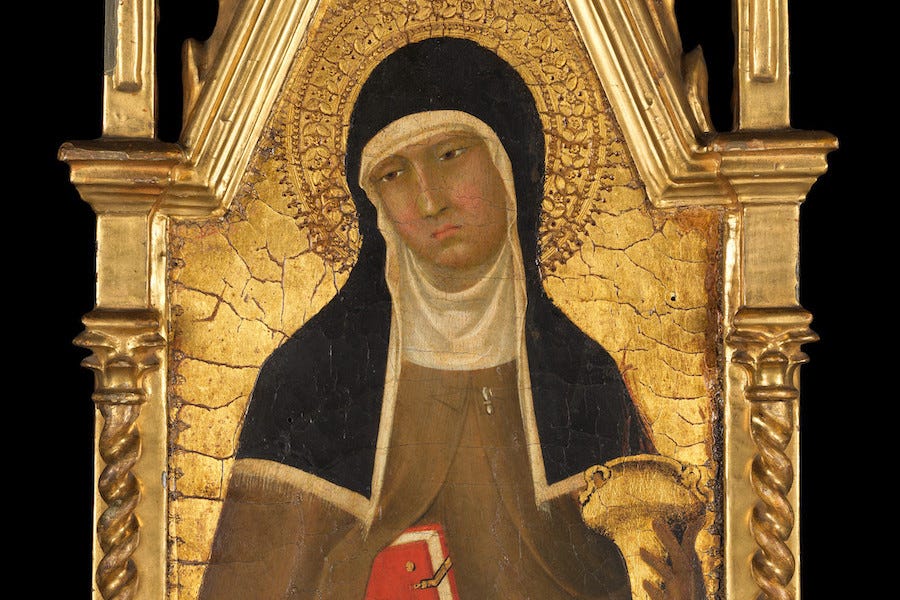
We remember Clare of Assisi too often as a shadow of Francis—the woman who followed, the quieter echo of a louder saint. But Clare was no follower. She was a formidable, resolute, and profoundly loving mystic whose life turned on a single, radiant conviction: that Christ dwells in each of us, and that our whole vocation is to let God live within us and shine back the face of Christ to the world. To understand Clare, we have to begin where she began—not with poverty as deprivation, but with the Incarnation as love made visible.
Clare’s spirituality is thoroughly centered on Christ, and specifically on the astonishing fact of the Incarnation. God did not remain remote and self-sufficient. God took on human flesh—not merely to suffer and die for us, but to draw us into a life so intimate that we could reflect that same divine love outward to everyone we meet. This is the heart of the matter. When we gaze on the crucified Christ, Clare invites us to see two things at once: the depth of God’s self-giving, and the truth of our own humanity. To contemplate Christ’s flesh is to discover what we are and what we are called to become. The Incarnation is not a doctrine to be admired from a distance; it is a mirror held up to the human person.
Here is where Clare becomes genuinely radical. Born into nobility in 1194, she gave up a world of privilege for a world of destitution—and was happy. That happiness makes no sense unless we understand that her poverty was never about scarcity. It was about love. Clare saw the poverty of God as a fountain—a love that brings us into being, sustains us, and yearns for us. If God’s own life is a ceaseless self-emptying, a pouring out of love that holds nothing back, then to become poor is simply to become like God. When someone asked how we center ourselves in the love of God, Clare’s answer was disarmingly simple: become poor. Poverty is not primarily the absence of possessions, for Clare. It is dependence—the willingness to need others, to let go of our stubborn insistence on independence and control. When we grasp at self-sufficiency, we close ourselves off. When we choose poverty, we open a door, and God’s goodness comes shining through the people around us. Poverty, in this vision, is the condition for communion. It is how love gets in. This is the same movement we see in the Incarnation itself: a God who chooses dependence, who becomes small and vulnerable, who enters the world needing to be held. Clare’s poverty is nothing other than her participation in that self-emptying love. The manger and the empty cell tell the same story.
Clare’s mysticism was never a retreat from the world. For forty-two years she lived in the enclosure of San Damiano, and from that hidden place she extended herself outward. Her contemplation of the crucified Christ was a longing to be transformed into him—and transformation always spills over into action. It led her to wash the feet of her sisters, to serve, to love concretely. There is a costliness to this. If we truly see the depths of God revealed in a person or a creature that others might discard, reject, or ignore, then we cannot look away unmoved. Seeing becomes loving, and loving has consequences. We may be excluded, misunderstood, even rejected. But once we have really seen, reverence for every person becomes instinctive. Contemplation, inflamed by love, is the ground of a discipleship that costs us something—and that is exactly what makes it real.
Clare wrote her own Rule of Life—the first monastic rule known to be written by a woman—and shaped a way of life built on strength, clarity, and a fierce, unapologetic movement toward God. Hers was a “light and swift” journey, undeterred by earthly weight. Though she belongs to a distant medieval past, her question is entirely ours: how do we live as though Christ truly dwells in us and in everyone we meet? Her answer runs against every instinct of a culture built on accumulation and control. Become poor. Become dependent. Let God’s goodness flow through you. Reflect back the face of Christ to a world that badly needs to see it. That is the heart full of love that Clare offers us—a heart emptied of everything except the One who fills it. ♦
Author of over twenty-five books, Ilia Delio, OSF, PhD, is a Franciscan Sister of Washington, DC, and professor at Villanova University. She is the founder and executive director of the World Institute for Science, Religion and Culture, an online educational forum focused on integrative thinking and personal formation.