


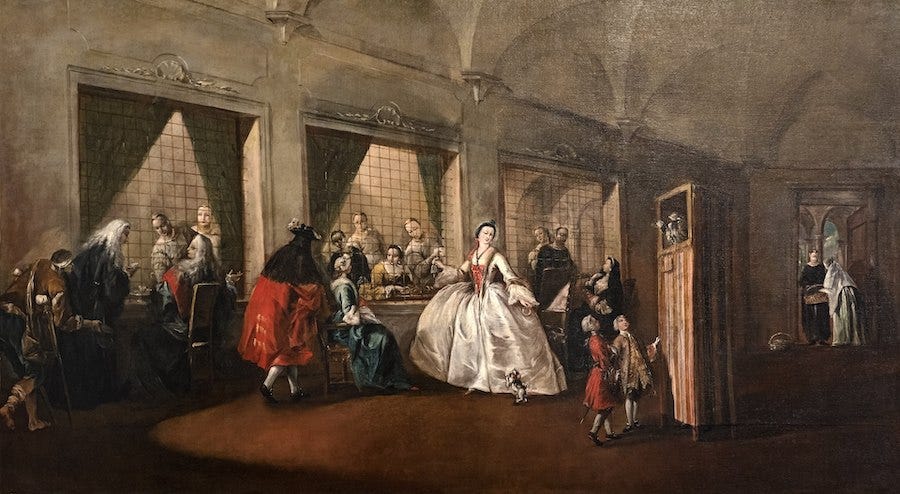
Convent Wisdom: How Sixteenth-Century Nuns
Could Save Your Twenty-First Century Life
By Ana Garriga and Carmen Urbita
Avid Reader Press / Simon and Schuster, 2025
256 pp. $28.99
Ana Garriga and Carmen Urbita’s Convent Wisdom: How Sixteenth-Century Nuns Could Save Your Twenty-First Century Life is one of the best books of 2025. To be able to equate what happened to sisters from centuries ago to what happens to contemporary women who do not wear a habit—most especially to those women who are earning graduate degrees in a misogynistic academic system—is remarkable. From its introduction to its final chapters, this new book is at turns captivating, humorous, astute, and welcoming. It takes up what could be a difficult subject matter and delves into serious issues surrounding women’s physical, emotional, mental, and spiritual health, resulting in an accessible study of historical female figures and current misogynist tropes geared toward suppression and assumed ownership.
Convent Wisdom begins with the fact that nuns, whether they want to be or not, are pervasive throughout American culture. While working on their doctorates and essentially taking a vow of poverty because of their studies, Garriga and Urbita shrewdly identified this societal obsession with nuns and ran with it. They noticed, based on their extensive research of Christian exemplars such as Saint Teresa of Avila, the Discalced Carmelites, Maria de Salazar, Maria de San, and others that work problems, money troubles, dieting trends, and the lures and pitfalls of fame all were happening, in their own way, during the 1500s and 1600s. This recognition leads to some beautifully crafted observations: “Venetian nuns were the crème de la crème of DIY, renowned for their skills in painting, music, and most notably their needlework.” The sentence may seem simple and unassuming; however, this is just one illustration of Garriga’s and Urbita’s uncanny ability to equate contemporary terminology with moments in history.
Another example comes when the authors speak of the “nuns of the Royal Discalced” and how they “knew nothing of mortgages or haggling with moneylenders. Had they been able to get a gel manicure in those days, they would have never suffered a single chipped nail.” These sorts of moments, peppered throughout Convent Wisdom, draw readers into an understanding of the complexities of what these women went through in a time of limited means and great strife.
The book is also a social commentary how humanity experiences the world now, where things deemed as essential (like TikTok trends and K-Pop Demon Hunters) are nothing but a smokescreen for more serious issues of capitalist overreach, xenophobia, war crimes, exploitation, and immigration. The nuns prayed to God and Jesus Christ; we now pray to false idols and care more about what makes us comfortable and happy than our religious obligations. Convenience and our insatiable need to constantly be occupied by visual imagery have taken precedence over contemplation, faith, and spirituality.
I may be extrapolating a bit from Garriga and Urbita’s central thesis; however, it is obvious that their religious and academic journeys, which feature prominently throughout Convent Wisdom (along with multiple amusing if disconcerting paintings of nuns from previous centuries engaged in modern-day activities such as working on a computer), have led them to think about how the worlds of present and past, secular and sacred, could collide or have collided. They speak about how their time in college was like that of living in a convent, so it made sense for them to take a peek “through the looking glass” to see if similarities existed between them and those residents of a real convent.
It is unclear if the two authors are trying to produce an argumentative work here, but they are certainly presenting a claim, and it is clear they are capable of proving that claim. With that said, though, the work is also written in a matter-of-fact way: the tone of the voice comes across like that of an individual who has resolved herself to the idea that she may never get a job in academia, but at least she can feel connected to women of different eras and to the friends she has made along the way.
Convent Wisdom, thus, is not only humorous but also speaks to the healing effects of camaraderie, friendship, and love when one can easily become bitter and lonely, whether by choice or otherwise. The writers present a profound discussion about the state of humanity in dark times—and how, even with tenacity and a strong work ethic, success still may be hard to come by. As long as we connect with the people around us and the core our beliefs, we can get by, exhausted but fulfilled. Garriga and Urbita’s book teaches how all of us, even with differing backgrounds and differing ideals during differing times, are one and the same: variations on a theme, living together in our own convents, attempting to connect to anyone or anything we can in the hopes that we find true or fleeting happiness. ♦
Dr. Douglas C. MacLeod Jr. is an associate professor of composition and communication at SUNY Cobleskill. He has written multiple book chapters, peer-reviewed journal articles, and book reviews throughout his almost 20-year career as an academic and teacher. Recently, he has had essays published in Childhood and Innocence in American Culture: Heartaches and Nightmares (Lexington Books); Holocaust vs. Popular Culture: Interrogating Incompatibility and Universalization (Routledge); and Film as an Expression of Spirituality: The Arts and Faith Top 100 Films (Cambridge Scholars Publishing). He lives in Upstate New York with his wife, Patty.