


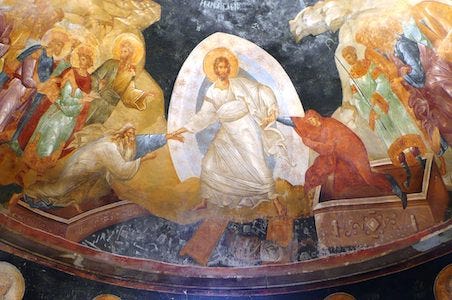
A very attentive reader got in touch with me this week and noted that there were two words he had never encountered in these weekly newsletters: hell and purgatory. He had been raised in an era of American Catholicism, he said, when both concepts were at the forefront of catechetical consciousness: you were either in the right or in the wrong, and your place in the hereafter shadowed your every move.
Though I haven’t used the words, it doesn’t mean that conceptions of the afterlife are ever far from my mind; in fact, I might think about them too often, how our ideas of heaven, hell, and purgatory are not places to be spatialized but conditions of the here and now.
Hell is the isolation brought about by the absence of love, the misperception of my separateness from God and the ways in which I act out to fill the void of that separateness. The more I act out, the more I try to fill that void by demonizing others in a projection of my own self-loathing, the deeper I fall into the pit of isolation. The way out is simple: I have only to acknowledge that I am loved by God fully and unconditionally so that I am free to love my neighbor as myself.
Purgatory, that doctrinally debated place between, is more insidious. Here I am neither this nor that: I lack the will to turn from the false face to the true, or, worse yet, I don’t even care. I go with whatever is most expedient. If it means indulging in my feeling of separateness from God to build up my own egoic self-image, I’ll do that; if it means following this with a halfhearted prayer for restoration, I’ll do that, too, because I’m only praying with my lips and don’t believe the words anyway.
This leaves heaven, which is the most important concept and the only one deserving of our focus because it is where we are trying to go—if go is even the right verb for a condition to be uncovered from within (cf. Luke 17:21) rather than stormed in the style of “church militant” metaphors from without. Lately I have been meditating on it in terms of the memory of Christ: when we think of the Mystical Body, we might imagine the hands, the feet, or the head, but what happens when we add to the anatomical the psychological, neurological, and cognitive processes that are the “starter cultures” of human character? How might this change our prayer picture and, with it, our vision of the eschaton?
Memory is a generative theme here because we have it at the apex of our sacramental life in the Eucharist: “Do this in memory of me” (Luke 22:19). The commandment to remember echoes throughout the Bible and is indeed one of the reasons why the oral traditions it records were preserved in the first place: to bear witness, to retell, to pass on. As Christ moved through the world, he remembered—scenes, images, figures, words—imprinting on his consciousness the sensory data of experience that shaped his vocation, just as it shapes all of ours.
Could it be that heaven is how we are remembered by Christ, who calls each one of us by name? Partaking of the Eucharist in memory of him, he, in turn, assimilates us into his memory—a bilateral process, an exchange just as body and blood are exchanged with bread and wine. Perhaps what we dream of as the afterlife is really Christ’s dream of us, that moment out of time when he is “all in all” (1 Cor 15:28), reminiscing on a personal history that is coterminous with the cosmos.
Michael Centore
Editor, Today’s American Catholic