


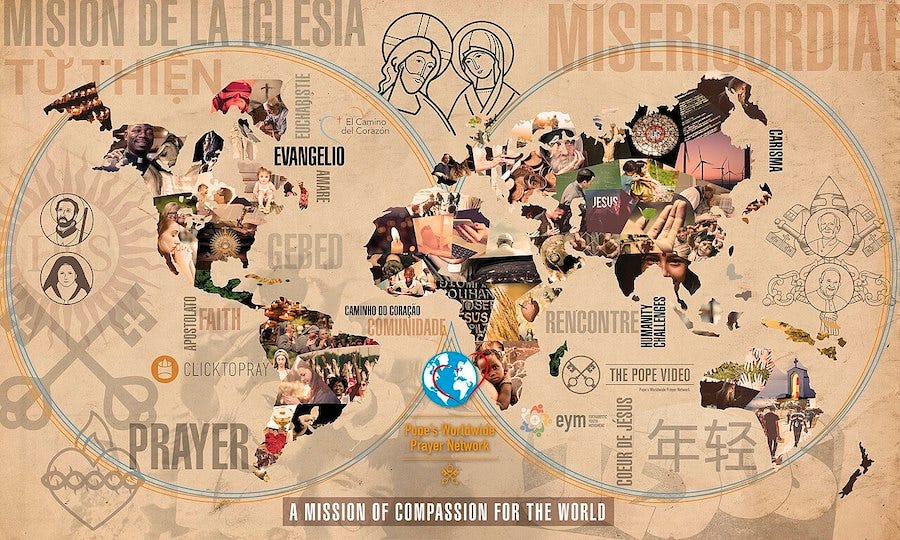
The church does not exist by self-sufficiency but by grace. She lives not from what she possesses but from what she receives and shares. From Pentecost onward, the life of the church has been marked by movement, encounter, and mutual dependence—by a continual exchange of gifts given by the Holy Spirit “for the common good” (cf. 1 Cor 12:7). Wherever the gospel takes root, it generates not isolated communities but a communion of churches, each incomplete yet whole in Christ.
It is within this theological horizon that language matters profoundly. Words do not merely describe ecclesial realities; they shape how those realities are perceived, ordered, and lived. They can reflect communion—or implicitly undermine it. They can proclaim grace—or reduce gift to transaction. For this reason, the church must remain vigilant about the words she uses, especially when those words concern mission, ministry, giving and receiving gifts, and eventually belonging.
It is this vigilance that informs the present reflection on the designation “Extern,” commonly applied to priests of other dioceses who live and exercise pastoral ministry in the United States and Europe. These priests are frequently described as Externs rather than fidei donum priests or, more fittingly, missionaries. Such terminology invites careful theological scrutiny. What vision of the church does it presuppose? What ecclesial relationships does it normalize? And what aspects of communion does it leave unnamed?
These questions arise within the broader context of the church’s renewed emphasis on the New Evangelization. When Pope Saint John Paul II spoke of a “New Era of Evangelization” in 1983, he was responding to a deep pastoral and spiritual crisis in regions where Christianity had once shaped culture and public life but was now receding from memory and practice. Pope Benedict XVI gave voice to the same concern when he spoke of the “eclipse of God” or “disappearance of God” in societies that had once been missionary senders. Pope Francis, in Evangelii Gaudium, further clarified that the New Evangelization embraces the whole church: it renews ordinary pastoral ministry, reawakens faith in the baptized who have grown distant, and continues the proclamation of Christ to those who do not yet know him.
Taken together, these teachings make one truth unmistakably clear: mission today is no longer geographically unidirectional. The distinction between “mission lands” and “Christian lands” has lost its theological adequacy. The gospel is needed everywhere, and the Spirit sends missionaries wherever faith must be awakened or rekindled.
Historically, the church’s missionary consciousness was largely shaped by an ad extra framework—mission understood as going outward to those who had not yet heard the Good News. In fidelity to Christ’s command to “make disciples of all nations” (Matt 28:18-20), missionaries from Europe and North America carried the gospel across continents. The flourishing of Christianity in Africa, Asia, and Latin America stands as enduring testimony to their courage, sacrifice, and faith. This calls for applause, as it was not an easy task.
Yet the very fruitfulness of those missionary endeavors now reveals a deeper ecclesial truth: the gospel, once received, becomes a gift meant to be shared. Churches that were once recipients of mission have matured into missionary churches themselves. Today, the vitality of faith and the abundance of vocations in many parts of the Global South are not anomalies; they are signs of the Spirit’s fidelity to the church.
By contrast, much of the Christian West now faces a severe pastoral and vocational crisis. Declining Mass attendance; parish closures, clusters, and merging; and diminishing religious communities are no longer isolated phenomena but structural realities. These developments, which so concerned Saint John Paul II and Pope Benedict XVI, have compelled dioceses and religious institutes in North America and Europe to seek new sources of missionary vitality.
In the providence of God, that vitality has come, in large measure, through priests and religious from Africa, Asia, and Latin America. Their presence in parishes, hospitals, universities, and chaplaincies is not simply a pragmatic solution to personnel shortages. It is a theological event—a concrete expression of the church’s catholicity and a visible sign of the Spirit’s work across cultures and histories.
This reality ought to be received with gratitude and wonder. It is the gospel returning enriched, faith responding to faith, mission answering mission. And yet, despite the profoundly missionary nature of their service, these ministers are often described not as missionaries but as international or external priests. Defined primarily by jurisdiction and domicile, their identity is reduced to administrative categories that say little about their participation in the church’s evangelizing mission.
Why is it so difficult to speak of these ministers in explicitly theological terms? Why is the language of mission—or the deeply ecclesial category of fidei donum, “gift of faith”—so rarely employed? Such language would make visible what is already true: that these priests and religious are not merely assisting local churches but co-laboring in the one mission of Christ.
The designation “Extern” both reveals and conceals. It reveals an implicit perception of those who come from elsewhere, while concealing the real dependence of the receiving churches. It risks suggesting that these ministers arrive primarily for personal or economic reasons while downplaying the urgent pastoral needs that called them forth. In this way, the relationship can subtly be cast as a favor granted rather than a gift received.
This framing distorts the ecclesial reality. The present moment of the church calls not for a logic of repayment or charity, but for a theology of reciprocal mission. In such a theology, no local church stands as self-sufficient, and no church exists merely to supply another. All are givers and receivers because all are participants in the one Body of Christ.
As Saint Paul teaches, the Body does not consist of one member but of many, and none can say to another, “I do not need you” (cf. 1 Cor 12:12-27). Applied to the church’s missionary life, this means that every particular church offers its charisms, faith, and resources—not as surplus, but as service—and receives from others not as dependency, but as grace.
When churches fail to acknowledge what they receive spiritually and missionally from one another, they weaken the ecclesiology of communion at the heart of the gospel. More gravely, when missionaries from Africa, Asia, and Latin America are described primarily through sociological or bureaucratic categories rather than theological ones, the church risks obscuring her own identity as family, sacrament of unity, and pilgrim people journeying together.
Mission today is no longer a one-way movement from center to periphery. It is a shared pilgrimage, sustained by an exchange of gifts given freely by the Spirit for the building up of the whole church, the Body of Christ. To recognize this truth is not merely a matter of courtesy or justice; it is an act of faith in the God who “has so arranged the body . . . that there may be no division” (1 Cor 12:24-25). ♦
Fr. Cornelius Uchenna Okeke is a priest from Ekwulobia Diocese, Nigeria. He holds a Ph.D. in psychology from the Institute of Psychology, Gregorian University, Rome. Since the time of his ordination, he has been involved in the formation of priests and religious men and women, and has written books on the subject. Fr. Okeke is currently on mission in the Archdiocese of Detroit, as the pastor of St. Andre Bessette Parish, Ecorse.