


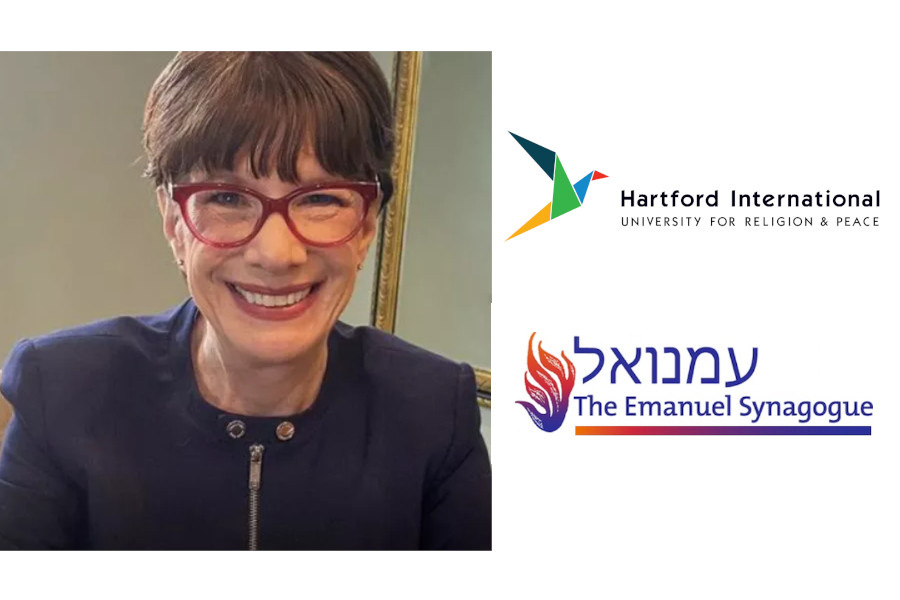
Guided by the observation that “a text without a context becomes a pretext for something antisemitic,” Dr. Amy-Jill Levine delivered a lecture on the topic of “Reading the New Testament as Jews: History, Antisemitism, Respect” at the Emanuel Synagogue in West Hartford, Conn., on Wednesday evening.
The lecture was presented by the Hartford International University for Religion and Peace (HIU) and cosponsored by nine area Jewish organizations.
Levine is the Rabbi Stanley M. Kessler Distinguished Professor of New Testament and Jewish Studies at HIU. In her introductory remarks, HIU president Dr. Sherry L. Turner described Levine’s work as “affirming the faith of others while also honoring her own.”
A noted author and scholar, Levine received multiple audiences with Pope Francis. Francis’s 2019 address to the Pontifical Biblical Institute was included in a volume she co-edited with Joseph Sievers, The Pharisees. In the spring of 2019, she became the first Jew to teach New Testament at Rome’s Pontifical Biblical Institute.
Levine’s deep knowledge of Scripture and experience of reading the New Testament “within Judaism” was immediately evident in her presentation, as she unpacked “the history [Jews and Christians] share in common.”
She noted that the period of Jewish history between the second century BCE and the early third century CE was “saved” by Christians through the writings of the New Testament. Christian history can “fill in the gaps” of Jewish tradition, the life and culture of the Jewish diaspora, and Jewish women’s history, she said. She pointed out how Jesus of Nazareth is the first person in literature called “rabbi” and that Paul is the only Pharisee from whom we have written records.
“You can’t talk about Jesus without talking about Jews,” she said. “If we don’t know the social context, we’re going to get [Jesus] wrong.”
She elaborated on Jesus in his “Jewish context,” explaining that his frequent debates with fellow Jews on the meaning of the Torah “puts him right in the heart of Judaism.” Such debates have been integral to Jewish life since the time of Moses, she said.
Levine referenced Matthew 5:17, where Jesus says, “Do not think that I have come to abolish the law or the prophets; I have come not to abolish but to fulfill.” She explained that Jesus “breaks no Torah instruction” but instead “tops off” the law “a little bit more, until the glass is overflowing.”
Acknowledging antisemitic interpretations of the New Testament is critical in engaging with the texts, Levine said. She asked the audience to consider: “How do we hear through other people’s ears so we don’t end up inculcating prejudice?”
She cited paragraph 4 of Nostra Aetate, the Declaration on the Relation of the Church to Non-Christian Religions that emerged out of Vatican II and was promulgated by Pope Paul VI in 1965. Calling it a “brilliant document” that created “a sea change in Catholic religious education,” she credited it with revoking the doctrine of “perpetual blood-guilt” against the Jews for Jesus’s crucifixion that had held sway within the church for centuries.
Despite the shift in Jewish-Catholic relations conditioned by Nostra Aetate, antisemitic readings of the New Testament still endure. Levine looked at 13 different reasons for these interpretations as well as various errors in Christian practice and teaching that enable them to persist.
Among the reasons for antisemitic readings of the New Testament is the text itself, Levine said. She pointed to passages such as Matthew 27:25 and John 8:44 as having an overtly antisemitic tone.
The lectionary cycle can prompt antisemitic interpretations, she said. She quoted from the US Conference of Catholic Bishops’ 1988 document “God’s Mercy Endures Forever: Guidelines on the Presentation of Jews and Judaism in Catholic Preaching” and said that work still needs to be done to follow on the bishops’ recommendations.
Negative stereotypes of the Pharisees, demographic and temporal shifts in the church to areas where people may not have a recollection of the Shoah as a “check” against antisemitism, and a lack of mandates requiring candidates for Christian ministry to undergo training on how to avoid anti-Jewish preaching are other factors that contribute to antisemitic readings of the New Testament, Levine said.
A sense of privilege, or an inability to recognize the problem, can exacerbate antisemitic interpretations, she added. She shared an experience of visiting a church in Germany where an explanatory note stated that Jesus’s “way of talking about God challenged the moral and religious beliefs of his day” and led to his death.
The idea that Jesus was killed for his teachings is not so simple, she clarified. She called church officials’ attention to the note, and last year it was amended to the more accurate “At the age of 33, [Jesus] was charged with disturbing public order and sentenced to death by crucifixion by the Roman prefect.”
Errors in practice and teaching that perpetuate antisemitic readings include the claim that the Torah was impossible to follow and that Jesus made it easier. Levine cited a passage from liberation theologian Leonardo Boff’s Passions of Christ, Passions of the World as an example of this line of thinking: “In the world as Jesus found it, human beings were . . . under the yoke of absolutization of religion, of tradition, and of the law.”
Returning to the theme of Jesus “topping off” the law, Levine offered the corrective that Jesus does not abolish Torah but rather “intensifies” it. She gave the example of Matthew 5:28, where Jesus says that even harboring lustful thoughts is tantamount to adultery.
Other errors in practice and teaching that impact readings of the New Testament include a misunderstanding of Jewish purity laws, the idea that all Jews wanted a “militant Messiah,” and the false distinction between a Christian “loving father” and a Jewish “distant God.”
“Jews always call God Father,” Levine said. She emphasized that “Jews follow Torah not to earn divine love but to respond to that love.”
Additionally, the idea of an exclusionary “Temple domination system” in Jesus’s time is not borne out by the evidence, Levine said. She noted that Paul affirms Temple worship in Romans 9:4, and the Temple worked on an inclusive “sliding scale” so that rich and poor alike could participate in the life there. Such is the case in Luke 2:24, where Mary and Joseph’s offering of two young pigeons is evidence of their meager resources.
In the Q&A session that followed, Levine teased out the difference between the Messiah and the “Messianic Age.” Christianity decouples the Messiah from the arrival of the Messianic Age, which she described as “the time when the world changes.”
Martha’s claim to Jesus in John 11, “I know [Lazarus] will rise, in the resurrection on the last day,” is “standard Jewish thought,” she said. This general resurrection of the dead, along with the ingathering of the exiles, the turning of gentiles from “idolatry” to the God of Israel, the final judgment, and peace on earth are all markers of the Messianic Age in the Jewish tradition.
This means that “Jews and Christians are both unfinished products,” Levine said, as the former are waiting for the Messiah and the latter for the fulfillment of the Messianic Age. That sense of mutual expectation can be a spur to further dialogue and exchange, she added. ♦
Michael Centore is the editor of Tomorrow’s American Catholic.
Welcome and necessary analysis.
Thank you so very much for this wonderful article Michael. I must be a reincarnated Jew because I always feel like they are my people. And I love reading the Bible from a Jewish point of view. Bravo !!!