


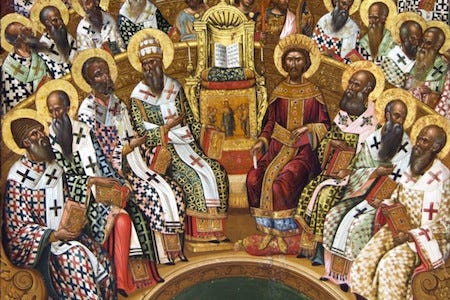
“The Confession of the Council of Nicaea: History and Theology” commenced yesterday at the Pontifical Gregorian University in Rome. The three-day conference was organized to commemorate the 1,700th anniversary of the Council of Nicaea, convened in 325 by Emperor Constantine to settle questions about the divinity of Christ. The council ended by condemning the heresy put forth by the Alexandrian priest Arius that Jesus was a created being separate from God the Father.
The council also established the Nicene Creed, with its firm declaration that Christ is “begotten, not made, consubstantial with the Father.” “From today’s perspective, the Council of Nicaea turned conventional images of God upside down: God himself became man in Jesus. This is the main message of the Nicene Creed,” explained Michael Seewald, a professor of dogmatics at the University of Münster, in a prepared statement. The University of Münster is a cosponsor of the conference.
Philipp G. Renczes, Dean of the Faculty of Theology at the Pontifical Gregorian University, emphasized the profession of faith in the Creed as a moment of collective inspiration: “With Nicea, the personal confession ‘I believe’ is coagulated and sustained in content and form in the common confession ‘We believe,’” he said, adding, “the Church did not invent the Creed, it found it already made, it was also given to the Church as a whole.”
The international conference will feature presentations on the council from a variety of historical, ecclesiological, and theological perspectives. A specially curated art exhibit, “Of All Things Visible and Invisible,” will “offer a historical yet contemporary approach to engage visitors in a deeper contemplation of this defining event for the Church” and highlight Nicaea as an “eye-opener to Synodality,” per the press release.
With a fragile pope and an ailing democracy, it may seem that there are better things for American Catholics to turn their attention to this weekend than an academic conference on a council from antiquity. But it is precisely this kind of deep historical memory that we need to cultivate as we seek to move our church and world forward in the face of so many multiplying crises.
“Do this in remembrance of me,” Christ said at the institution of the Eucharist (Luke 22:19). Every time we repeat these words at the Mass, we are reminded that memory is an active, living mechanism, not a storehouse of dead images from the past. To know ourselves as part of a lineage that includes the Last Supper and the Council of Nicaea makes the church come alive. It erases the division between the “visible” and “invisible” church and unites us with those who came before and those who have yet to embark upon their earthly journey. “The ‘undivided Church’ is not merely something that existed in the past, and which we hope will exist again in the future,” says Kallistos Ware, “It is something that exists here and now.”
In this unified vision of the church, we can take our place not just as rightful heirs to the faith, but as shapers and co-creators of it as well. Sometimes we forget this. With the major questions of Christology settled by Nicaea and subsequent councils, we tend to focus on reception and repetition, on ecclesial structures and the church’s institutional bearing, rather than dreaming new ways to articulate the “Christ event” for our frenetic era. We might ask ourselves: What might an ecumenical council in the age of the Anthropocene look like? What questions might it take up? How might we safeguard the faith—not the outward pomp, but the quiet, hidden, inward truth of Christ’s appeal to his Father through the Spirit “that they may be one, as we are one, I in them and you in me” (John 17:22-23)—in a fragmented, simulated, “post-truth” world?
Michael Centore
Editor, Today’s American Catholic
beautiful. Thank you