


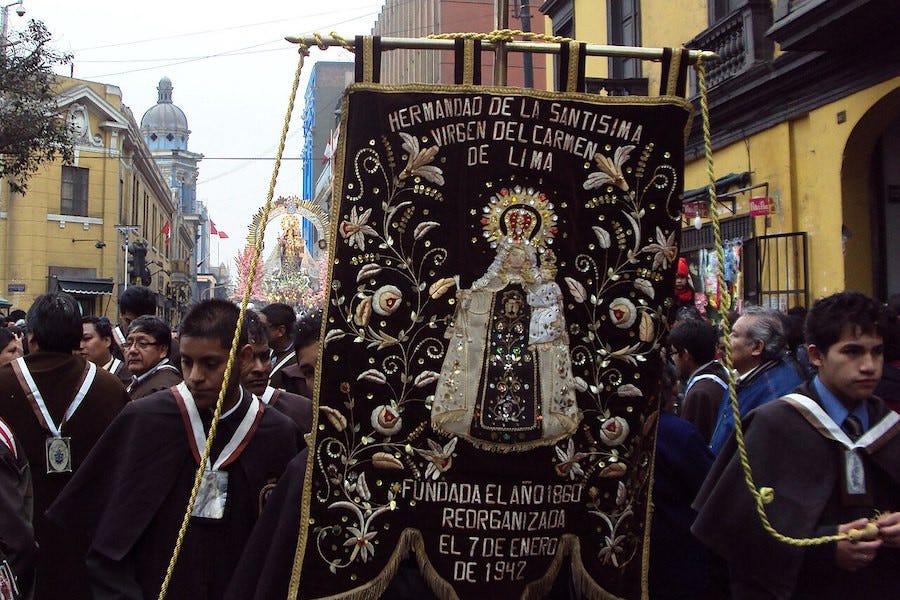
As happens each July for the past 142 years, a large Marian observance was held at the Pontifical Shrine for Our Lady of Mt. Carmel in New York City. The church, located on 116th Street between First Avenue and FDR Drive, schedules extra novenas, rosaries, individual prayer opportunities, and a major procession. The original parishioners at Our Lady of Mt. Carmel were immigrants from Italy. Today there are services in Spanish and Polish. Other nationalities are represented during the feast: Haitian, Mexican, the Dominican Republic, Irish, and more. It is a great feast of diversity as well as solidarity.
A committee at our neighborhood parish in Chicago recently arranged a weeklong display of a traveling painting of Our Blessed Lady. A prayer service took place each evening. Because of the display, people drifted into the church each afternoon to pray and lingered around the painting after each weekend Mass. All for the good. The painting was scheduled to move to another church on Monday morning.
A pulpit announcement on Sunday drifted close to the objectionable side of devotions: “Join us this evening as we say goodbye to Mary.” Critics of our Catholic devotions might say that the casual “goodbye to Mary” confused the painting with Mary herself. Further, they insist, neither Mary nor images of her should be worshiped.
Statues, icons, shrines, religious paintings, and the like will always be found in Catholicism. They serve as reminders, disposing Catholics to attend to God’s grace in their lives. Most Catholics understand that devotions are not worship. The saints are heavenly role models, and images of them are reminders of holiness. Nonetheless, caution is necessary.
Catholic devotions, particularly those centered on Our Blessed Lady, can divert attention from the unique saving action of Jesus Christ. They can foster superstition because people expect guaranteed outcomes (usually healing) from participation in the devotion. They can devolve into idolatry when people presume that statues and other images in themselves contain divine power. The temptation to regard saints and even their images as quasi-divine is serious enough that in November 2025 Pope Leo XIV warned against the careless use of some titles for Mary, including co-redemptrix and mediatrix.
For the record, no Catholic is obliged to participate in any devotion. This especially needs to be clear to those coming into Catholicism from another denomination. All Catholics find unity around dogma, Scripture, and worship. Devotions can be helpful, but always optional.
The Catholic devotions of Benediction and Eucharistic procession do not detract from Christ, our Redeemer. Rather, they reinforce the unique and full presence of Jesus. They accentuate devotion to Our Lord. Yet even with these Christ-centered devotions, caution is warranted. Catholics should not turn the incarnate Jesus, the bread of the world, into a private possession. This danger is more likely to occur with Benediction than with an outdoor Eucharistic procession.
While visiting Spain on the feast of Corpus Christi last June, Pope Leo participated in a Eucharistic procession. This devotion began in the late 11th century as a corrective to denials of the Real Presence of Jesus in the Eucharist. In due time, Pope Urban IV (1195–1264) introduced an annual Feast of Corpus Christi on which many churches, then and now, have processions. In addition to the dogma of the Real Presence, this devotion is a reminder that God is present in the world through faithful people who act responsibly around the home, in the neighborhood and on the job.
During the June procession, Leo displayed the Eucharist in an ornate monstrance. It was commissioned by King Philip II (1527–1598) of Spain. It now belongs to and is treasured by Madrid city council. Leo offered this caution about the Eucharistic procession and about devotions in general: Devotions are “not merely a matter of bringing out the monstrance, but of allowing ourselves to be brought out of our selfishness and indifference, [out] of a comfortable private faith, so as to respond to [Jesus’s] invitation to conversation and to . . . make us builders of a new world.” ♦
William Droel is editor at National Center for the Laity (PO Box 291102, Chicago, IL 60629). He writes: “For more on the Shrine for Our Lady of Mt. Carmel in NYC, try The Madonna of 115th Street by Robert Orsi (Yale University Press, 1985). It is a classic study of a major devotion.”