


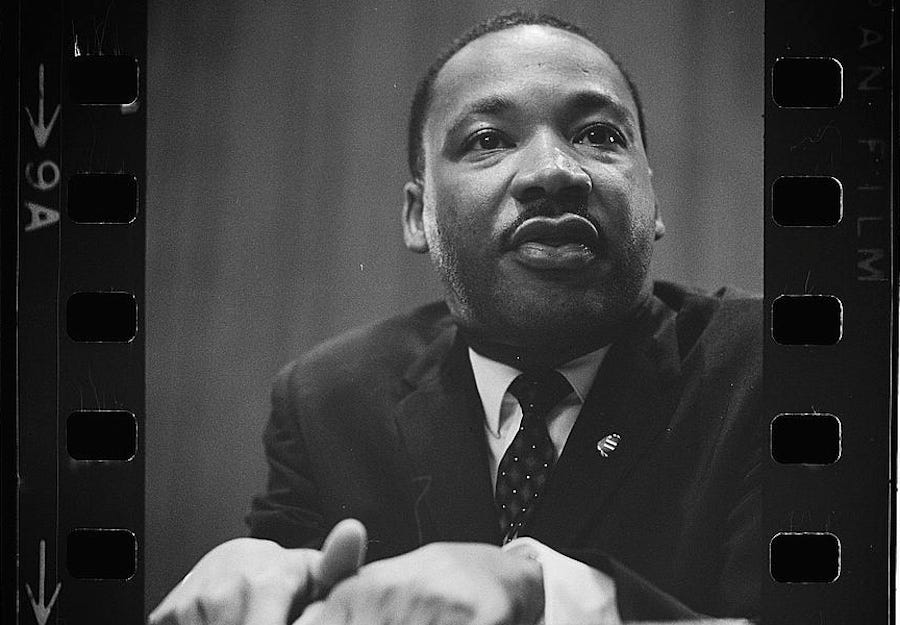
The following is the text of the keynote speech given by Fr. Reginald Norman on Sunday, January 18, 2026, at the Stratford (CT) Interfaith Service honoring Dr. Martin Luther King Jr. We are grateful to Fr. Reginald for permission to reprint it here. We are also pleased to share our podcast episode with Fr. Reginald, “Spirit to Spirit, Soul to Soul,” available here—Ed.
“Is the dream still alive?”
That question echoes across generations.
It is asked by young people who look at the world and wonder if justice will ever truly come.
It is asked by elders who marched, prayed, protested, and sacrificed—and who now wonder whether the ground gained is being lost.
It is asked quietly in homes, loudly in the streets, and prayerfully in sanctuaries like this one.
Today, we gather not just to remember Dr. Martin Luther King Jr., but to wrestle honestly with his legacy. Not to freeze him in history, not to turn him into a harmless hero, but to ask a serious question:
Is the dream still alive?
And if it is—
What would Dr. King say about the progress we have made?
And what would he say about the ways we seem to be moving backward?
The Dream Was Never Just a Speech
Before we answer whether the dream is alive, we must remember what the dream actually was.
Dr. King’s dream was never just about a speech delivered on the steps of the Lincoln Memorial. That speech was powerful—but it was not the whole dream. The dream was rooted in something much deeper: a moral vision grounded in faith, justice, and the belief that America could be better than it was.
Dr. King dreamed of a nation where character mattered more than color, where laws reflected justice, and where love—not hatred—would have the final word. But let us be clear: he did not dream of a colorblind society that ignored injustice. He dreamed of a just society that confronted it.
He believed progress was possible, but he never believed it was automatic.
Progress, he taught us, requires pressure.
Justice requires sacrifice.
And freedom is never given voluntarily by the oppressor—it must be demanded by the oppressed.
So when we ask if the dream is still alive, we must also ask:
Are we still willing to do the work that keeps it alive?
What Progress Would Dr. King Acknowledge?
If Dr. King were standing with us today, he would not deny that progress has been made. In fact, he would insist on honesty—both about the victories and the unfinished work.
He would acknowledge that doors once slammed shut are now open.
He would see African Americans in positions of leadership that were unimaginable in his lifetime: presidents, governors, mayors, judges, CEOs, educators, military leaders.
He would recognize the expansion of voting rights—however fragile they may be—and the dismantling of legal segregation.
He would acknowledge that the signs that once read “Whites Only” are gone, and that laws that enforced racial apartheid have been struck down.
He would see greater access to education, expanded opportunities for professional advancement, and a broader public conversation about race, equity, and justice.
And he would say, “Yes—these are real victories.”
Dr. King was not blind to progress. He celebrated progress because he knew how hard it was won—through marches, boycotts, jail cells, bomb threats, and martyrdom.
But Dr. King would also remind us of something essential:
Progress is not the same as fulfillment.
The Difference Between Progress and Justice
Progress can change appearances.
Justice changes conditions.
Progress can place a few at the top.
Justice lifts the many.
Progress can make us feel good.
Justice makes us do better.
Dr. King would look at our society today and ask hard questions:
Why does wealth remain so deeply divided along racial lines?
Why do educational opportunities still depend so heavily on zip code?
Why are communities of color still disproportionately affected by poverty, environmental harm, and inadequate healthcare?
Why does the criminal justice system still treat Black and Brown lives as more disposable?
He would remind us that the dream was never about access alone—it was about equity.
And he would caution us against celebrating symbolic progress while ignoring systemic inequality.
What Would Dr. King Say About What Is Falling Backward?
This is where Dr. King’s voice would grow more urgent—and more uncomfortable.
He would see the erosion of voting rights and be deeply troubled. He would warn us that democracy is fragile, and that when people are discouraged, disempowered, or denied the vote, injustice soon follows.
He would see the rise in hate speech, racial resentment, and open hostility toward diversity—and he would name it for what it is: a moral failure.
He would see the widening gap between rich and poor and remind us that near the end of his life, he spoke more forcefully than ever about economic justice. He would say, “What does it profit a nation to grow its wealth but lose its soul?”
He would see the normalization of violence, the glorification of power over principle, and the hardening of hearts—and he would grieve.
Dr. King warned us about this very moment. He said that one of the greatest dangers to justice was not just the extremist, but the moderate who prefers order over justice, comfort over conscience, silence over sacrifice.
He would ask us plainly:
Are we tired of justice?
Have we mistaken inconvenience for oppression?
Have we grown numb to the suffering of others?
The Danger of Forgetting the Cost
One of the greatest threats to the dream today is not overt hatred—it is forgetfulness.
We forget the cost of the movement.
We forget the blood, the tears, the jail cells, the funerals.
We forget that the Civil Rights Movement was not popular when it happened.
Dr. King was not universally admired in his lifetime. He was surveilled, criticized, labeled dangerous, and ultimately killed. Today, he is celebrated—but often sanitized.
We quote his dream, but ignore his demands.
We honor his legacy, but resist his challenge.
We love the memory of Dr. King—so long as he does not ask us to change.
If Dr. King were here today, he would remind us that justice is never maintained by nostalgia. It is maintained by courage.
Is the Dream Still Alive?
So—is the dream still alive?
The honest answer is this:
The dream is alive—but it is fragile.
It lives wherever people still believe that love is stronger than hate.
It lives wherever young people refuse to accept injustice as normal.
It lives wherever communities organize, vote, serve, teach, and speak out.
It lives wherever faith compels action and conscience refuses silence.
But dreams do not survive on belief alone.
They survive on commitment.
Dr. King would tell us that the dream does not belong to one generation—it is handed down. And each generation must decide whether it will carry the dream forward, or let it fade into history.
What Is Required of Us Now?
If Dr. King were speaking to us today, he would not only diagnose the problem—he would issue a call.
He would call us to moral courage in a culture of convenience.
He would call us to truth-telling in an age of misinformation.
He would call us to community in a time of division.
He would call us to hope with discipline, not optimism without effort.
He would remind us that despair is a luxury the oppressed cannot afford.
And he would say to us, as he said to those who came before us:
“The arc of the moral universe is long, but it bends toward justice—if we help bend it.”
Closing: Carrying the Dream Forward
The question before us is not simply whether the dream is still alive.
The real question is:
Are we alive to the dream?
Are we willing to confront injustice where it exists today—not just where it existed yesterday?
Are we willing to speak, act, and sacrifice for a future we may not fully see?
Are we willing to be the generation that does not retreat, but recommits?
Dr. King once said that everyone can be great, because everyone can serve.
So let us serve the dream.
Let us protect it.
Let us expand it.
Let us pass it on stronger than we received it.
Because the dream is not finished.
And the work is not done.
And history is still watching.
How Do We Respond in a Time of Political Turmoil and Rollback?
How to deal with the turning political turmoil and loss of DEI initiatives and black accomplishments . . .
If Dr. King were speaking to us today, he would not be surprised by the moment we are in—but he would be deeply concerned by how we respond to it.
Periods of progress in American history have often been followed by periods of backlash. Reconstruction was followed by Jim Crow. The Civil Rights Movement was followed by resistance, retrenchment, and coded forms of exclusion. What we are witnessing now—the political turmoil, the retreat from diversity, equity, and inclusion efforts, and the questioning of Black history and Black achievement—is not new. But how we respond now will shape what comes next.
So what would Dr. King urge us to do?
1. Refuse Amnesia: Protect the Truth
Dr. King would insist that history must be told truthfully. When DEI initiatives are dismantled and Black accomplishments are minimized or erased, the deeper danger is not political—it is moral. A society that forgets its full story cannot heal from it.
We must support schools, churches, community organizations, and families in teaching accurate history. We must tell our children not only about oppression, but about resilience, brilliance, creativity, leadership, and contribution. Black history is not a footnote to American history—it is essential to it.
To remember is an act of resistance.
To teach the truth is an act of justice.
2. Build What Is Being Dismantled
Dr. King believed in institutions—but he also believed in people-powered movements. When formal DEI structures are removed, the responsibility does not disappear; it shifts.
If systems pull back, communities must step forward.
That means mentoring where programs are cut.
That means scholarships where funding is withdrawn.
That means supporting Black-owned businesses, educators, artists, and leaders intentionally—not symbolically.
That means churches and civic groups becoming spaces where dignity, belonging, and opportunity are practiced, not just preached.
Justice does not depend solely on policy. It also depends on participation.
3. Do Not Let Political Chaos Kill Moral Clarity
Dr. King warned against confusion masquerading as neutrality. In times of political turmoil, it becomes tempting to retreat, disengage, or declare everything “too divisive.” But moral clarity does not require partisan allegiance—it requires ethical conviction.
We must be clear about what we stand for:
Human dignity over dehumanization
Truth over convenience
Inclusion over exclusion
Justice over comfort
Dr. King would remind us that silence is not peace, and disengagement is not wisdom. The question is not whether politics is messy—it always has been. The question is whether our values remain firm when the ground shifts.
4. Reclaim DEI as a Moral Commitment, Not a Buzzword
Dr. King did not need the phrase “diversity, equity, and inclusion” to believe in its substance. For him, it was rooted in the Gospel, in the Constitution, and in the inherent worth of every human being.
If the language is under attack, we must protect the principles.
Equity is about fairness, not favoritism.
Inclusion is about belonging, not lowering standards.
Diversity is about reality, not ideology.
We must articulate these truths clearly, calmly, and consistently—especially to younger generations who are watching how we respond.
5. Choose Hope That Works
Dr. King never offered shallow optimism. He offered disciplined hope—hope that organizes, votes, educates, builds, and perseveres.
Hope that shows up to school board meetings.
Hope that supports educators and students.
Hope that mentors, advocates, and serves.
Hope that believes progress is possible—even when evidence suggests otherwise.
He would tell us that cynicism is easy, but transformation is costly.
Dr. King would remind us that backlash is not a sign that the dream is dead—it is often a sign that the dream is dangerous to injustice.
The question before us is not whether times are hard.
They have always been hard.
The question is whether we will:
Protect the truth when it is challenged
Build community when systems retreat
Speak with courage when silence feels safer
Carry the dream when it feels heavy
The dream is still alive—but it needs guardians.
It needs teachers.
It needs builders.
It needs believers who refuse to quit.
May we be those people.
And may history say that when the moment demanded courage, we did not shrink—we stood.
“How Did We Get Here?”
Christian teaching helps us name what Dr. Martin Luther King Jr. spent his life confronting: fear rooted in false ownership, dignity denied, and justice misunderstood.
When people believe something is being taken away from them—and that they must fight to stop it—Christian faith asks a deeper question:
What has God truly given us, and what has God entrusted to us to be shared?
1. Human Dignity: The True Diamond Given at Birth
Christian teaching begins with this foundational truth:
“So God created humankind in his image.” (Genesis 1:27)
Every person is created in the image of God. This God-given dignity is the only diamond truly given at birth.
It is not earned.
It is not inherited from systems or power.
It cannot be taken away by laws, culture, or force.
When people confuse dignity with privilege or control, fear takes root. They believe their worth is shrinking because someone else’s dignity is being recognized. But Scripture is clear: one person’s dignity never diminishes another’s.
Dr. King understood this. He did not ask America to grant dignity; he called the nation to recognize the dignity God had already given.
2. Stewardship and Responsibility: Given vs. Earned
Christian teaching distinguishes between what is entrusted to us and what is forged through sacrifice.
The diamond “given at birth” in this metaphor represents unexamined advantage—something protected fiercely because it is fragile, dependent on control, and fearful of loss.
The diamond that is earned represents justice pursued through:
endurance
faith
sacrifice
community struggle
Those who earn their diamond know its cost. That is why they do not hide it. It is shared. It shines. It becomes a testimony.
“From everyone who has been given much, much will be required.” (Luke 12:48)
Christian faith teaches that blessings are not meant to be hoarded, but used for the good of others.
3. The Common Good: Love of Neighbor, Not Fear of Loss
Jesus summarized the law in two commands:
“Love the Lord your God . . . and love your neighbor as yourself.” (Matthew 22:37–39)
Fear-based rhetoric convinces people that loving their neighbor will cost them something essential. Christian teaching rejects this lie. Love multiplies—it does not subtract.
Dr. King echoed this Gospel truth when he insisted that justice for one group does not threaten another. The problem is not that too much is being shared, but that too much has been withheld.
“Do to others as you would have them do to you.” (Luke 6:31)
4. Solidarity: Shining the Diamond Together
Christian teaching calls believers into shared responsibility.
“If one member suffers, all suffer together.” (1 Corinthians 12:26)
An earned diamond shines not to elevate the self, but to illuminate the community. Even when rights are taken away, solidarity keeps the light alive.
Dr. King’s commitment to nonviolence was not passive—it was deeply Christian. It declared: I will not surrender my humanity, even when mine is denied.
“Let your light shine before others.” (Matthew 5:16)
5. Care for the Least: Where the Light Matters Most
Throughout Scripture, God measures faithfulness by how the vulnerable are treated.
“Whatever you did for one of the least of these . . . you did for me.” (Matthew 25:40)
Christian teaching insists that justice be judged not by comfort at the top, but by compassion at the margins.
Those who have always had diamonds stored away may never understand their weight. Those who earned them know exactly what they cost—and why they must shine for others.
Dr. King stood where Jesus stands: with the poor, the excluded, and the forgotten.
Christian teaching does not promise that justice will never be lost.
It promises that God is still at work when it is.
“We are afflicted in every way, but not crushed.” (2 Corinthians 4:8–9)
When civil rights are rolled back, when dignity is denied, when progress feels reversed, the earned diamond still shines—because its brilliance lives in faith, memory, and hope.
And those who earned it know this truth:
If we earned it once, we can work together to make it shine again.
That is Christian hope.
That is resurrection faith.
That is the Gospel Dr. King lived and proclaimed.
We are not called to protect what we fear losing.
We are called to shine what we know is true.
Because dignity comes from God,
justice flows from love,
and light—once lit—cannot be put out. ♦
Fr. Reginald Norman is pastor at St. Mark Church in Stratford, Connecticut. He holds leadership roles in national Black Catholic organizations, including president of the National Association of Black Catholic Administrators and vice president of the National Black Catholic Congress.