


Speak to our hearts, and we will follow the path of your commands
– Benedictine prayer for Holy Week
In addition to my work for Today’s American Catholic, I sometimes take on freelance assignments for other publications. So it was that I found myself in southern Connecticut on Monday to cover a Holy Week Peace Pilgrimage organized by the Atlantic Life Community for the National Catholic Reporter.
The Atlantic Life Community emerged out of the Catholic left of the 1960s and 70s, eventually broadening to become more ecumenical. Today it counts Buddhists, Quakers, Protestants, and a variety of nonviolent activists among its members. Several participants in the Plowshares actions against nuclear weapons came out of the community, which gathers periodically for retreats and acts of witness.
I went to the pilgrimage as a reporter, but also as a participant. In preparation I rewatched Ched Myers’s captivating presentation for the Association of Pittsburgh Priests from 2023 on Palm Sunday as a form of “public liturgy” or “planned political street theater” where Jesus enters into the “dangerous, conflicted, contested space” of Jerusalem. The Atlantic Life pilgrimage began from New Haven on Palm Sunday and had as its final destination the “conflicted” spaces of southeastern Connecticut, including the US Naval Base and the submarine manufacturer Electric Boat in Groton.
I also reread Robert Hass’s poem “The Creech Notebook” from his 2020 collection Summer Snow. In lines as clear as glass, Hass records an experience of traveling from Berkeley to Creech Air Force Base in Nevada to protest the use of drones. The word “protest,” however, is never overt, and Hass builds his case by the steady accumulation of diaristic detail. If for nothing else, this poem would be important to me for introducing me to the presence of Fr. Jerry Zawada, a “legendary Franciscan” known for his quiet yet persistent pursuit of the cause of peace.
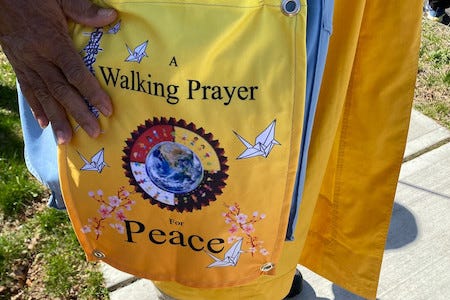
Monday’s portion of the pilgrimage began in the town of Branford and proceeded along Connecticut’s coastal Route 1. About fifteen of us set out that morning—a number that would grow throughout the day—carrying signs in support of the Treaty on the Prohibition of Nuclear Weapons and flying flags adorned with the logo of the Veterans for Peace. We walked against the grain of traffic, and I was impressed with how many drivers honked their horns or waved in solidarity.
In places where the road widened or there were sidewalks, we were able to connect with one another in what felt like a series of “conversations in the Spirit” on foot. It put me in the mind of another Hass poem called “Santa Barbara Road” where he describes families on a Memorial Day hike “chatting in constantly re-forming groups.” Though the impetus for our walk was to draw attention to the darkest of threats—the specter of omnicide at the hands of nuclear weapons—there was a lightness, almost a joy, woven like filigree within our interactions.
This blend of levity and gravity, of hope and hardened reality, became for me a kind of tonal prayer. It took me back to the Palm Sunday procession as a parade laced with lamentation: Jesus knew he was leading a troupe against the worldly power of the Roman Empire, the dominant force that had made life so difficult for his people, and yet he undertook the march to open up another path, another way—a path within a path, as it were, hidden within his route down the mountain and into Jerusalem—to show another kind of life was possible. In our day and time, that new life might mean a defense-conversion economy that redirects the $1.7 trillion appropriated for an upgrade of nuclear weapons into projects that secure the future of humanity rather than threaten to destroy it.
Michael Centore
Editor, Today’s American Catholic