


I
These past few weeks we have seen an escalation in angry rhetoric and violence in our country. In Minneapolis, 37-year-old Renee Good was shot three times in the head by an ICE agent while sitting in her car. A week later in in Richfield, Minnesota, 17-year-old US citizen with no criminal record was working at Target when ICE agents came in, dragged him to their car, and drove off. About ten minutes later they pushed him out several miles away, bloodied and seriously injured. A 22-year-old preschool teacher was arrested in Michigan for demonstrating against the US invasion of Venezuela and capture of Nicholas Maduro. Rev. Hannah Kardon was beaten with a baton while praying in front of an ICE detention center in Illinois.
I recently had the opportunity to visit Amsterdam with my wife, Stella, for a few days. We had been there before, but this time it felt different. As most of us know, Amsterdam was the home of Anne Frank, a young Jewish girl who was 10 years old when the Nazis invaded the Netherlands in 1940. Fearful for their lives, her family went into hiding. They built a tiny annex in the back of the building where Anne’s father, Otto, had a business. Along with her parents, sister, and four other people, Anne lived here for two years, until the group was betrayed and discovered by the Gestapo in 1944. The family was separated, and Anne and her sister were sent to Bergen-Belsen concentration camp, where they were killed. Her father and mother were sent to Auschwitz. Her father managed to survive, but Anne’s mother died there.
While in hiding, Anne had kept a diary. After the Frank family was captured, a family friend, Miep Gies, snuck into their hiding place to recover any personal items. She found Anne’s diary and saved it until after the war. Gies then gave the diary to Otto, who had it published. It is still one of the most haunting yet inspiring books in the world.
Stella and I had visited the Anne Frank house on our previous trip to Amsterdam. This time we decided to take a walking tour of the Jewish section during the Nazi occupation. Our guide was an amazing young woman who pointed out historic buildings while sharing the stories of some of the courageous people who had lived in them. She would stop at various points to read passages from Anne Frank’s diary. She shared how Miep Gies and her husband, Jan, were just an ordinary Catholic couple living ordinary, everyday lives in Amsterdam. They worked, socialized, and went to church, just like you and me. Miep worked for Otto Frank and Jan worked for the government welfare department. They would often have diner with the Franks. But when the Nazis occupied Amsterdam, everything changed. The Franks, knowing that they would soon be deported and likely executed, made the decision to go into hiding. The Gies were being bombarded every day by the media of the time—and even on Sundays from the pulpit—about how it was their patriotic duty as Christians and Dutch citizens to support the actions of the government and the Nazis by reporting their neighbors, who were considered “undesirables and undocumented.”
The Gies had three choices: they could become collaborators and report neighbors who were considered undesirable; they could, as many did, mind their own business and go about their daily lives; or they could actively oppose what was happening and try to help those who were being unjustly deported and executed.
The Gies chose option three. They assisted the Franks in creating a space to hide and transported them there. Every day, Miep would ride her bike to shops in different parts of Amsterdam to buy food. She had to be very careful not to go to the same store twice and to only purchase one bag of groceries at a time so as not to arouse suspicion; food was scarce and citizens were issued food-ration coupons. In his position at the welfare department, Jan was able to steal extra coupons. They had to sneak the groceries into the Franks’ hiding place.
The Gies had to do all of this while maintaining the appearance of being common, everyday people minding their own business. They knew if they were caught, or if a neighbor or even a friend or co-worker who supported the Nazis reported them, they would be arrested and immediately executed. When asked why she did what she did many years later, Miep replied, “In those dark days during the war we didn’t stand on the sidelines. We offered a helping hand; we committed our very lives.”
II
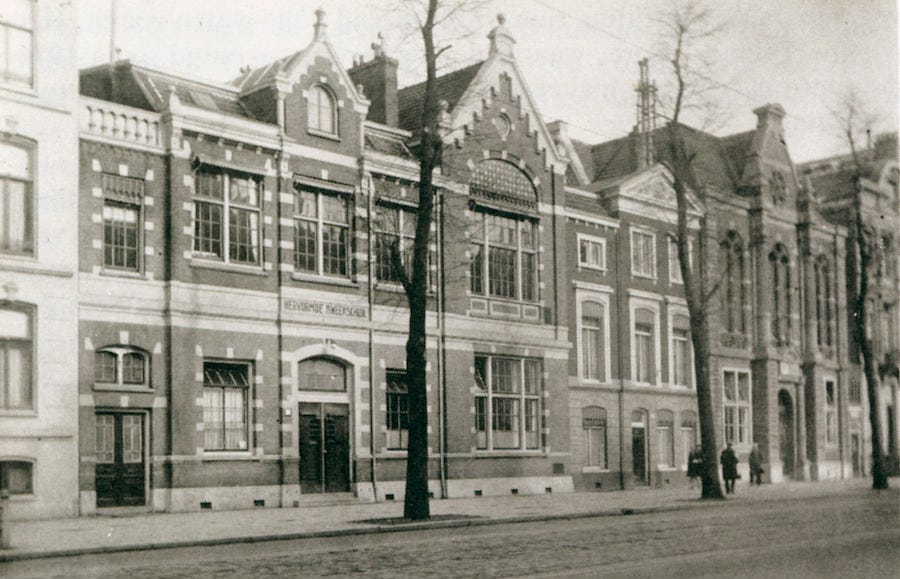
Our guide took us to what was known in the Franks’ time as the Reformed Teacher Training College. Here she told us the story of Johan van Hulst. Van Hulst was the director of the college, as well as a teacher, committed Christian, and father. At the time of the occupation, it was required that each student at the Training College had to have their religion listed on their official registration. This was a way for the Nazis to identify Jewish families and arrest and deport them. Van Hulst and several friends went into the college’s records and changed Jewish students’ religion to Christian.
Across the street from the college was the Schouwburg, a former theatre seized by the Nazis in 1941 to be used as a deportation center. When families were arrested, they were taken to the detention center before they were sent to the death camps. The children were separated from their parents and sent across the street to a nursery on the grounds of the college. From there they would be deported and killed.
With the help of Henriëtte Pimentel, the director of the nursery, van Hulst devised a plan to rescue some of the children. When the soldiers would bring the children across the street to the nursery, they would just leave them there unattended. Pimentel was responsible for preparing a registry of the children’s names and how many there were. If the soldiers bought 25 children, she would list only 20 on the registry. She would then select five children, smuggle them through the bushes to the college, and give them to van Hulst. He would hide them until the Dutch resistance came and took them to safety. In order to not arouse suspicion, they had to be very careful to take only a few at a time. This proved to be very painful to the rescuers, helping some while knowing others could not be spared. As van Hulst later said, “Everyone understood that if 30 children were brought, we could not save 30 children. We had to make a choice, and one of the most horrible things was to make a choice.”
There were many other groups and individuals from all across Europe who risked their lives to speak and act against injustice. One was the White Rose Society. This was a group of students from the University of Munich that was active in the early 40s. The students were probably excited to start the next chapter of their life journey learning new things—and if they were anything like me, they were probably also excited about meeting new friends and finding the best beer halls—until they began to realize the horror of what was going on around them. They saw people being dragged from their homes or places to work, taken to camps, and executed simply because they were Jewish or foreigners, or because of their sexual orientation.
These young students were outraged, not only at the government for committing these atrocities, but at their churches and neighbors and classmates for refusing to stand up and speak out. They formed the White Rose Society, which called on their friends, fellow students, church leaders, and the German public to take action to decry Nazi crimes and resist the Nazi state. Members came from various background and faiths, mostly Catholic and Lutheran. They drew from their understanding of the teachings of Jesus and the gospels. With the help of their professors, they produced a series of pamphlets and wrote graffiti urging people to stand up and resist. The students did this knowing that if they were caught, their lives would be endangered.
In 1942, someone reported the White Rose Society. The group’s leaders were arrested, and after a show trial where they were not allowed to present any defense, they were executed. One of the leaders, 22-year-old Sophie Scholl, interrupted the judge: “How can we expect righteousness to prevail when there is hardly anyone willing to give himself up individually to a righteous cause. . . . It is such a splendid sunny day, and I have to go. But how many have to die on the battlefield in these days, how many young, promising lives. What does my death matter if by our acts thousands are warned and alerted.”
III
Today in the United States, we are living in challenging and dangerous times. President Trump recently declared war on a large portion of the American people when he said: “America is under invasion from within. We’re under invasion from within. No different than a foreign enemy.” Many autocrats have said the same thing in their rise to power. Recently David Harris, a law professor at the University of Pennsylvania who is considered an expert on police procedure, said, “The growing number of incidents where we see agents resorting to deadly force without any reasonable basis is a recipe for disaster.” He added, “These actions don’t reflect the current thinking of law enforcement generally or best practices.” Despite what the vice president or some religious leaders suggest, these violent actions by the current administration do not in any way reflect the teachings of Jesus.
In my travels through Holland and Germany, I found it fascinating that when I stopped and talked with folks from various towns we visited, people would often whether Americans had learned nothing from what the Dutch people had gone through during the war. How could Americans vote for a person who was following in the footsteps of Hitler, they asked. I had no idea how to respond to their questions.
During the time of Hitler, the German Catholic church was divided. There were priests, nuns, bishops, and cardinals who spoke out about the atrocities at great risk to the own lives. More than three thousand were arrested and sent to concentration camps. It is estimated that close to one thousand were executed. At the same time, there were priests preaching from the altar that it was one’s Catholic and patriotic duty to support Hitler. Some would go so far as to have the Nazi flag on the altar. In 2020, the German Bishops’ Conference issued a formal letter of apology for the actions, and lack of actions, of the German Catholic church during that time.
We see the same division roiling the US Catholic church today. As Christians, we are taught to live our lives according to the message of Jesus. A message of love, of caring for the poor, feeding the hungry, welcoming the stranger. The early followers of our faith weren’t called Christians. They had no gospels or rituals. There were no hierarchies. They formed small communities and shared simple stories of the message of Jesus. A message of peace, of seeing God in each other. A message of creating the kingdom of heaven on earth, not of “going” to heaven. A message of Love. It was not until several hundred years later that the church became ritualized and hierarchical. We stopped seeing God in each other and looked for God in the sky. It is what allowed people to support someone like Hitler while still claiming to be Christian.
Today we can stand up and cheer for a government that passes legislation that will allow children to starve or go without necessary health care. We can go to Mass and pray, feeling comfortable and self-satisfied, and then stand by and watch as people are being separated from their children and sent to detention centers. In light of this, we all have a choice to make. Most of us would prefer to live our lives in our small communities and hope all the current turmoil goes away. But as Dietrich Bonhoeffer said, “Silence in the face of evil is itself evil: God will not hold us guiltless. Not to speak is to speak. Not to act is to act.” So, I ask you to take a minute or more and sit and reflect. Ask yourself the simple question: Will you choose to be Miep Gies, Johan van Hulst, or Sophie Scholl and be willing to risk everything to stand up to injustice?
There is one final question that has been asked but never answered: Who betrayed Anne Frank and the others in hiding? The answer is very simple: We all did. As Bonhoeffer said, if we remain silent, if we think that, yes, we know what is happening is wrong but we refuse to stand up and speak out due to fear or intimidation, then we are, in effect, supporting these actions. I think here of a wall of statements from people who were alive during the Holocaust displayed at the Holocaust Museum in Washington, DC. Whether the statements come from business, religious, and political leaders or everyday people, they all pretty much say the same thing: I wish I knew. If I had known, I would have done more. I knew, but it didn’t affect me, and so I did nothing.
I hope and pray that in 30 years there is not a memorial wall with our names up there, saying, I wish I knew, I should have done more. ♦
Patrick Carolan is a co-facilitator of the Tomorrow’s American Catholic podcast.