


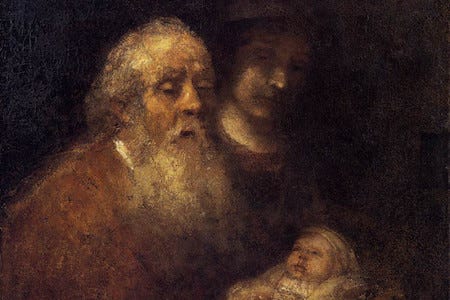
This Sunday our readings bring us into contact with the elder Simeon and the prophetess Anna, two figures in the Temple where Jesus’s parents have taken him as part of a purification ritual (Luke 2:22-40). Following the precepts of Mosaic law, Mary and Joseph present their firstborn son 40 days after his birth, along with a sacrifice of “a pair of turtledoves or two young pigeons” to represent the expiation of sin.
I find myself drawn this year to the prophetess Anna, who, we learn from Luke, “was advanced in years, having lived seven years with her husband after her marriage, and then as a widow until she was eighty-four.” Luke continues, sketching a portrait of stalwart patience that recalls the hardiest Desert Mother: “She never left the temple, but worshipped night and day with fasting and prayer.”
Simeon and Anna take turns looking on the Christ Child, the savior promised by God to Israel they have waited so long to behold. Simeon breaks into spontaneous song, inspiring the canticle (the “Nunc dimittis,” or “Now, Lord, let your servant go in peace”) that will come to crown thousands of monastic days as the final hymn for the evening office of Compline.
Generally, when we think of a prophet—or prophetess, as the case may be—we imagine someone of a certain boldness, perhaps even arrogance, as they unfailingly declaim truth to power. They can see farther and more penetratingly over the horizon, while at the same time calling us back to the best of the tradition that lays behind us.
Yet Anna, here, earns her title by a different means: a long period of solitary widowhood, of prayer and fasting that has prepared her for a quietly unexpected revelation. She shows us prophecy’s preparatory period, that the grasping of the truth and its subsequent communication rarely comes full-sprung, all at once, but is instead the product of steady, attendant devotion. Fittingly, her revelation is a quiet one, no more dramatic than the simple gaze of a child. I think of an image from Richard Shaw’s poem “Openings into Things”:
first eyelid opened
of a newborn
letting through
soft pearled
light
from another world
That that “light / from another world” is now accessible to us may be the core of Simeon and Anna’s prophetic gift—and why Anna is driven to verbalize her insight like her forebears, like Isaiah himself whose syntax Luke subconsciously echoes in his description of the scene: “And coming forward at that very time, she gave thanks to God and spoke about the child to all who were awaiting the redemption of Jerusalem” (Luke 2:38; cf. Isa 52:9).
The author known as a Monk of the Eastern Church invites us to apply this text to our interior lives. “Each soul ought to be a Temple of God, to which Mary brings Jesus,” he writes. “And each one of us should, like Simeon, take the child in his arms and say to the Father, ‘My eyes have seen thy salvation.’”
To prophecy from this means to recognize that the “light / from another world” is now capable of shining through each of us into this one. Christ is continually “presenting” himself to us—in the stranger, the outcast, the migrant, the one who society says does not count—and the fact of his becoming human means that humanity is divinized and no one is discardable. That is the seed of the truth Simeon and Anna experienced in their long-suffering tenderness, and it is one that we take up anew each time we enter with them into the Temples of our souls.
Michael Centore
Editor, Today's American Catholic