


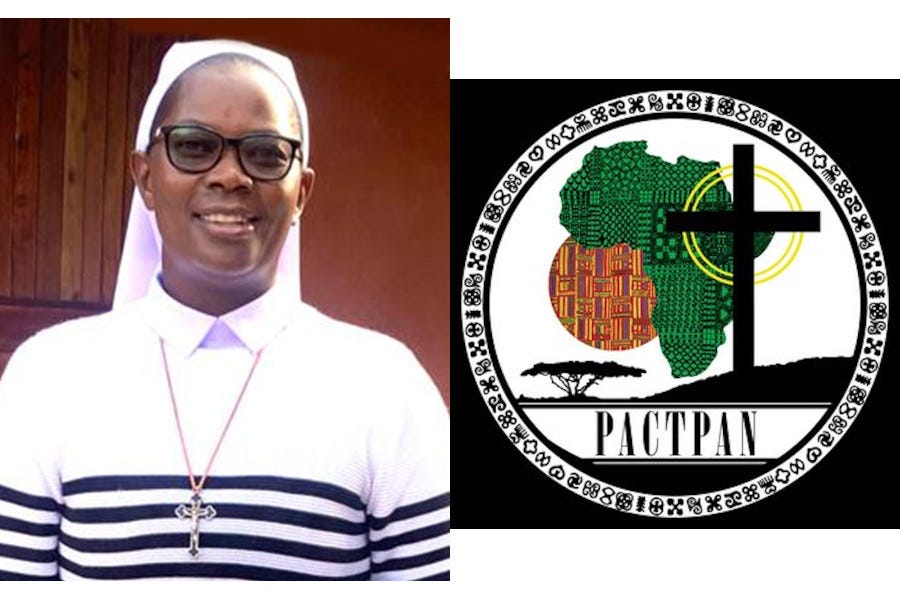
The Pan-African Catholic Theology and Pastoral Network (PACTPAN) was founded six years ago following a gathering in Nigeria to celebrate the Golden Jubilee of the Symposium of Episcopal Conferences of Africa and Madagascar (SECAM) and the 25th anniversary of the first African Synod. The network brings together theologians, philosophers, scientists, social workers, human rights activists, and pastoral agents—both lay and religious—from across Africa and the diaspora.
Recently, members of PACTPAN formed small committees to evaluate the interim reports of the 14 Study Groups of the Synod on Synodality. One of these committees focused on the interim report from the Study Group on the Liturgy. The resulting reflection, “Liturgy, Synodality, and Sacramentality in the African Church,” was drafted collaboratively and synthesized by PACTPAN member Sr. Leonida Katunge. Sr. Leonida hails from Machakos, Kenya, and holds a doctorate in theology from the University of St. Anslem in Rome. She is currently an adjunct professor of sacramental theology at Marian University in Indiana.
With its development of the ideas of “communal anthropology,” the Eucharist as a “covenant meal,” the importance of Small Christian Communities (SCCs), and preaching as “a decisive synodal practice,” the reflection offers timely, pathfinding insights into the future of the synodal church. “PACTPAN functions as a vital bridge of ‘giving and receiving’ between the church in Africa and the global church,” Sr. Leonida says, demonstrating “that the African church is not merely a recipient of missionary activity, but an active theological subject capable of offering insights rooted in communal faith, lived experience, and concrete pastoral realities.”
Sr. Leonida was kind enough to answer a few questions about the aims and intentions of the reflection, as well as some background on its composition process. The full text of the reflection is available following our interview below—Ed.
TAC: Why was PACTPAN motivated to produce this reflection?
Sr. Leonida: From its inception, PACTPAN’s mission was both simple and urgent: to ensure that the church in Africa meaningfully participates in the global ecclesial and theological conversation, sharing African perspectives on Christianity and emerging issues shaping the continent. This mission emerged from a clear paradox—while Africa is home to one of the fastest-growing Christian populations in the world, its theological and pastoral insights have often remained underrepresented or unheard in global ecclesial processes.
Over the past six years, PACTPAN has matured into one of the most dynamic continental networks and has increasingly become recognized as a voice for the voiceless. This vocation was especially evident during the Synod on Synodality, where PACTPAN organized numerous webinars, participated in high-level ecclesial consultations, and published scholarly and pastoral works that served as key resources for the synodal journey. Through these initiatives, PACTPAN contributed substantively to the Synod by articulating African ecclesial experiences with theological clarity and pastoral depth.
It is precisely this synodal engagement that explains PACTPAN’s participation in the present reflection. Following the release of the interim reports of the Synod’s 14 thematic committees, PACTPAN discerned that remaining silent would contradict its founding mission. The interim reports invited reception, dialogue, and contextual interpretation. As a network explicitly committed to synodality, PACTPAN recognized a responsibility to offer a structured African theological and pastoral response, particularly where the reports touched on areas central to African ecclesial life.
One of these committees focused on liturgy, a domain in which African ecclesial experience, inculturation, communal participation, and eucharistic practice raise urgent and distinctive questions. As a member of the PACTPAN liturgy committee, I participate directly in this discernment. The present reflection therefore emerges not as an external commentary, but as a synodal act of reception and contribution, rooted in lived pastoral realities.
At the heart of this reflection lies PACTPAN’s core mission: to interpret, discern, and communicate what is happening in the world and in the church to Christians in Africa, while at the same time bringing African ecclesial experiences into conversation with the universal church. There was a pressing need to make visible the lived faith, struggles, and hopes of African Christian communities, particularly in relation to the Synod on Synodality and, more specifically, its reflections on liturgy as the source and school of synodal life.
Can you tell us a bit about the process of composing the reflection as a group?
The process was intentionally synodal in both spirit and method. Participation was not imposed but emerged through discernment and openness, allowing those who felt called and competent to step forward freely. PACTPAN reached out to its global membership, and individuals expressed interest based on both commitment and expertise.
Following this initial openness, a process of deliberation ensured that contributors brought not only academic specialization but also lived pastoral, cultural, and ecclesial experience. This safeguarded the reflection from becoming abstract or purely theoretical and grounded it firmly in real ecclesial life.
Ultimately, the synthesis was entrusted to scholars and practitioners whose specializations aligned with the themes under reflection, allowing the final text to be both academically credible and pastorally resonant. The result was a global yet contextual engagement, marked by dialogue, listening, and shared responsibility—key hallmarks of synodality as articulated by the universal church.
What can the American Catholic Church learn from the liturgical, synodal, and sacramental practices of the African Church? Can you elaborate on the notion of “African communal anthropology,” the importance of Small Christian Communities (SCCs), and the African concept of “palaver” as it applies to preaching as a synodal practice, all of which are referenced in the reflection?
For the church in Africa, the liturgy is fundamentally communal. It is not the domain of a few selected ministers or “armchair scholars,” but the lived expression of the faith of the whole people of God. Theology in Africa emerges from both the field and the academy, from lived worship as much as from written texts.
The liturgy in Africa is understood not merely as an event but as a sacred encounter that embraces the living, the dead, and the unborn. It recognizes the interconnectedness of human life, creation, and the spiritual realm, where sacred time and sacred space are not confined to church buildings or scheduled hours. Any moment can become liturgical when the community encounters the Holy Creator together, even under a tree or on a mountain.
This vision is rooted in African communal anthropology, expressed in the Ubuntu Spirit: “I am because we are.” This also finds concrete expression in SCCs, which stand out as tangible realizations of the Synod’s vision of a listening church. In SCCs, the Word of God is shared, faith is interpreted communally, and the Eucharist is translated into daily life. Here, the Synod’s insistence that the Holy Spirit speaks through the whole people of God becomes visible, challenging clericalized models of ecclesial life and affirming grassroots discernment as a genuine locus theologicus.
Related: “Praxis and Palaver” by Joseph G. Healey (May 14, 2024)
The notion of “palaver”—defined loosely “as sitting under a tree to discuss matters of importance, including community concerns” and, today, matters relating to liturgical life—offers a powerful model for synodal preaching and ecclesial discernment. Palaver is marked by listening, patience, storytelling, and consensus-building. In this model, preaching becomes not a monologue but a shared act of interpretation, where the Word of God is received, reflected upon, and lived together in dialogue with real-life situations.
The reflection speaks of “conscious, ecclesial engagement that flows from the Eucharist into mission,” which “requires liturgical practices that integrate silence.” Can you comment briefly on this notion of “liturgical silence”?
Within African synodal liturgy, silence is not absence or passivity but a communal act of listening. In many African cultures shaped by palaver, Ubuntu, and communal discernment, meaningful speech emerges only after attentive silence. This cultural instinct resonates deeply with the Synod on Synodality’s insistence that the church must first listen to the Spirit before speaking or deciding.
In the liturgical context, especially within vibrant celebrations such as the Zaire Rite, silence functions as a counterbalance to expressive participation. While song, movement, and symbol visibly embody actuosa participatio, synodality exposes the danger of equating participation solely with outward performance. Integrated moments of silence—after the proclamation of the Word, following Communion, or during communal intercessions—create space for interior conversion, shared discernment, and the maturation of the sensus fidei.
Such silence is profoundly communal rather than individualistic. It allows the assembly—living and dead, present and unborn—to stand together before God. In this way, silence becomes a school of synodality, forming a people capable of listening to one another, to their suffering contexts, and to the promptings of the Holy Spirit. Without silence, synodal dialogue risks becoming noise; without listening, participation risks becoming superficial.
The reflection also states that “African liturgical theology is uniquely positioned to articulate the Eucharist as covenant meal.” Can you elaborate on this?
The reflection powerfully presents the Eucharist as the heart of African synodal life, not merely as ritual observance but as a covenant meal that constitutes the church as a reconciled and missionary community. In African communal anthropology, a shared meal is never private; it establishes belonging, heals ruptured relationships, and binds participants into mutual responsibility. Read through this lens, the Eucharist naturally emerges as the sacramental enactment of walking together.
Aligned with the Synod on Synodality, this understanding challenges eucharistic reductionism—where the sacrament is experienced as a personal devotion disconnected from social, ecclesial, and ethical consequences. In African contexts marked by poverty, displacement, ecological vulnerability, and political instability, the Eucharist must be experienced as God’s covenantal response to brokenness, forming communities committed to justice, reconciliation, and peacebuilding.
The Eucharist as covenant meal also sharpens the pastoral urgency of the Eucharistic famine experienced in many rural and mission contexts. Synodality demands that this deprivation not be spiritualized or normalized. If the Eucharist is truly the “source and summit” of ecclesial life and the primary sacrament of communion, then ensuring access to it becomes a matter of synodal responsibility and ecclesial justice, not merely sacramental discipline.
Together, silence and covenantal Eucharistic practice reveal liturgy as the primary space where synodality is both enacted and learned. Silence forms a listening church; the Eucharist forms a covenant people. In the African context, this integration safeguards liturgy from becoming “un performance” and protects synodality from becoming merely procedural.
As the reflection suggests, when liturgy is lived as communion, participation, and mission—rooted in African communal wisdom and guided by ecclesial discernment—it becomes not only the expression of a synodal church but the engine of its conversion. In this sense, African liturgical practice offers the universal church a vital witness: synodality does not begin in documents or structures but at the altar, around the shared table, and in the sacred silence where God’s people learn again how to walk together. •
Liturgy, Synodality, and Sacramentality in the African Church: Reflections by the PACTPAN Liturgy Study Group
For the Catholic Church in Africa, synodality is not a newly imported ecclesial concept but a lived reality deeply rooted in African communal cultures. Practices such as Ubuntu, palaver, Umunna, and the long-standing experience of Small Christian Communities (SCCs) embody a way of “walking together” characterized by listening, dialogue, shared responsibility, and communal discernment for the common good. Within this horizon, liturgy—especially the Eucharist—emerges not merely as ritual observance but as the primary ecclesial space where synodality is both expressed and learned.
At the foundation of this vision lies a renewed appreciation of the sacramental identity of the People of God. Baptism is not simply an entry point into ecclesial membership but incorporation into a synodal, missionary community endowed with sensus fidei and shared co-responsibility. African communal anthropology offers a vital theological resource here, countering individualistic interpretations of sacramental life and affirming relational identity, interdependence, and intergenerational transmission of faith. However, this richness demands sustained mystagogical formation so that baptismal dignity matures into active ecclesial agency rather than remaining nominal or purely ritual.
The vitality of African liturgical celebrations such as the Zaire Rite—marked by song, movement, symbol, and communal response—reveals both strength and challenge. While these expressions visibly manifest participation and joy, synodality exposes the risk of external or performative participation without sustained interior listening, discernment, and conversion. Actuosa participatio must therefore be reclaimed not only as expressive involvement but as conscious, ecclesial engagement that flows from the Eucharist into mission. This requires liturgical practices that integrate silence, communal intercessions rooted in lived realities, and structures that resist priest-centered or clericalized models of worship.
The Eucharist stands at the heart of this synodal vision. In African contexts marked by poverty, conflict, displacement, and resilience, the Eucharist must be experienced as a source and summit of reconciliation, justice, and communal transformation. African liturgical theology is uniquely positioned to articulate the Eucharist as covenant meal, healing and reconciling ritual, and strengthening for mission—forming communities capable of discerning together how faith addresses land, governance, corruption, peacebuilding, and ecological care.
At the same time, the persistent reality of the Eucharistic Famine/Eucharistic Hunger, particularly in rural areas and mission outstations, poses an urgent pastoral challenge. In many regions, communities receive a visit from a celibate priest once or twice a year, raising serious questions about access to what constitutes the core of Catholic identity. As has been observed by episcopal leadership in Southern Africa, the faithful—especially in rural contexts—should not be deprived “of the major source of Catholic identity, the Eucharist.” This reality compels the Catholic Church in Africa to explore pastoral responses that are both faithful to ecclesial tradition and attentive to lived realities.
In this regard, Small Christian Communities represent a privileged locus of synodal and sacramental life. Far from being merely provisional structures, SCCs function as pastoral, ecclesial spaces where the Word of God is shared, faith is interpreted communally, and the Sunday Eucharist flows into daily life. They demonstrate that authentic ecclesial renewal often emerges from grassroots pastoral experience rather than awaiting juridical decrees. Such lived discernment reflects the synodal conviction that the Holy Spirit speaks not only through hierarchical pronouncements but also through the faithful gathered in prayerful listening.
This grassroots perspective also sheds light on the uneven reception of ecclesial ministries across Africa. The permanent diaconate, for example, has developed very differently across regions. In parts of Eastern Africa, it was set aside largely for pastoral and economic reasons, and because it did not correspond to rural realities where catechists already carry out many analogous ministries. Conversely, other regions—particularly urban dioceses in Southern Africa—embraced the diaconate early after the Second Vatican Council. This diversity underscores the necessity of regional discernment rather than uniform solutions imposed across vastly different contexts.
A synodal liturgical vision in Africa likewise calls for renewed reflection on the participation of women in ecclesial and sacramental life. Women remain the primary bearers of faith within families and communities, yet their visibility and recognition within liturgical and ministerial structures often remain limited by cultural patriarchy and clerical habits. In this light, a revisiting of the question of women deacons—subject to regional cultural norms and ecclesial discernment—deserves serious theological and pastoral consideration. Such reflection flows directly from baptismal equality and the Catholic Church’s commitment to honoring the gifts of all the faithful, without reducing ministry to clericalization.
Similarly, echoing the pastoral vision articulated in Querida Amazonia and the theological proposals of Bishop Fritz Lobinger of South Africa, the suggestion to ordain married viri probati merits renewed discernment in African contexts. This proposal arises not from ideological pressure but from concrete pastoral suffering: communities deprived of regular Eucharistic celebration. If the Eucharist truly stands at the center of Catholic life, synodal responsibility demands that the Church “move heaven and earth” to ensure the faithful’s right to regular sacramental nourishment.
Preaching also emerges as a decisive synodal practice. In multilingual and multicultural assemblies, the homily must be reclaimed as an act of ecclesial listening and proclamation rather than moral instruction or authority-driven discourse. African storytelling, proverbs, and narrative wisdom offer rich resources for synodal preaching that connects Scripture to lived experience, provided they remain rooted in sound biblical exegesis and ecclesial teaching. The question of expanded lay participation in preaching including women, with proper formation, thus represents a concrete pastoral issue requiring careful and prayerful discernment.
Underlying all these dimensions is the urgent need for sustained mystagogical formation. Without post-sacramental catechesis, liturgy risks becoming repetitive rather than transformative. Small Christian Communities offer a privileged space where the Sunday Eucharist is received, interpreted, and translated into concrete acts of solidarity and mission, allowing the liturgy to function as a genuine school of synodality.
Finally, any synodal-liturgical vision in Africa must take seriously the continent’s profound diversity. Africa is not a single cultural entity but a mosaic of societies shaped by regional histories, urban-rural dynamics, generational shifts, and varying degrees of cultural hybridity. Eastern Africa differs markedly from Southern Africa and from West Africa, and even within regions, significant variations persist. Consequently, liturgical renewal, inculturation, and the development of African rites must be carefully negotiated in a truly synodal spirit—where representation and participation are genuine rather than symbolic.
Synthesis Conclusion
For the Catholic Church in Africa, liturgy and synodality must be allowed to interpret and purify one another. A Uganda proverb says: One hand washes the other. When sacramentality is lived as communion, participation, and mission—nourished by African cultural resources, attentive to pastoral realities, and guided by ecclesial discernment—the liturgy becomes not only the expression of a Synodal Church but the very place where the Catholic Church in Africa learns how to walk together toward the fullness of life in Christ. •
Contribution sent to the Coordinator and Secretary of the Liturgy Study Group on December 31, 2025.
This is an insightful statement: The "Eucharistic famine issue raises hard questions about whether celibacy requirements are pastoral prudence or structural injustice when rural communities go without sacraments for months, which deserves more attention than it gets." Catholics in Africa, the Amazon, etc. deserve a practical, pastoral response.