


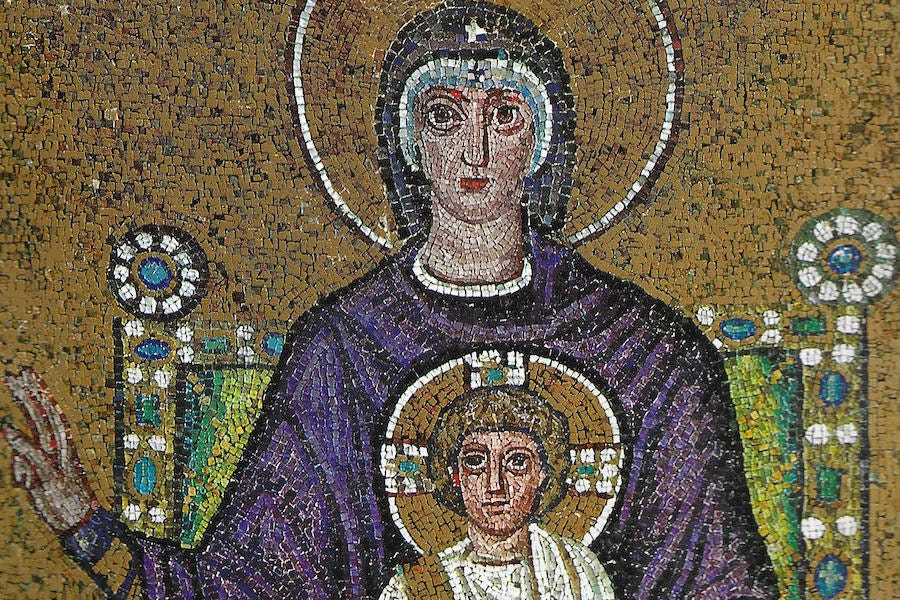
Who invented Christmas? Over the years, several people have contributed their variations to the Christmas season: St. Nicholas, St. Francis of Assisi, Charles Dickens, and others. However, from the Bethlehem stable to today’s observance, Our Blessed Lady is the best answer to the question.
The gospel writers leave us with scant details about Jesus’s mother. Yet because Christians have long been attracted to Mary, they have supplemented the gospels with their own memories and legends, with many titles and a few doctrines, with apparitions and devotional feasts—such as today’s Solemnity of the Immaculate Conception—and images.
Christians draw upon an ancient document for a fuller story of Mary, though often unaware of the source. That document is the Protoevangelium of James, sometimes called the Gospel of James or the Infancy Gospel or the Birth of Mary. It probably dates from 150 AD. Early copies of the original text still exist.
Though each of the books of the New Testament underwent “inclusion tests,” the Gospel of James did not make the canonical cut. Nonetheless, assertions in the Gospel of James support Christian doctrine. For example, the text upholds the virgin birth of Jesus, an accepted teaching among nearly all Christians. It also affirms the perpetual virginity of Mary, which many Christians accept as doctrine. The Gospel of James is also a source for some liturgical feasts, including that of Jesus’s grandparents, Joachim and Anne.
Further, the Gospel of James is a source for the Immaculate Conception doctrine. Many Christians wrongly conflate Immaculate Conception with the virgin birth. One way think of it is that the Immaculate Conception pertains to Joachim and Anne, who conceived a daughter who lived sinlessly, whereas the virgin birth refers to Mary’s delivery of Jesus.
Interestingly, Islam shares some Marian doctrines with Christianity. Mary (Maryam bin Imran), though giving birth to Jesus (Isa bin Maryam), was a virgin, says the holy Qur’an. Further, most Muslims have no problem with the Immaculate Conception because the prophet Mary was a pure vehicle for conveying the will of God.
Dogmatic arguments swirled around and through the early Christian church. Was Jesus only a spirit, or was he only human, albeit an exceptional human? Was/is he divine, even though God is One? What is the proper language to use in dogmatic statements about Jesus? What is the Holy Spirit? As dogmatic formalities took precedence, common people turned their interest to Mary, the primary female metaphor for God, and to other saints.
Through the centuries, devotion to the saints added to the vibrancy of Christian spirituality. The danger with popular religiosity, however, is idolatry. Is the Christian worshiping Mary? Worse yet, is a Christian worshiping a statue or image of Mary? Honoring Mary can even drift into heresy when, for example, Mary is called a “co-redeemer.” The proper truth is that everyone’s redemption comes only through Jesus’s suffering, death, and resurrection, as the Vatican recently affirmed.
After Vatican II, many Catholics cooled to Mary. Some of them thought she should be tested only by strict reason, the principles of biology, physics, and the like. But fondness for Mary cannot be squashed. Affection cannot be reduced to scientific explanation nor limited to polite orderliness. In fact, Our Blessed Lady, the Theotokos or “God-Bearer,” is making a 21st-century comeback.
Christmastime is full of affection—gifts for family, friends, postal workers, teachers, and librarians. It is a time for joyous songs in public places, for parties, special meals, marriage proposals, and more. Christmas is a time for imagining peace and acting upon it. Christmas is for letting go of spiritual inhibitions. Christmas is Mary’s time. Hail Mary, the inventor of Christmas. As she says in her Magnificat: “My spirit delights in God my Savior.” ♦
William Droel edits INITIATIVES (PO Box 291102, Chicago, IL 60629), a printed newsletter about faith and work.