


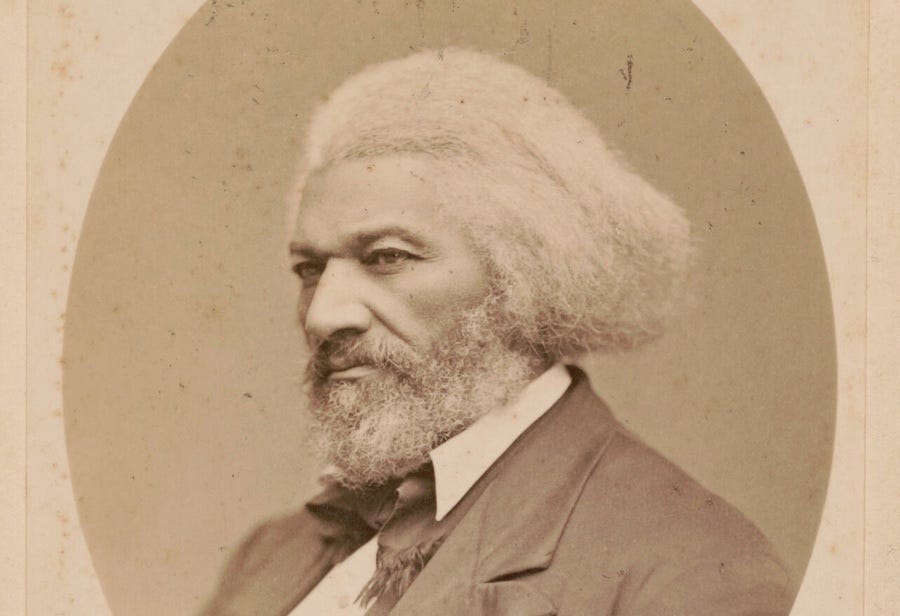
“What, to the slave, is the Fourth of July?”
Frederick Douglass asked that question in 1852, and if we are honest, it has never stopped echoing.
What is Independence Day to a Black man whose history in this nation began in chains?
What is it to a young Black girl, sitting alone on a train, surrounded not by celebration but by quiet, watchful hate?
What is it to those who still see men marching in formation—not for freedom, but for exclusion—waving flags that were once raised to defend slavery?
On this 250th anniversary of American independence, we watched white nationalists move in cadence through the capital region—masked, uniformed, chanting about reclaiming a country that was never theirs alone to claim. And I could not help but hear Douglass again.
Because the question is not just historical. It is present. It is pressing.
I have worn the uniform of this country. I have sworn to defend its Constitution. I have stood in the long tradition of Black men and women who believed enough in the promise of America to risk their lives for it—even when that promise was not fully extended to them.
And I have also walked the road of civil rights, where that same Constitution had to be demanded, interpreted, and sometimes wrestled from the hands of those who would deny its reach.
So I live in the tension.
I know what this day is supposed to mean.
It is supposed to mean liberty.
It is supposed to mean dignity.
It is supposed to mean that all are created equal—not in theory, not in aspiration, but in lived reality.
But for too many, it still means something else.
It means exclusion dressed up as patriotism.
It means silence in the face of hatred.
It means watching those in power hesitate—or refuse—to clearly reject forces that traffic in division and supremacy.
And so the question remains.
What does the Fourth of July mean—to the marginalized, the threatened, the unseen?
For me, it means this:
It is not just a celebration. It is a summons.
A summons to tell the truth about our history—not the polished version, but the whole story.
A summons to stand against hatred, even when it marches openly and loudly.
A summons to protect the vulnerable—not just in word, but in action.
A summons to make real the promise that this nation so boldly declared.
Because freedom that is not shared is not freedom at all.
And faith—real faith—does not allow us to look away.
The Gospel calls us to stand with the least of these.
The Constitution calls us to form a more perfect union.
History calls us to remember.
And this moment calls us to act.
So today, I celebrate—but I do not celebrate blindly.
I remember those who fought for a freedom they could not yet taste.
I honor those who still struggle to breathe under the weight of injustice.
And I recommit myself—to the work, to the truth, and to the belief that this country can still become what it claims to be.
Not by denial.
Not by nostalgia.
But by courage.
Because until liberty reaches that young girl on the train . . .
until it confronts the marching hatred in our streets . . .
until it is truly for all—
Douglass’s question will remain unanswered. ♦
Deacon, author, radio host, revivalist, and retired businessman, Deacon Art Miller is the former director of the Office for Black Catholic Ministries for the Archdiocese of Hartford.