


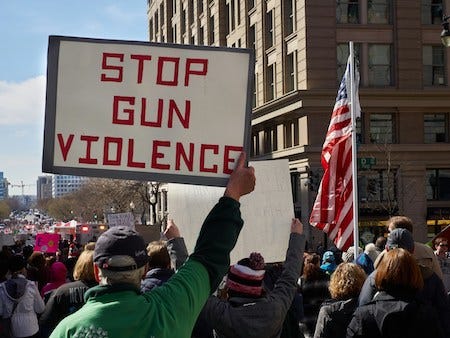
There have been many impassioned reflections in the wake of the tragic shooting at Annunciation Catholic Church in Minneapolis on August 27. I might refer the reader to Tom Reese’s column for the Religion News Service, Matthew Shadle’s latest entry on his Substack, Window Light, Paul Chu on “the pandemic of arms” in Where Peter Is, or Sr. Mary Ann Flannery’s blog post drawing on her forty years as an educator to offer a careful, compressed take on the relationship between thought, prayer, and action.
Reese’s column contains some sobering statistics:
[A]bout 3,500 American children died of gun-related causes in 2023, according to data from the Centers for Disease Control and Prevention. Guns have been the leading cause of death for children 18 years and under in the United States since 2020, even exceeding deaths from car crashes. The U.S. not only has more guns than children, it has more guns than people.
Pause on that statement for a moment: “more guns than people.” “It is a horrible thing to contemplate that our societal inability to limit access to guns comes down to a love of money by manufacturers and politicians,” Michael Sean Winters wrote in the National Catholic Reporter. Winters’s op-ed pondered the presence of “ontic evil” in Minneapolis that day, the fact that “there is no rational explanation for this horrific act,” that “[t]he mystery of evil remains a mystery, something ultimately beyond our comprehension.”
If we cannot pretend to understand the innerworkings of evil, we can, as an individual might in doing depth psychology, look to our collective “shadow side” to see what must be named, integrated, and healed. What structural sins have caused, as Reese reports, the U.S. homicide rate to be seven times higher than that of other high-income countries?
There is the practical factor of how easy it is to obtain an assault-style weapon in this country, and the urgent need—repeated after every senseless tragedy and neutralized by political inertia—to reinstate the ban on their sale that lapsed in 2004. And there is the oft-maligned “culture of violence” that pervades so many aspects of American life, even down to the way we conduct our discourse with each other. We name it, yet we cannot seem to extirpate it: the idea of “regeneration through violence,” to borrow a phrase from Michael Herr, is hardwired into the American myth, our self-understanding as tamers and shapers instead of cocreators of the land. Married to a Christian nationalist rhetoric, it can pervert our understanding of the cross, where we see all of the scourging and none of the self-emptying that was the lesson Christ meant to impart.
“Today’s great enemy of truth, drawing men to perdition, is delusion,” says Saint Gregory of Sinai. His words resound from the fourteenth century to now, when our most basic relationships with each other and our earth can seem fraught and disconnected, when we take everything personally and yet the climate, the culture, feels strangely depersonalized. It marks another aspect of our “shadow self” that needs to be brought into the light: we are deluded in our separateness, in the belief that the grief of one does not impact the grief of all. We may not be able to escape the presence of evil, but we can create conditions where it doesn’t have to thrive. We might begin with Ignacio Ellacuriá’s call to action based on the colloquy of Saint Ignatius: “before this crucified people, [ask] yourself: What have I done to crucify them? What am I doing to end their crucifixion? What should I do so that this people might rise from the dead?”
Michael Centore
Editor, Today’s American Catholic