


We are all very familiar with the words of the institution of the Eucharist. They are, in broad strokes, “Take and eat. This is my body. Take and drink. This is my blood of the new covenant.” What we refer to as the institution narrative appears in the Synoptic Gospels (Matt 26:26-28, Mark 14:22-24, Luke 22:19-20) as the central focus of a meal. It appears as well in the First Letter to the Corinthians (1 Cor 11:23-24).
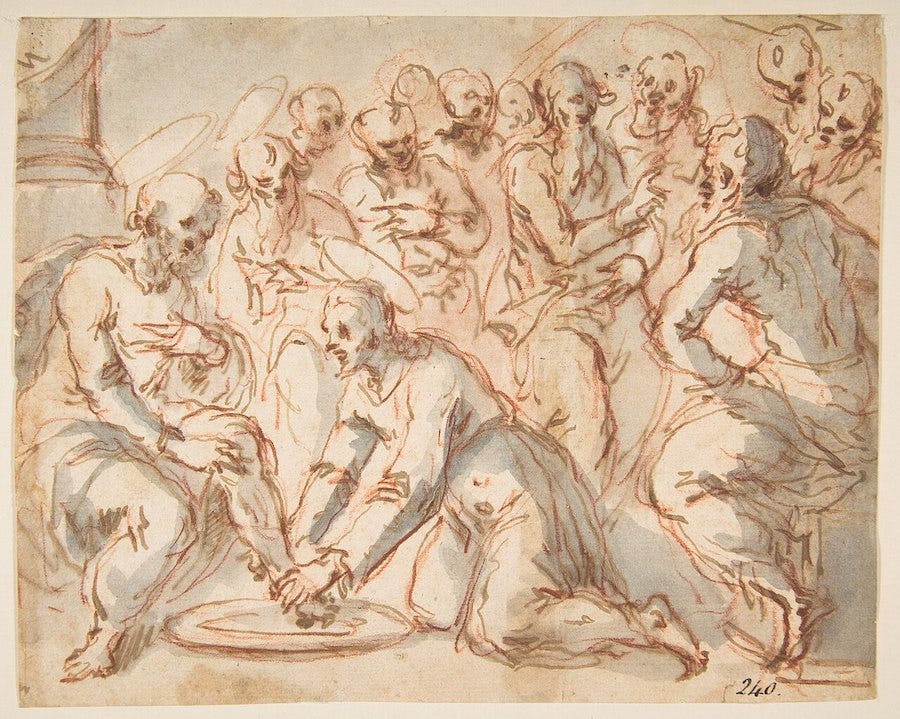
John’s gospel takes a different approach. The central act there, again within the context of a meal, is that of Jesus washing the feet of his disciples, an act of service. When the disciples question it, he doubles down, insisting that such acts of service are essential if one is to have life in him.
John places the actions of eating and drinking Jesus’s flesh and blood in another area of the gospel, chapter 6. We will look at each of these moments in turn, beginning with the Synoptic Gospels, to see what they may have to say to us.
In Search of the Pronoun
Within the institution narratives, there is a small yet interesting word. I am speaking of the pronoun this. A pronoun points to something beyond itself. But what does it point to?
We take it as a given that “this” refers to the bread and wine, which we believe has become, in substance, the body and blood of Christ.
Must that be the only interpretation? Could it also be referring to something else, of equal importance? Having had for some time a hunch that this may be an important possibility, I now present it as a hypothesis and invite your reflections.
In the institution narratives, it is important to note that while we see bread and wine, we also see actions: take, eat, drink, do. We are called to carry out these actions “in memory” of, “as a remembrance of” Jesus the Christ. These actions are part of the whole eucharistic celebration. And that, I suggest, is important. But why?
In his book Deconstructing Sacramental Theology and Reconstructing Catholic Ritual, Dr. Joseph Martos points out that the word εὐχαριστ (“eucharist,” meaning “give thanks”) invariably appears in the New Testament in verb form. It was only when the New Testament was translated from Greek to Latin that the word morphed into a noun, a thing rather than an action.
What does this tell us? We do not come together to be given “the eucharist.” Rather, we come together to form the ecclesia, to eucharist, that is, to give thanks. We are called together to be a “eucharisting” community. Eucharist, in the New Testament, is not understood to be a thing but an action, a practice of thanksgiving, followed by actions through which we receive the Christ. Rather than solely through the sacred elements, it is through our actions of giving thanks, of taking, eating, drinking, and doing what Jesus told us to do, that we become able to receive the substantive reality of Christ.
The Whole of the Person
In John’s gospel, having life in Jesus brings with it the necessity to “wash the feet” of those around us. None of us is greater than our master. In washing the feet of those who are lower than him, Jesus has given us a template for our lives. It is, however, not enough to know this, to believe this. We will be blessed if, knowing it, we apply the template in our own lives, doing as he has done. This is, for John, as central to the meal, and to life, as is the institution narrative in the Synoptics. While the words are different, the same reality applies. It is in the actions we perform as an expression of our faith that we receive, are taken up in, the substantive reality that is Christ.
While the actions of eating Jesus’ flesh and drinking his blood are not present in the Last Supper, John presents them very clearly. We find these actions in a different time and place, that of John 6. This is of significant importance and is worth examining in detail.
Consider: while Jesus is clear that his disciples are to eat of his flesh and drink of his blood, this passage takes place about a year before the Last Supper and the institution of Eucharist. Can he be insisting on their doing something that is not yet possible? Make no mistake, Jesus is insistent that such eating and drinking must happen. Not only does he tell them they must eat of his flesh and drink of his blood (6:32-51), he doubles down on this when they begin to grumble at his words (6:53-58).
Let’s look at the actual words used. Jesus speaks of eating and drinking his flesh and blood. The term “flesh and blood” is a Jewish way of saying “the whole of the person.” Jesus is not speaking of his physical flesh and blood any more than saying a man is “the spitting image of his father” is describing a man who is spitting.
In versus 32 to 53, Jesus uses the words φάγῃ (phagay) and φάγητε (phagayteh), “to eat.” This appears to be the equivalent of taking a bite out of his arm. That he is speaking metaphorically, however, is reinforced in versus 54 to 58 when, in response to his listeners grumbling about the literal meaning, Jesus speaks of eating using the term τρώγων (trogon), “to dine.” The word carries the sense of a slow, reflective action. With cattle, we speak of chewing the cud, ruminating on what has been eaten until it is fully absorbed. Indeed, in verse 58 Jesus contrasts eating, ἔφαγον, with dining or ruminating, τρώγων, saying that the fathers who did the former died, while those who do the latter will live.
In short, Jesus is asking his followers to take him more seriously. He is not asking them to physically eat and drink. Instead, he wants them to go deeper, to take the whole of his reality, his life, into them, and be changed by it. That more serious reception of and reflection on who he is can begin immediately, without needing to wait for the institution of Eucharist.
Interconnected Realities
Let us turn now to the words of the institution narrative itself. In Matthew, Mark, and Luke, and later in First Corinthians 11:23-25, we see the same or similar words being used. Invariably, we see that Jesus says we are to take and eat his body. The word for body, however, is not σάρξ (sarks) or σάρκα (sarka), but σῶμά (soma). There is a clear difference. With σάρκα, we would be dealing with a fleshly body. The word σῶμά speaks of the mind-body connection, i.e., the whole person. The word forms the root of words such as psychosomatic, where that which the body experiences is understood to be real, but not necessarily caused by something physical. When Jesus uses the word σῶμά, he is referring to that totality of him, his entire interconnected reality, his whole person.
The word for blood is αἷμά (ayma), which we can indeed understand as blood. Again, though, we remember that “flesh and blood” conveys a Jewish understanding of the whole person, not just liquid blood. In this understanding, in the action of receiving, one receives the whole of the person, Christ himself.
Note, too, that in Acts 2:42, the disciples are not spoken of as devoting themselves to the bread and the prayers, but to the breaking of the bread and the prayers. Again, the action, rather than the bread, is what stands out.
In the story of the disciples on the road to Emmaus, we are told that a man joins them on the walk and asks them what they are talking about. They respond with astonishment, wondering how he could be the only person in Jerusalem who does not know about the events that have taken place. He proceeds to explain the Scriptures to them as they walk. Then they invite him to stay with them.
The words here are important. The do not tell us that the disciples recognized him in the bread that he broke. Rather, “they recognized him in the breaking of the bread.” It is in the action of breaking bread (as happens in the fraction rite) that they recognize him. But it is clear in what they say on the way back to Jerusalem that, when they recognized him, they recognized that he had been present with them all along. Clearly, in every case, the actions around the bread and wine are as important as the elements themselves.
Remembrance of Acts Past
Jesus told his disciples to take these actions in memory of, as a remembrance of, him. How can we respond to that? How can what we do at Mass be truly done as a remembrance of him if we haven’t taken the time to get to know him, walk with him, talk with him, see what he does, hear what he says, learn how he relates to people and to creation itself? From Jesus’ words, we can see that building such a memory of him is of critical importance. How do we do that?
There are any number of ways. We can read the Scriptures, reflecting on them as we go. We can pray the “Scripture rosary,” a form of prayer in which the words are not the prayer, but instead form background music stilling the chatter of our minds so we can reflect deeply on the mysterious events of the birth, life, death, and resurrection of Jesus the Christ. If we sit before the sacred elements, we can do so not merely in silence as with a friend, each doing our own thing, but instead being truly present to Jesus, asking him about his life, listening as he speaks to us, learning from him.
We can do it in especially the Mass, treating it as a family reunion. We gather and greet each other. We recognize each other and ask all present to pray for us. Then we listen to the stories of our ancestors in faith: our great aunt Ruth, our cousin Jonathan, our great-grandfather David, and more. And we can listen to the stories of the words and actions and relationships of this man we have come to know as the Christ. We can then join in the preparation of the meal and together give thanks, or eucharist. All these actions serve to build a memory, a remembrance of him, so that we may do what he told us to do: namely, to take, eat, drink, do the whole of him (including washing the feet of those around us), thereby receiving the substantive reality of him. Finally, we are sent out to live our lives according to his template.
And so we come full circle. Are we invited individually to participate in the Mass so that we may receive the Eucharist as a noun? Or are we invited to an ongoing practice of faith by gathering, eating, and drinking deeply of the stories of our ancestors in faith, of the ecclesia, and especially of the words and actions, the whole life, of Jesus of Nazareth?
Perhaps, indeed, “this” refers back to the whole of the life of this man Jesus, God become human in our midst. Perhaps it is the memory of this which makes it possible to take, eat, drink, receive the substantive reality which existed before time began, then go out to do as he did: wash the feet of our brothers and sisters, feed the hungry, clothe the naked, and visit and heal the sick. ♦
Ray Temmerman (Catholic), with his wife Fenella (Anglican), administers the website of the Interchurch Families International Network. A former Board member of the Association for the Rights of Catholics in the Church (ARCC), he continues to conduct research into the place of interchurch families and the gift they bring to their churches and the Church.
Thanks Gene. Much appreciated.
Ray
I feel compelled to respond. First of all, thank you for the great insights, Mr. Temmerman.
Active voice and present tense. Those words could easily provide a basic theme for what we want the New Testament, the four Gospels, and their writers to be. We don’t want to read a story about a Son of God that happened a couple thousand years ago. We want it to be here and now, for us, without the constraint of time. Jesus, his words and actions, have to be here and now just as Jesus has to be here and now. I can see that in John’s writings but not in the other Evangelists. They weren’t quite sure. . . From that perspective I don’t fancy taking individual words and concepts, even if they are at the heart of the Good News, and parsing them to death. Such parsing, in my view, kind of kills them and makes them static, lifeless, all of a sudden. I need the whole picture, present and real, in order for the event to come alive. It sounds wise alecky to say “parsing them to death.” But there is a certain death to a whole way of seeing and thinking when we take Jesus things apart like that. Perhaps that must be done for the sake of academia. How else can we explain the timelessness of Jesus, his words and actions? Ah! Now I understand. There is the rub. Good work, Mr. Temmerman.