


Often it is a few stray lines or sentences, copied into a notebook and recontextualized, that teach us something:
A poet must be a professor of the five senses. (Federico García Lorca)
I have no philosophy: I have senses. (Fernando Pessoa)
Go from Pessoa to Dorothy Day:
Our philosophy is firmer than flesh.
I like thinking of this link between poetry and the senses, between philosophy and bodily existence. It distills for me the idea of the real and the ideal of the dream, God’s secret writing inscribed within each of our hearts. I hear this in how Michael Hofmann describes the poetry of Robert Lowell as “browsing along the seam of self and world,” or, more closely approaching spiritual direction, in a homily from Hieromonk John Ludischev:
Harmony, inner order, and arrangement within us begins only when we take the side of the will of God and establish an orderly life in our spirit as an indispensable law of our life. From the moment that such a decision emerges within us, the power of God begins to gather all the other forces of our nature, both spiritual and physical, and to arrange all their activities, maintaining within them what is good, and eradicating all that is bad.
“Love is not a feeling,” a priest once told me, “it is a decision of the will.” I’ve heard it said in a folksier way, that if you take one step toward God, God takes two steps toward you. “Make every effort to maintain the unity of the spirit in the bond of peace,” counsels the author of the Letter to the Ephesians (4:3); as the hieromonk concludes: “Then then peace of God, surpassing every intellect, will overshadow the inner temple of our nature.” This is where the poetry of the senses, the philosophy of the flesh, must come into play, because it is only in and through the world that we are divinized. A present-day contemplative states it plainly: “The universe is not merely a backdrop for the story of human salvation but its object.”
It all sounds very heady, but the process is really just one of attending to what’s in front of us. “Dream, dream, during / Ordinary life,” was the calm, clear exhortation of Alfonso Cortes. Pessoa grounded this pared-down if piquant advice in a place, albeit one that could stand for the “inner temple” as easily as a physical location:
I do not know what nature is: I sing nature.
I live on top of a hill
In a lonely whitewashed house
And that is my definition.
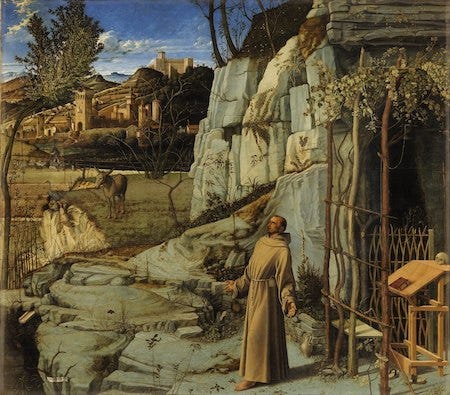
It is the displacement of knowing into singing that captivates me here. I am reminded of how praise is its own form of theology, of Bellini’s Saint Francis in the Desert as a kind of visual hymn to attentiveness “surpassing every intellect.” In the picture I always noticed what was in front of Francis—the plinth-like rock and swatch of blue sky, the laurel twisting overhead—but studying it more closely this morning I am aware of what is behind: the Bible on the lectern beneath the rustic arbor and the gate of woven branches before the entrance to the cave. The objects sing to me in their specificity, as evidence of a physical life that refracts the light of spiritual transformation. Francis, here, has turned from the Bible, but he has not turned away from it: he has opened himself from one dimension of the text to another, the text as teaching tool of the five senses that project their prayer of apperception:
Scripture teaches us, I think, that the voice which is melodious and ascends to God’s hearing is not the cry made with the organs of speech, but the meditation sent up from a pure conscience. (Saint Gregory of Nyssa)
Michael Centore
Editor, Today’s American Catholic