


Last month, the 10 Study Groups of the Synod on Synodality established by Pope Francis published their Interim Reports. Along with such topics as “Listening to the Cry of the Poor,” “Mission in the Digital Environment,” and “Theological and Canonical Matters Regarding Specific Ministerial Forms”—the latter closely watched for its comments on women’s access to the diaconate—was a contribution from the Group on Liturgy in a Synodal Perspective.
The group was formed at the special request of Pope Leo XIV to develop perspectives on liturgy advanced by the Synod’s Final Document. Its contribution offers several questions that are guiding its work, including: “How can the modes of liturgical preaching be reinterpreted from a synodal perspective? How can its quality be enhanced? How can the development of mystagogical catechesis on synodality be encouraged?”
Through its series of award-winning books and its comprehensive website, the ongoing project of Catholic Women Preach (CWP) offers one practical example of how these questions might be answered. CWP provides “theologically informed perspectives of Catholic women to serve as an inspirational, theologically based resource for ordained priests, deacons, catechists, and all involved in the ministry of the word in the Catholic Church,” according to its website.
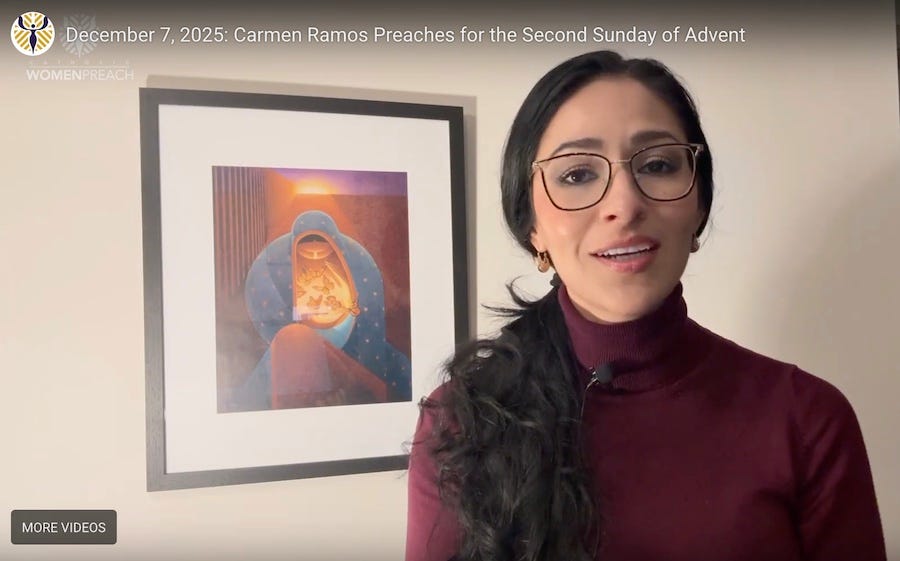
This Advent-Christmas season, in solidarity with a migrant population that is threatened and ostracized, CWP is embarking on a special initiative to feature scriptural reflections from Latina women, migrant women, and women who minister to and advocate for migrants.
The opening reflection for the First Sunday of Advent was given by Angélica Nohemi Quiñónez, Director of University Ministry at the University of San Francisco. A reflection by Carmen Ramos, Director of Renovación (Parish Renewal Initiative) at Marian University in Indianapolis, follows for the Second Sunday of Advent this week.
In addition to reflections for Advent and Christmas, CWP will also include offerings for the Solemnity of the Immaculate Conception on December 8 and the Feast of Our Lady of Guadalupe on December 12.
Russ Petrus, executive director of FutureChurch, CWP’s organizational sponsor, commended the US Conference of Catholic Bishops’ “Special Message” on immigration and Pope Leo’s defense of the dignity of migrants as “important responses to what is being asked of the Church in this moment.”
Still, he said, “statements alone will never be enough. For real change in the national conscience, words need to be carried forward with action—through direct ministry, public advocacy, and by storytelling and uplifting the voices of migrants. And it’s on this last point that we believe Catholic Women Preach can play an important role.”
In this spirit of public advocacy, FutureChurch sent a letter on November 21 to every US bishop encouraging them to reflect upon the preaching of the women featured in CWP’s Advent-Christmas program.
The letter also appealed to the bishops as “shepherds of the Catholic Church” with “a unique moral authority” to “continue raising your voice in bold opposition against the sinful and dehumanizing treatment of migrants and in advocacy for compassion, justice, and systemic reform.”
Petrus said that this particular series of CWP reflections will give added meaning to the liturgical season.
“Hearing from Latina and migrant women and those who accompany migrants invites us to experience Advent through the stories, experiences, and insights of those who—not unlike the Holy Family—know what it means to long, to hope, to await, and to keep moving forward in faith,” he said.
“It’s a way of helping all of us not only prepare for but to live Christmas with a deeper sense of solidarity and hope in action,” he added.
Jack McDonald of Calgary, Alberta, is a retired priest and professor emeritus of social work at the University of Calgary who consults CWP as a member of a Zoom-based small Christian community facilitated by Tomorrow’s American Catholic. He describes himself as a “faithful reviewer” of the preaching resources and says that they “add richness to our weekly small Christian community group liturgy meditations.”
“I am continually impressed by the ministerial knowledge, talent, sincerity, and passion brought by each woman to historical interpretation and current application,” he said, characterizing the reflections as “a welcome balance within liturgy sermonizing.”
At a time when figures like White House “border czar” Tom Homan—a professed Catholic—are openly defying the church’s teachings on immigration, it is clear more catechetical resources such as those provided by CWP need to be made available.
Homan made headlines last month when he critiqued the USCCB’s “Special Message” on immigration, saying, “I’m saying it not only as a border czar, but I’m also saying this as a Catholic, I think they need to spend time fixing the Catholic Church.” His comment revealed a fundamental misunderstanding and failure of “mystagogical catechesis”: that “the church” ends with the institutional structure and is not, instead, a sign and sacrament of “a very closely knit union with God and of the unity of the whole human race” (Lumen Gentium, 1).
Petrus believes that the voices of the women in the Advent-Christmas CWP initiative can restore something of this true nature of the church: “Our hope is that their reflections move us and our Church to be more aware of how God is showing up at the margins and calling us to join.” ♦
Michael Centore is the editor of Tomorrow’s American Catholic.
What a wonderful and beautifully written article Michael. I had no idea Tomorrow’s American Catholic was facilitating sessions like that! Thank you once again for sharing hope.