


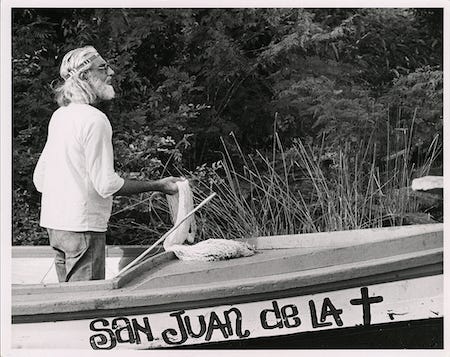
Preparing for our Lenten Synodal Practice earlier this week, I took special note of this passage from the Final Document:
Gathered from every tribe, language, people and nation and living in different contexts and cultures, the synodal process gave us the “spiritual taste” (EG 268) of what it means to be the People of God. The People of God is never the simple sum of the Baptised but the communitarian and historical subject of synodality and mission still on pilgrimage through time and already in communion with the Church in heaven. . . . Being in the world and for the world, they walk together with all the peoples of the earth, in dialogue with their religions and their cultures, recognising in them the seeds of the Word, journeying towards the Kingdom. (17)
The idea of walking together “with all the peoples of the earth” brings to mind the teachings of eco-theologians like Leonardo Boff and Ernesto Cardenal, who show us how to care for our planet as a “common home” without losing sight of the cosmic dimensions of consciousness and creation. I hear between the lines the pioneering interfaith work of Raimon Panikkar, who went beyond the relative safety of “dialogue” to immerse himself in other religions while retaining his core Christic orientation.
Panikkar once referred to the Word as “the ecstasy of silence”—a definition of considerable value here, when we called to recognize in others “the seeds of the Word” latent with meaning and connection. This happens not by sheer force of will, but by something closer to what the poet John Keats named as “negative capability”: the ability to hold within oneself “uncertainties, mysteries, doubts, without any irritable reaching after fact and reason”—in other words, the ability to create a space of reception without judgement, an essential component of ecumenism and of synodality itself.
It is in this space where we become present as presence to others. We seek to be simple, pliant, not to teach but to be taught. We want to meet others where they are. We want to gather the seeds of the Word they sow within us, even—especially—if they challenge us or impel us to renew our perspective. Every encounter can become the vector of a new direction, a new stage of evolution in our faith.
In another of Christianity’s innumerable paradoxes, the less we view that faith as something to be asserted, imposed, or protected, the stronger it becomes. The seed of our internal conviction roots itself in quiet trust. It grows when we open ourselves to others. What the world sees as weakness—our flexibility, our receptivity over assertiveness—we experience as strength. As part of a daily practice, this reversal becomes a rehearsal for the ultimate paradox through which all of us must pass: “For those who want to save their life will lose it, and those who lose their life for my sake will find it” (Matt 16:25).
During our Synodal Practice, one of our participants shared the image of the institutional church as being like an ocean liner, with our small, “base” communities as so many dinghies traveling alongside. I thought immediately of a photo I’d recently discovered of Cardenal standing in a rowboat near Solentiname, the lay monastic and artistic community he established in Nicaragua in the 1960s. The image shows him holding a net, facing forward purposefully as if conducting a “Conversation in the Spirit” with the surrounding vegetation. It reminds me that being “present as presence” means occupying the outlying place, the marginal place, where the mystery is often most pronounced.
Michael Centore
Editor, Today’s American Catholic