


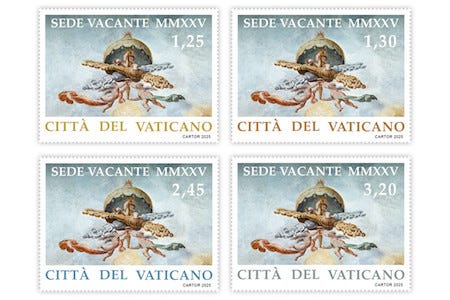
The Catholic Church is currently in a period of sede vacante—literally, “the see being vacant”—as it awaits the selection of the next pope. The cardinals gathering in Rome have asked for prayers as they prepare for the opening of the conclave on May 7. Of the 252 current members of the College of Cardinals, 135 are under the requisite age of 80 to be able to cast their vote.
In La Croix, Youna Rivallain reported on the opening meditation for the general congregation, a “pre-conclave” gathering where the cardinals prepare themselves for the upcoming election, given by Benedictine Father Donato Ogliari. I was heartened by the Franciscan—in the spirit of both the pope and the saint from whose name that adjective derives—overtones of Father Ogliari’s words: “The church rooted in Christ is a church capable of incarnating itself in history and moving through it with confidence alongside its Lord, not conforming to the worldly standards of power and domination, but shaped by the gentleness, humility, and merciful love that Jesus embodied in his earthly life.”
Amidst all the speculation about Francis’s successor, it is worth taking a moment to appreciate the unique spiritual opportunities such a sede vacante period affords. Without having a leader instantiated in a single person, the church—the whole church—is suddenly democratized, not in the civic sense but in the religious: clergy and laity, from the cardinal to the newly confirmed, are all awaiting on the one Spirit to discern the next step forward. There is an eschatological shading to this, a sense of expectancy that puts me in the mind of the prayer we hear during the Communion Rite of the Mass:
Deliver us, Lord, we pray, from every evil,
graciously grant peace in our days,
that, by the help of your mercy,
we may be always free from sin
and safe from all distress,
as we await the blessed hope
and the coming of our Savior, Jesus Christ.
Regardless of the outcome of the conclave, this is a moment we can draw on in subsequent stages our ecclesial life. We can remember when there was no identifiable leader but the Spirit itself, and thus be clued into a new understanding of this element of the Trinity as “protagonist,” a term we heard so often throughout the course of the synod.
It is also worth considering that the next pope emerges as a leader, yes, but also as a servant and vessel for the hopes and dreams of the faithful. He “embodies” the movement of the church by hearing and heeding its prayer for itself and working, within the limitations of a timebound existence, to actualize that prayer in word and deed. He comes to us formed by many disparate influences, from his earliest teachers through the varieties of his life experience, and he emerges as the projection of similarly disparate prayers from all corners of the world. Perhaps this is one reason why he changes his name, a tradition that dates to the sixth century: it acknowledges that he is a creation, that others are in relationship with him as both person and representation of a collective voice.
So it was that Jorge Mario Bergoglio “became” Pope Francis in March 2013, aligning himself with Francis of Assisi and the qualities of “gentleness, humility, and merciful love” that gather around his name like the multiplicities of meaning around a poetic word. Bergoglio discerned it was the voice the church and world needed to hear at that time; now, twelve years on, it is needed even more. Whomever the Spirit selects from the conclave, I do not think I am alone in praying he conceives of his role as Francis II.
Michael Centore
Editor, Today’s American Catholic
I’m with you on Francis II.
Great Michael ! Love this !