


These days we often hear the expressions “We live in a perilous time” or “Our world is in crisis.” We read such sentiments on social media and regularly hear them on the news. I have even used these expressions in articles and talks.
We certainly are living in a perilous time. However, if we stop for a moment and think about it, these expressions could describe any period in the history of our civilization. Since we first began recording our story—initially orally, then through the written word—it has been one of war, conquest, slavery, death, and destruction. A great deal of it has centered around our religious beliefs. We have believed that our religion, whatever faith we practiced, was the one true religion and all the others were erroneous or, worse yet, evil. In the 12th century, Pope Honorius III issued a papal bull describing Muslims as beasts, devils, and contemptible beings. Other religions felt the same way about Christianity. We created religion and went to war based on fear and hatred of the other. We ignored the teachings of the great spiritual mystics like St. Francis, the Sufi Rumi, or the teachings of the Hindu Vedas. We have turned our sacred stories into a battle cry against the other instead of a call to oneness with all creation.
Thomas Berry wrote in The Dream of the Earth, “The deepest crises experienced by any society are those moments of change when the story becomes inadequate for meeting the survival demands of a present situation.” Our sacred communities are defined by our sacred stories. We view these sacred texts as the unchanging word of God. All of our different faith traditions have their own version of sacred stories, some written and some oral. For Christians, our sacred stories and our sacred texts are told from a historical perspective as it is developed in the Bible. They narrate events that happened centuries ago, recorded by people whose vision was limited by their understanding of the universe and all that it contained at that point in time. Sacred stories are not necessarily sacred because they contain deep and significant truths—though, indeed, they may—but because enough people believe that they do.
Our most sacred Christian stories originated in the oral tradition. Our earliest known written versions date from the late first century to the early second century CE. They were retold, reinterpreted, and rewritten until approximately the fourth century, when church leaders codified them into official canonical texts. The website Patheos summarizes in an historical overview: “The idea of a New Testament canon first emerged in the second century, when church leaders began making lists of the books determined to be authentically apostolic. In 367, Athanasius of Alexandria listed all 27 books of the New Testament in a letter and referred to it as the Canon. Athanasius’s list was widely recognized in the eastern churches, and then was approved by a number of authoritative councils in the West.”
Our sacred stories were interpreted and edited by early church fathers in a way to justify their beliefs. Some of them took the beautiful story that Jesus spoke about, a message of love and oneness, and replaced it with stories of sin, separation, individual salvation, and substitutionary atonement. They created rituals, prayers, and rules centered around worshiping at the foot of the cross instead of, as Jesus taught us in Matthew 16:24, taking up our cross and being one with Jesus. Instead of us being the image of God, they created God in our image. In doing this, they created a patriarchal, hierarchical system where the church leadership, bishops, and clergy serve as the intermediaries between God and the faithful.
When I was younger, I was taught that our Christian theology, our beliefs, were unchanging and absolute. This led to some confusion as the church danced around the peripheries: for instance, first condemning and then embracing science. We realized that the Earth was not created in six days and was not exactly six thousand years old, so we had to adjust our theology to accommodate scientific facts and learned experiences; we had to reimagine our sacred stories. Through it all, we had to maintain our core beliefs, including the belief in the “one, holy, catholic and apostolic church.” This phrase represents the idea that our church today is identical to the church founded by Jesus and bestowed upon the apostles.
Yet our sacred stories do not end with the crucifixion, resurrection, and sending forth of the apostles. They are not static historical narratives about the life of Jesus and his followers. Visionary thinkers like the Jesuit priest Teilhard de Chardin and the contemporary Franciscan theologian Sr. Ilia Delio teach us that evolution and science are not separate from our sacred stories; they are our sacred stories. As Delio has written: “We have not accepted evolution as our story. We treat evolution as a conversational theory or something that belongs to science, as if science is something separate from us and outside our range of experience.” We consider ourselves enlightened when we accept that Jonas probably didn’t spend three nights in the belly of the whale, or Noah didn’t take two of each creature on board the ark to avoid a flood. We can accept the grace we receive in the message of these stories without believing in their historical accuracy.
To create a new Earth, we have to start with a story of oneness and interconnectedness, not separation. St. John of the Cross taught us that human desire is unlimited; the heart of all creation is not satisfied with less than the infinite. This infinite is clearly God. Our deepest desire is a desire of oneness with God. We turn away from God when we no longer consider God’s creation and all that it encompasses as sacred. We view evolution as a separate scientific theory rather than a spiritual movement, as St. John of the Cross describes, towards the infinite desire of oneness with God. Unless we accept the story of evolution as our sacred story we cannot go forward, as Berry challenged us, “as a single sacred community.”
We find another approach to the sacred story in the work of George MacDonald, a mid-19th-century Scottish author, poet, and Christian minister. A pioneer in the field of modern fantasy literature, he influenced such writers as C.S. Lewis and J. R. R. Tolkien. MacDonald realized that stories had the potential for being transformational. His works of fantasy were written with a symbolic depth where the reader could find spiritual meaning. As a pastor, he understood that all stories, whether they were works of fantasy or the Scriptures, were sacred stories, and he felt that we would come to a better understanding of God if we took the time to grasp this. To understand an intrinsically relational God, he believed, we had to move beyond the idea that our sacred stories were historical narratives, as this could never convey the fullness of their meaning.
In addition to writing fiction, MacDonald wrote a series of essays entitled Unspoken Sermons. In them, he is less interested in developing and supporting official church dogma and more concerned with understanding that God is love. “How terribly, then, have the theologians misrepresented God in the measures of the low and showy, not the lofty and simple humanities!” he writes. “Nearly all of them represent him as a great King on a grand throne, thinking how grand he is, and making it the business of his being and the end of his universe to keep up his glory, wielding the bolts of a Jupiter against them that take his name in vain.”
Many of our sacred gospel stories incorporate miracles. Their hidden meanings have been interpreted to have many layers of literary significance. Still, we often consider and believe in them as literal accounts of history and the story of Jesus. They have much deeper resonance if they are not naively accepted as factual history.
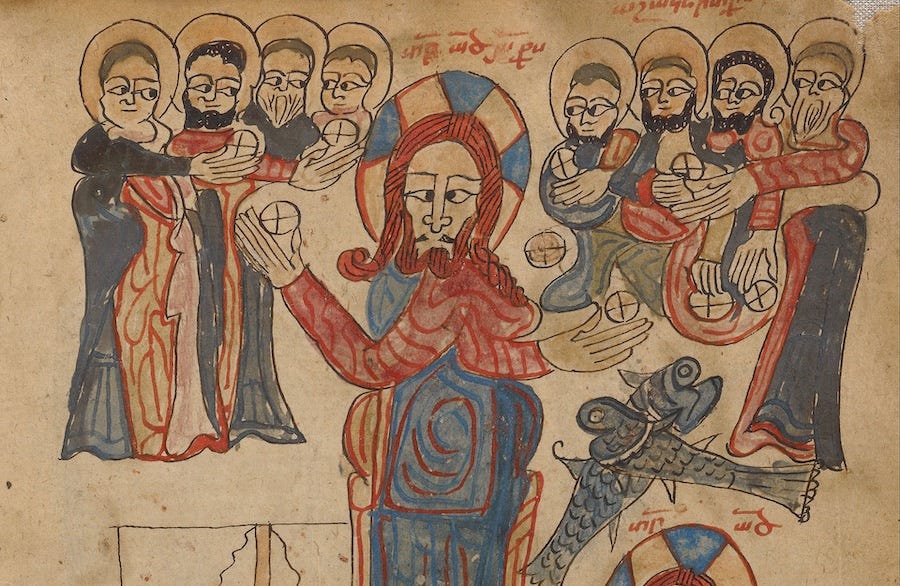
One such miracle story is that of the loaves and the fishes. It is one of the most interpreted miracle stories. There are six different versions in the four gospels. We all know the events: Jesus is getting ready to preach to, depending on the version, four thousand or five thousand people. The apostles approach him and plead with him to send the people home because they are hungry. Again, depending on the version, a young boy has two baskets containing five loaves and two fishes. Jesus blesses them and tells his apostles to distribute them. All are fed, with much left over.
This is often considered the greatest miracle which shows how powerful and caring Jesus was. In his article “Hidden Meaning of the Loaves and Fishes,” Dr. Marcellino D’Ambrosio writes: “Elijah had multiplied flour and oil to save a widow and her son from starvation. Elisha did a bit better than his master, multiplying 20 barley loaves so as to feed 100, with some even left over. But in the Gospel, Jesus multiplies 5 barley loaves and feeds 5,000, leaving 12 baskets left over. We’re talking serious one-upmanship here. So, here’s one clear message: Jesus is a prophet greater than even Elijah and Elisha.”
Every day more than 18,000 children die from hunger and hunger-related diseases. I often wonder why God doesn’t just send manna from heaven or bless the loaves and fishes. We know from our sacred stories that God can when God chooses to. Based on our interpretation of our sacred stories, at this point in history, God must be choosing to allow those 18,000 children to painfully suffer and die a horrific death. This does not exactly describe a God who is all love. Maybe if we reimagined the story of the loaves and fishes, we might understand a different perspective.
All the versions of the story tell us that there were men, women, and children present when Jesus performed the miracle. As anyone who has or helped raise children knows, parents do not leave the house without packing a bag of snacks! I have four children. When they were younger, we didn’t go to church, the store, grandma’s house, or anywhere else without some additional food. So while the men may have rushed off to hear Jesus, we can imagine the women would most likely have prepared baskets so their children would not have gone hungry. In Luke 9:14, it says: “And he said to his disciples, ‘Make them sit down in groups of about fifty each.’” Perhaps the miracle was not Jesus’s blessing of the loaves and fishes, but rather getting folks to gather together in small communities and share their food with each other. When they gathered in small groups and shared their food, everyone was fed and there was plenty left over.
Think of the different messages these two versions present. The message of the first version is how this act shows how great and powerful Jesus is. It is a message of God doing for us. If Jesus can feed five thousand, we hear, imagine what he can do for me if I just bow down and worship him. The message in the reimagined version is that Jesus is teaching us how to care for each other. The fact that 18,000 children die each day from hunger is not due to a lack of food; there is more than enough food in the world, so no one should go hungry. Rather, it is due to the fact that we are waiting for God to send manna or Jesus to bless the loaves and fishes instead of sharing what we have in abundance.
“To be religious will be to live in the art of letting go and engaging new structures of relationships of life,” Sr. Delio has written. It is those relationships centered on love, and as we pray through God, with God and in God, that will lead us into the future as the “single sacred community” that Berry references. But to do so, we first have to reimagine our sacred stories. ♦
Patrick Carolan is a co-facilitator of the Tomorrow’s American Catholic podcast.