


The teaching tradition of the church as well as theological scholarship must account for the sensus fidelium, or sense of faith arising from the people of God, said author, theologian, and social psychologist Diarmuid O’Murchu on Thursday.
His remarks came as part of “Reworking the Tradition,” an online presentation organized and facilitated by the UK-based church reform organization Root and Branch. Nearly 300 people joined the event from all parts of the world, including the UK, US, South Africa, and Australia.
Quoting Scripture scholar Walter Brueggemann on the subject of church interpretation, O’Murchu said, “We are in a new interpretative situation that requires and permits the interpreters to work at a different task.”
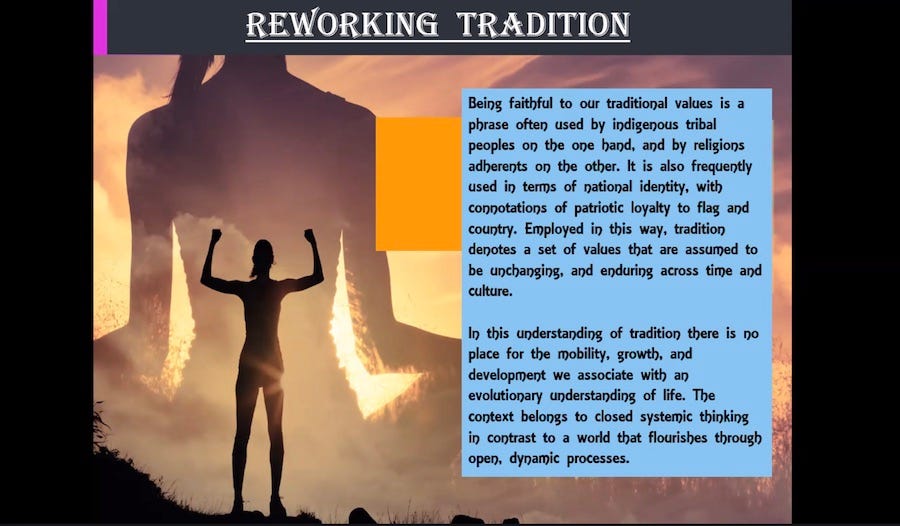
He characterized tradition as “one of the most misunderstood concepts in religion.” One view holds that it “denotes a set of values that are assumed to be unchanging,” yet “there is no place for the mobility, growth, and development we associate with an evolutionary understanding of life” in such a view, he explained.
“We need to engage tradition as a process of evolution,” he said.
He spoke of “seeking the new centering space” and finding a new synthesis within church tradition that moves beyond “dualistic splitting,” “inherited imperialism,” and “from the personal to the transpersonal.”
Part of this new synthesis involves humans “reclaiming our identity as creatures of the earth” and realizing “a deeper connection with the web of life,” he said.
He offered the metaphorical example of “hospice workers and midwives” to classify contributions to evolving tradition.
“Midwives” are groups or individuals “who want to give birth to something.” Yet “we sometimes have to face the reality that before we can give birth to the new, we have to deal with the dying of the old,” he said.
Within this reality, the metaphor of the hospice worker becomes “equally important,” he said, reminding listeners that “one of the great paradoxes of our faith” is that “without Calvary there would have been no resurrection.”
O’Murchu referenced the book After Jesus Before Christianity: A Historical Exploration of the First Two Centuries of Jesus Movements by way of explaining how the “institutional church” developed alongside networks of small groups. These groups gathered to do a kind of “midrash” on the life of Jesus and the Scriptures and share in a eucharistic meal.
Around 300 AD the “imperial church” began to assert itself, O’Murchu explained. He observed that the Feast of Christ the King, instituted in 1925, was the last “formal move” to try to protect the imperial church.
He also noted that the early church councils “wrestled with the incarnation of divine imperialism in the person of the historical Jesus.” While seeking honor both the divinity and humanity in their conception of Christ, “it was the divine imperial status that triumphed” and was “subsequently invested in kings, popes, bishops, and male clerics.”
As a counter to this historical trend, O’Murchu set forth a six-point framework of concepts that have been “substantially suppressed” for the church to reclaim: 1) a relational, nonimperial Jesus who is 2) contextualized in the New Reign of God and 3) grounded in the Hebrew covenant of God’s creation, thus 4) empowering human persons in a new transpersonal identity through 5) collaborative faith communities that are 6) energized and sustained by the creative Spirit of God.
O’Murchu suggested that the church needs to get “behind the Greek” to the original Aramaic term for “kingdom of God,” which he said would translate to something closer to “companionship of empowerment.”
He noted that the primary Hebrew covenant in the book of Genesis is with creation itself, and that imperial figures are “in service of that primary covenant,” which is “not just about human beings.”
He looked, too, at theologian Catherine Keller’s book Face of the Deep: A Theology of Becoming, an exegesis of the first two verses of Genesis that concludes that “creation begins with the energy of the Spirit.”
“A Creator Spirit dwells at the heart of the natural world, graciously energizing its evolution from within,” he said, quoting from Elizabeth Johnson’s book Quest for the Living God. “The universe, in turn, is self-organizing and self-transcending, energized from the spiraling galaxies of the double helix of the DNA molecule, by the dance of divine vivifying power.”
“That’s our vision, folks,” he said, inviting attendees to sit with Johnson’s words for a few moments in silence.
A Q&A and discussion period followed the presentation, facilitated by Root and Branch member Mary Ring.
To a question about whether to reform the church from within or outside of the institutional structure, O’Murchu said, “Our horizon is bigger from the position of the periphery.”
“We need to be exploring some new ways of outreach” while maintaining links to the traditional church to “recreate a sense of empowering community,” he continued.
“If we can do it from within, great; if not, we need to look wider,” he added.
To another question about how to respond to “the rampant evil in the world,” he said that “the old imperial system is collapsing,” making people “full of fear” and “looking for a new imperial guard.”
He referenced a teaching of French philosopher Gaston Saint Pierre as a way to counter evil individually: “When I change the level of my awareness, I start attracting a different reality.”
On a collective level, he pointed to the example of base ecclesial communities in Brazil. Though they never reached more than 10 percent of the Brazilian population, “there was something so profound and so authentic in that 10 percent that it sent waves of inspiration across the Christian world,” he said.
The apostle Paul based his own conception of the Christian community on the Greek “ekklesia,” or “town council” of its time. This exemplifies the early church as a series of communal movements inspired by the reign of God, he said.
Empowerment is a “relational” process, he added. In addition to the directives of our individual conscience, “we all need the support of a communal context.” ♦
Michael Centore is the editor of Tomorrow’s American Catholic.
Grateful for this thoughtful reporting out of an intelligent conversation in and about our tradition. More please.