


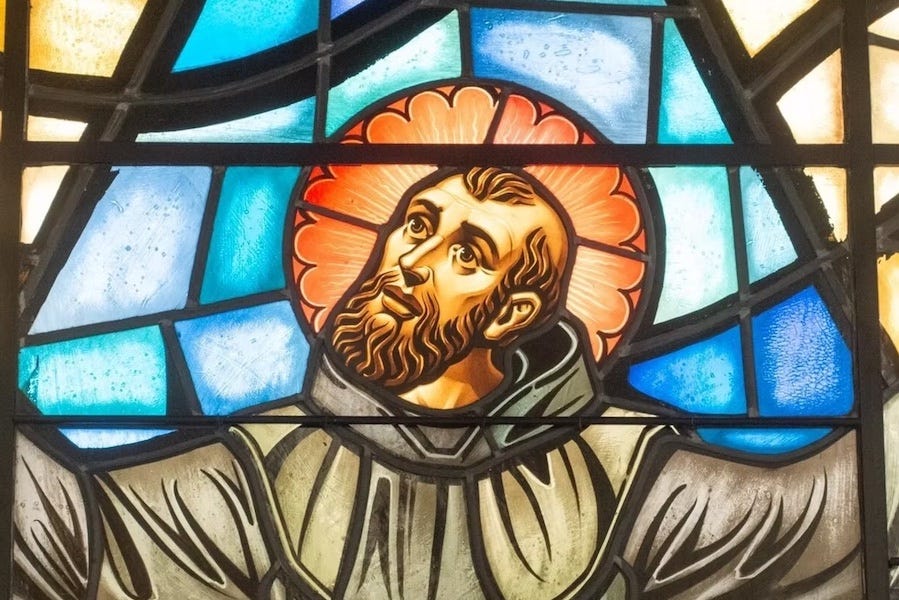
An AI search for “St. Francis of Assisi” along with the word October offers up a single sentence about the man himself: “St. Francis of Assisi is the Catholic Church’s patron saint of animals, ecology, and merchants, as well as a co-patron of Italy.” Alongside this, there are a few notes about the reasons behind his feast day on October 4, as well as information on a custom that many Franciscans still shake their head about: the blessing of the animals that is so often associated with him. (As well it should be, since he is the patron saint of animals.)
However, the mission of Franciscan Month, celebrated throughout October, is to educate people that Francis of Assisi is much more than a statue in a birdbath. Rooted in the teachings and example of St. Francis and St. Clare, Franciscan Month is an initiative that encourages people to pause from the noise of everyday life and discover the simplicity, gratitude, and joy at the heart of the Franciscan way. In the tradition of Tomorrow’s American Catholic, I will offer the story of my own spiritual journey as a way of explaining what the Franciscan charism has meant to me in light of this special month.
For much of the first two thirds of my life, I had not realized how closely I had been following in the footsteps of St. Francis and St. Clare. I was raised Catholic, the second of three girls in a tight-knit family that moved all over the country my father’s job with IBM. When my dad proposed to her, my mother was in discernment, considering joining the Franciscan Sisters of Perpetual Adoration in Colorado Springs. When we were little, my two sisters and I always knew (and made jokes about the fact) that mom was “learning to be a nun,” but we thought nothing further of being brought up in her Catholic-yet-Franciscan way.
This was a special upbringing with a significance I didn’t grasp until I was in my mid-forties, when I began working with the Franciscan Action Network (FAN) as communications director. When I started with FAN, I researched deeply into who St. Francis was. What did he preach? What did Franciscans believe? What convictions did they follow? Every time I learned something, I remember thinking to myself, “Well, yes, this is what I was taught.” One day, about two weeks into my new job, my mother came over to my house and asked what I was working on. When I told her about FAN and the newsletter I was building, she reminded me of her discernment and told me the name of her community. On that day I recognized that my faith, while Catholic, was also heavily Franciscan.
So, what does it mean to be “Franciscan”? I borrow one response from my friend and former boss at FAN, Michele Dunne, OFS: “A Franciscan path is one of continual conversion, interconnected to others and all of Creation turning toward God, justice, and mercy.”
For me, being interconnected to others and all of creation is the easy part. Due to my uniquely Franciscan Catholic faith, I developed deep friendships with people across a broad spectrum through a process of fraternitas during my 12 years with FAN. I became very adept at connecting with others. Intentionally asking people their story then telling mine was a good way of getting to know someone deeply. This knowledge helped me to care about them and, by extension, many other people I didn’t know. It guided my way of thinking about their lives and allowed my heart to open with compassionate empathy.
While canonized shortly after his death, the full story of Francis includes times when he did not act saintly. He was human, as we all are. He made mistakes, sometimes treating others poorly, as we all do. The difference in Francis was that he always sought to reconcile those relationships. Again, this is something I was brought up to do. Whenever my sisters and I had a fight (and there were some doosies), after giving us some time to cool off and hearing both sides tell their story, mom would gather us in a room together. We had to calmly tell the other person how we felt, why we were angry, and what wrong we believed needed to be righted. Then we had to apologize, hug each other, and tell the other person that we loved them. This was the hardest part! When my sister, with her older-sibling “what’s-mine-is-mine-and-what’s-yours-is-mine” attitude, took my things without my permission, ruined them, and was only marginally remorseful, I had to hug her—while still upset! It was very difficult for me as a nine-year-old, but I cherish these lessons now when I see too many sibling relationships crumble for lack of communication and reconciliation. Life is too short to hold a grudge.
My continual conversion has been more difficult. I have one of those personalities that yearns for completion. I’m someone who will write a list of things I’ve already done just to see them crossed off. Being in a state of flux makes me edgy and unsettled. I firmly believe God brought me to Francis in order to work on this aspect of my character. Learning the pillars of St. Francis was a gift that continues to impact my life beyond my time directly associated with FAN. I am better at balancing everyday life with my faith and my desire to act for social justice, and I feel confident in the lessons I have taught my own children about the importance of relationships.
While listening to a recent Tomorrow’s American Catholic podcast, where my good friend Patrick Carolan spoke with guest Daniel Horan, I was struck when Dan said, “Those of us in the Franciscan world know what we mean.” It was a simple phrase at the very beginning of the conversation, but to me it pointed to the mission of Franciscan Month: to welcome those “outside” the Franciscan world to learn about the teachings of Francis and Clare, to celebrate the Franciscan way of life, and to offer insightful perspectives on living as Franciscans in today’s world.
Franciscan Month is for everyone, regardless of faith background. It is catholicity in practice. Jesus came and taught everyone, irrespective of their personal history or faith life. He broke boundaries and did not exclude anyone. The first rule of all branches of Franciscans is the same. It reads, “The way in life of the Franciscans is this: to live the holy Gospel of our Lord Jesus Christ.” Francis chose to live his life prioritizing relationships, just as Jesus did. Nothing was going to hold either him or Clare back from relationships to others.
There are many stories of Francis’s equitable treatment of everyone he meets. He sees the inherent brotherhood and sisterhood of all through Jesus Christ. This powerful Franciscan charism—to “see each other as the siblings that we are in God, and to recognize that that sibling connection extends beyond the human family to the more-than-human world”—is so vital to us today.
This October, I invite you to consider joining in “Five Weeks of Living the Gospel” with the good people at Franciscan Month. We’ll be given the opportunity to meet St. Francis and St. Clare and learn how to open our hearts to God’s love. We will explore what it means to live in right relationship with the earth and with each other, and discover how compassion in the Franciscan tradition is not sentimental—it is demanding, courageous, and transformative. Finally, we will close the month where Francis would have us: learning how to live in simplicity, in service, and in joy. ♦
Janine Walsh is the former communications director of the Franciscan Action Network.