


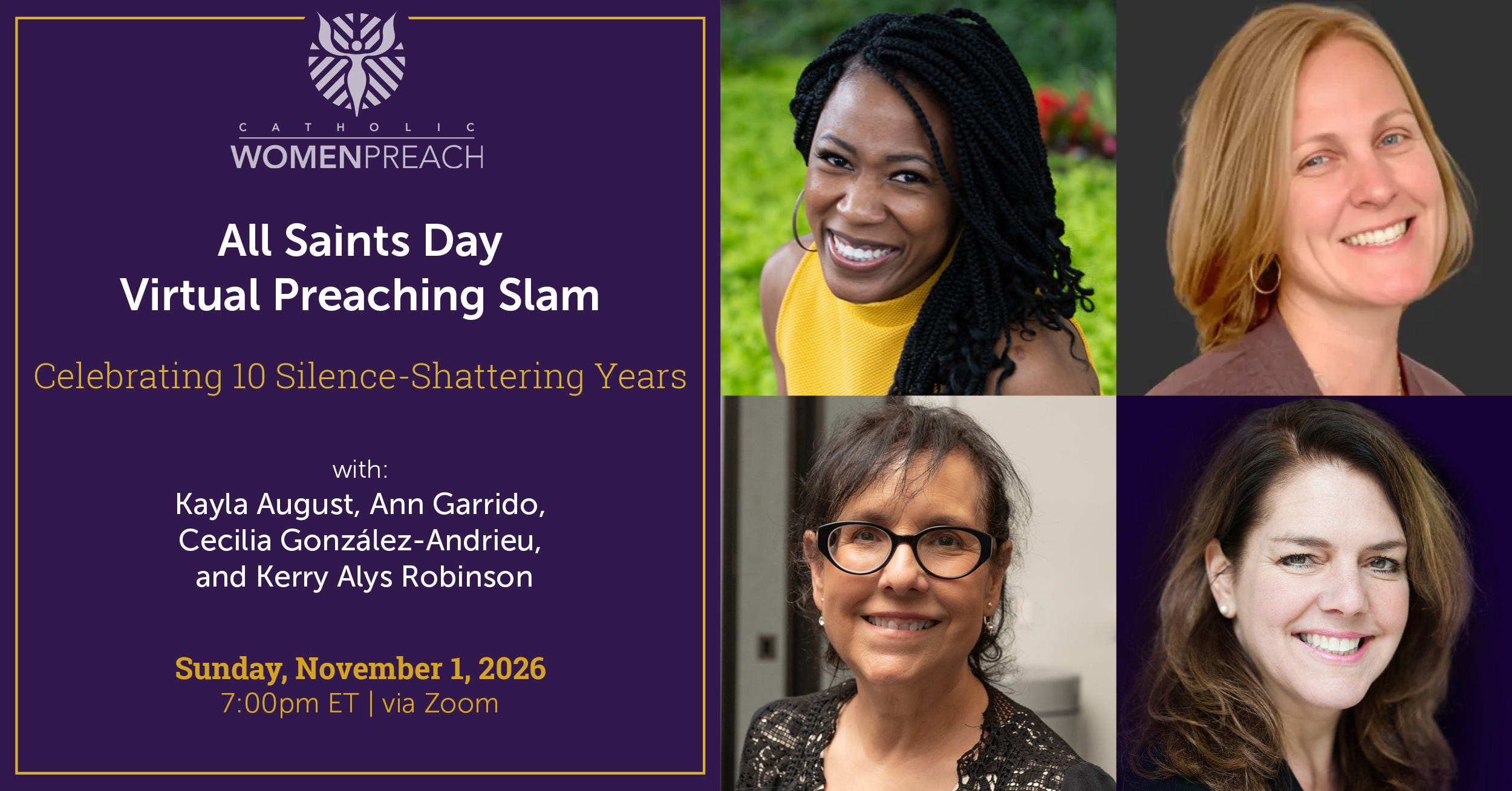
Since launching on All Saints Day in 2016, the Catholic Women Preach (CWP) project has provided a space for 483 women to offer 620 lectionary-based reflections. On Sunday evening, the advocacy organization and CWP project sponsor FutureChurch hosted a “virtual preaching slam” to celebrate what they described as “ten years of preaching that widens the table.”
Over 200 participants joined the Zoom-based event, which featured a full Liturgy of the Word with music, prayer, and readings for the day, as well as four individual preachers who previously contributed to CWP.
Ariell Simon, liturgical coordinator for FutureChurch, welcomed attendees with an expression of solidarity with Indigenous communities and a reminder of the “shared responsibility to care for our earth as our sacred home.” She invited those present to join in an opening hymn centered on women as “witnesses of wisdom, weavers of the Word.”
FutureChurch’s director of community engagement, Martha Ligas, offered a prayer for the Solemnity of All Saints. “We gather to remember our saints, those known globally across the church and those who are known just to us,” she petitioned, adding gratitude for “ten silence-shattering years of Catholic Women Preach” and “the saints who have companioned with us.”
Rita. L Houlihan served as reader for the Liturgy of the Word. Interspersed with her recitations from the book of Revelation (7:2-4, 9-14), the First Letter of John (3:1-3), and the Gospel of Matthew (5:1-12) were projections for the responsorial psalm (24:1-6) and the Alleluia.
Following brief introductory remarks from FutureChurch executive director, Russ Petrus, preacher Kayla August offered the opening reflection. August served as the itinerant preacher for FutureChurch’s racial justice pilgrimage in 2024 and is currently a doctoral candidate in theology and education at Boston College.
Her reflection drew on a line from Pope Francis’s apostolic exhortation Gaudete et Exsultate as frame for perceiving sainthood: “Each saint is a mission, planned by the Father to reflect and embody, at a specific moment in history, a certain aspect of the Gospel” (19).
Rather than focus on idealized images of saints in which their “humanness somehow gets washed away,” August invited listeners to remember that the saints were fellow strugglers who entered heaven “because they knew their mission.”
“To be holy and perfect are different things,” she clarified. She cited Peter’s denial of Christ, Augustine’s “sordid past,” and Mother Teresa of Calcutta’s “struggle with prayer” as examples of how the imperfections of our humanity do not diminish our capacity to “do good things for God.”
August raised up Servant of God Sr. Thea Bowman, known for her “vibrant spirit” and for preaching “with her life and with her words.” Bowman knew she wasn’t perfect yet “did not lack holiness,” August said, pointing to the inscription she requested for her tombstone: I tried.
“She knew her mission and she used every single moment of it,” August continued. She challenged listeners to take up Bowman’s example and ask themselves what aspect of the gospel they might embody at this moment in history, concluding, “Our moment is now, and your mission is calling.”
Betty Anne Donnelly, who co-edited the CWP series for Orbis Books with Petrus, connected August’s challenge to the final lines of Mary Oliver’s poem “The Summer Day”: “Tell me, what is it you plan to do / with your one wild and precious life?” She introduced preacher Ann Garrido, an author and associate professor at the Aquinas Institute of Theology.
Garrido observed that the richness of what the saints communicate symbolically is often more moving than their factual biographies. She shared an Orthodox icon of Thekla, a saint from Iconium in present-day Turkey who is believed to have been a follower of the apostle Paul. Today she is known as the “Holy Protomartyr and Equal to the Apostles.”
Garrido reviewed key points in Thekla’s hagiography, including the moment when she was ordered to be burned at the stake for refusing to marry, preferring instead to preach the gospel accompanying Paul. When it came time to inflict the punishment, a deluge of rain put out the fire and she escaped unharmed.
After following Paul to Antioch, Thekla was pursued by another suitor and refused his advances. Locals tethered her to two oxen and began to chase her, but the cords snapped and she escaped once again.
“She was as one unbound,” Garrido said, quoting from the second-century text The Acts of Paul and Thekla. That line “describes aptly” the rest of Thekla’s life, she said.
“Thekla is a woman for all of us in this particular moment,” she continued, “full of the qualities that are necessary for living a truly Christian life.” She singled out three of these qualities: gumption, interior freedom, and continued goodwill and charity toward others.
Following a brief interlude where participants entered breakout rooms for small-group sharing, Dr. Cecilia González-Andrieu offered the evening’s third reflection.
González-Andrieu is a professor of theology and human rights at Loyola Marymount University and past president of the Academy of Catholic Hispanic Theologians of the United States. Her reflection focused on “the stark reality of the world” as presented in the evening’s gospel, where Jesus acknowledges that the unmasking of injustice “brings persecution and insult.”
Observing that the journey to God’s splendor begins in the flesh, she named her model saint as her abuela, or grandmother, who kept an image of the Sacred Heart of Jesus alongside a saying from Saint Teresa of Jesus: “Con Cristo todo, sin Cristo nada” (“With Christ everything, without Christ nothing”).
González-Andrieu recalled how her abuela interpreted the saint’s saying to mean that “we must always act as Jesus’s hands, feet, and voice in the world” in order to “make present the abundance that Jesus incarnated.”
When González-Andrieu’s abuela was forced to flee her home as a refugee, she lost all of her possessions. Even as she endured “the dehumanizing indignities of those seeking refuge in a strange land,” her life continued to radiate a deep serenity rooted in her rich prayer life and constant generosity.
“She was now our image of the Sacred Heart,” González-Andrieu said, describing her as a “soft and constant center of light” who “taught me to long to see God’s face and do everything to build that reign of God that Jesus describes in the Beatitudes.”
The evening’s final preacher was Kerry Alys Robinson, president and CEO of Catholic Charities USA.
Robinson invoked the life and witness of Saint Catherine of Siena, a Third Order Dominican who corresponded with popes, was “poorly educated but fiercely intelligent,” and evinced a political astuteness capable of negotiating for unity in the church.
Robinson described how Catherine left her contemplative cell in 1370 after a series of visions that prompted her to enter public life. “Men and women were drawn to her for spiritual instruction,” she said, even as she “made a cell in her heart for the Lord.”
In 1380, when she was 33 years old, Catherine experienced a vision of a ship on her back, symbolic of the weight of a church that was crushing her. She persisted in her work, and was eventually canonized in 1461 and made a Doctor of the Church in 1970—one of only four women to be so designated.
What woman “cannot relate” to the “burden of expectations both low and high” that Catherine endured, Robinson asked. She held up the saint’s example as a reminder “that anyone can be called,” regardless of gender, culture, or stature.
In her life of service, “this blazing comet of a woman” demonstrated that “through Christ crucified, you can do everything,” Robinson said. She called on attendees to carry “the great weight of the church” as Catherine did, not collapsing beneath its weight but lifting it high to let others know they are welcome to full participation. ♦
Michael Centore is the editor of Tomorrow’s American Catholic.