


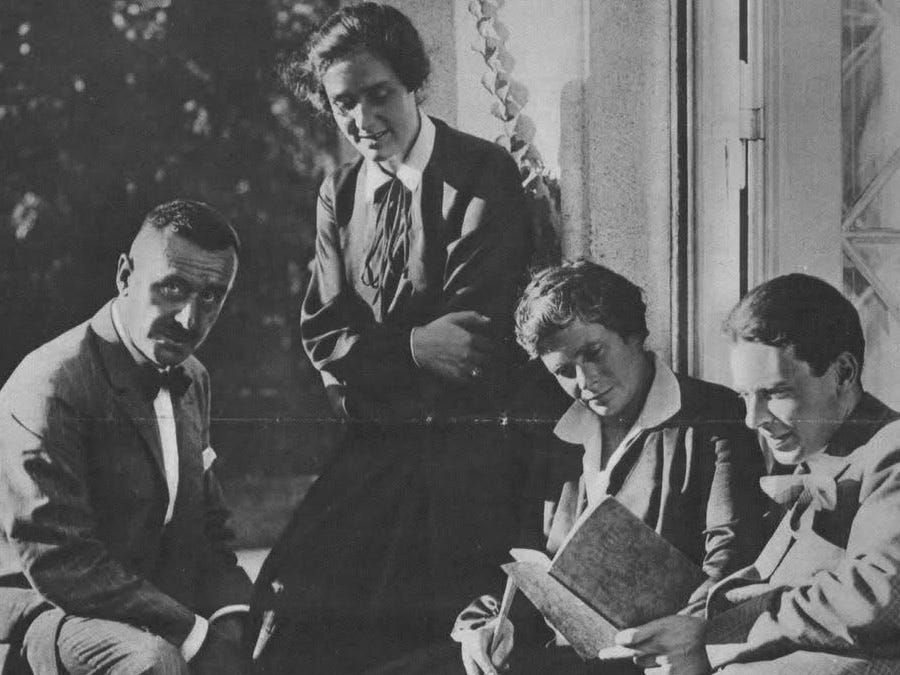
I first read Thomas Mann’s Faustus (1947) because I am an American who hates fascism and who still—perhaps wrongly and foolishly, as I’ve been told often—places some remaining credence in my country’s founding ideals. I went searching for someone who could understand living a life shaped by an awesome grief for something that had never quite existed; the loss not of a reality, but of a shared aspiration—a grief less for one’s country and more for the souls of one’s countrymen: How could they choose this? Doesn’t it matter who we pretend to be?
Mann understood this better than anyone. Born during the Second Reich into a sort of hereditary urban oligarchy known as Hanseaten, he fought in the First World War and was a committed conservative monarchist. Over the course of his life, however, he would witness the rise of Nazism, go into exile, and become the chief luminary of 20th-century German exilic literature. His youthful disdain for socialism would be uprooted by his mature horror at fascism. In Doctor Faustus—an extended allegory about Germany’s demonic pact with Nazism—the narrator, Serenus Zeitblom, closes the novel this way:
In those days Germany, a hectic flush on its cheeks, was reeling at the height of its savage triumphs, about to win the world on the strength of the one pact that it intended to keep and had signed with its blood. Today, in the embrace of demons, a hand over one eye, the other staring into the horror, it plummets from despair to despair. When will it reach the bottom of the abyss? When, out of this final hopelessness, will a miracle that goes beyond faith bear the light of hope? A lonely man folds his hands and says, “May God have mercy on your poor soul, my friend, my fatherland.”
That brings us to the 2026 film Fatherland, directed by Polish auteur Pawel Pawlikowski. A black-and-white, multinational production and masterpiece, Fatherland follows Mann and his daughter Erika as they travel across postwar West and East Germany to accept two competing literary lifetime achievement prizes, each named after Johann Wolfgang von Goethe. Set in 1949, Erika and Mann are both US-based exiles, with Erika facing mounting scrutiny for her suspected communist sympathies in an increasingly paranoid, Cold War America (she has been denied citizenship more than once). As the bipolar powers compete for global ideological dominance, Mann walks a delicate diplomatic tightrope, finding himself obligated to justify why, as an American citizen, he would even deign to accept the East German Goethe prize. His motivation is that of the lonely man who “folds his hands and says, ‘May God have mercy on your poor soul, my friend, my fatherland.’”
But Mann is not just a son of Germany, he is himself a father, and his relationship with the dutiful Erika, and his estranged relationship with his writer-addict son, Klaus, are the substance of the film’s dramatic conflict. Erika invites Klaus on the trip, but he will not come as he is convinced—and not without cause—that his father does not want him present. Halfway through the trip, while father and daughter are in West Germany, Klaus dies of an overdose in Cannes, and Mann refuses to abandon the itinerary, opting to continue on to East Germany with Erika in tow.
Despite its cleverly multivalent title, the film is not about paternity or patriotism, but rather about art and life. The film’s juxtaposition between silence and formal speech—criticized by at least one thoughtful critic—reveals the futility of even the most beautiful language when addressed to the morally dull. Mann’s audiences want themselves and their enterprises to be christened; they could not be less interested in being converted. Although the historical Mann was arguably more aware of the trip’s dynamics, Pawlikowski’s dramatized Mann is incapable of accepting them—of accepting the inability of his language to move worlds.
Yet cynicism does not prevail. While Mann’s estimation of his own impotent voice reeks of egotism, it is in Erika’s that we find a foil. Erika at one point tells her father directly that his speeches will not fix anything; that fine words will not redeem Germany’s soul, soften the edges of the Cold War, nor synthesize the better aspects of the two competing global systems. But Erika talks. Indeed, she cries out forcefully precisely at those moments where she is most confounded and hurt by the same moral, cultural, and political evils that offend her father, and she takes them just as personally as he does. At one point while still in West Germany, after Klaus’s death and contending with her father’s callousness, she hears passersby singing Nazi songs in the street. She opens the window and screams at them to stop, her German peppered with invectives, and proceeds to sob. It’s the first time we see her cry.
The difference between father and daughter: while they both shout into the void, only Erika realizes that there is a void, and only she has the courage to do something useless for the sake of remaining human. I am reminded of Antigone’s proud declaration, according to one translation, that she will gladly remain a “God-fearing criminal.” Mann, however, is not impermeable. The film’s ending is perfect. On their way out of East Germany, the two drive while trying to listen to the radio. They are close enough to the border with West Germany to pick up two competing sonic worldviews: on one wave are snappy, barbershop confections interrupted by constant advertising, and on the other are the same repugnant odes to fatherland with which they’ve just been bludgeoned for several days. Without words, Erika turns the radio off. As they drive on, they pass a church with which they seem to be familiar and associate prewar memories. The pair walk into the bombed-out, cavernous building and realize that two men are preparing to play its magnificent pipe organ. Erika and Mann sit, and as one of the men begins to play J. S. Bach’s “Jesus, Joy of Man’s Desiring,” the pater finally weeps.
Does he weep for his fatherland or his fatherhood? I think both. Earlier in the film, Erika tells Mann that towards the end of Klaus’s life, “Bach was the only one he could still listen to.” The only one of what: composers or great Germans? Bach, Erika says, almost made Klaus believe in God. Tonally, the ending rings of an elegy to the lost aristocracy of humanism; of sacred bonds of culture, language, art, and humanity—bonds both desecrated and seemingly replaced by the new, horrific, deadening, and lethal ones of nation, ideology, and sectarianism. On that subject, Mann once wrote: “What all has not happened before our eyes—or just not quite before our eyes—in the name of the folk, though it could never have happened in the name of God or humanity or the law!” I doubt very much whether that is true. But when listening to Bach, one can almost believe it. ♦
Jeromiah Taylor is a writer from Wichita, Kansas. He is the associate opinion editor of the National Catholic Reporter. Jeromiah writes at the intersection of culture, religion and justice. His work appears in a variety of outlets.