


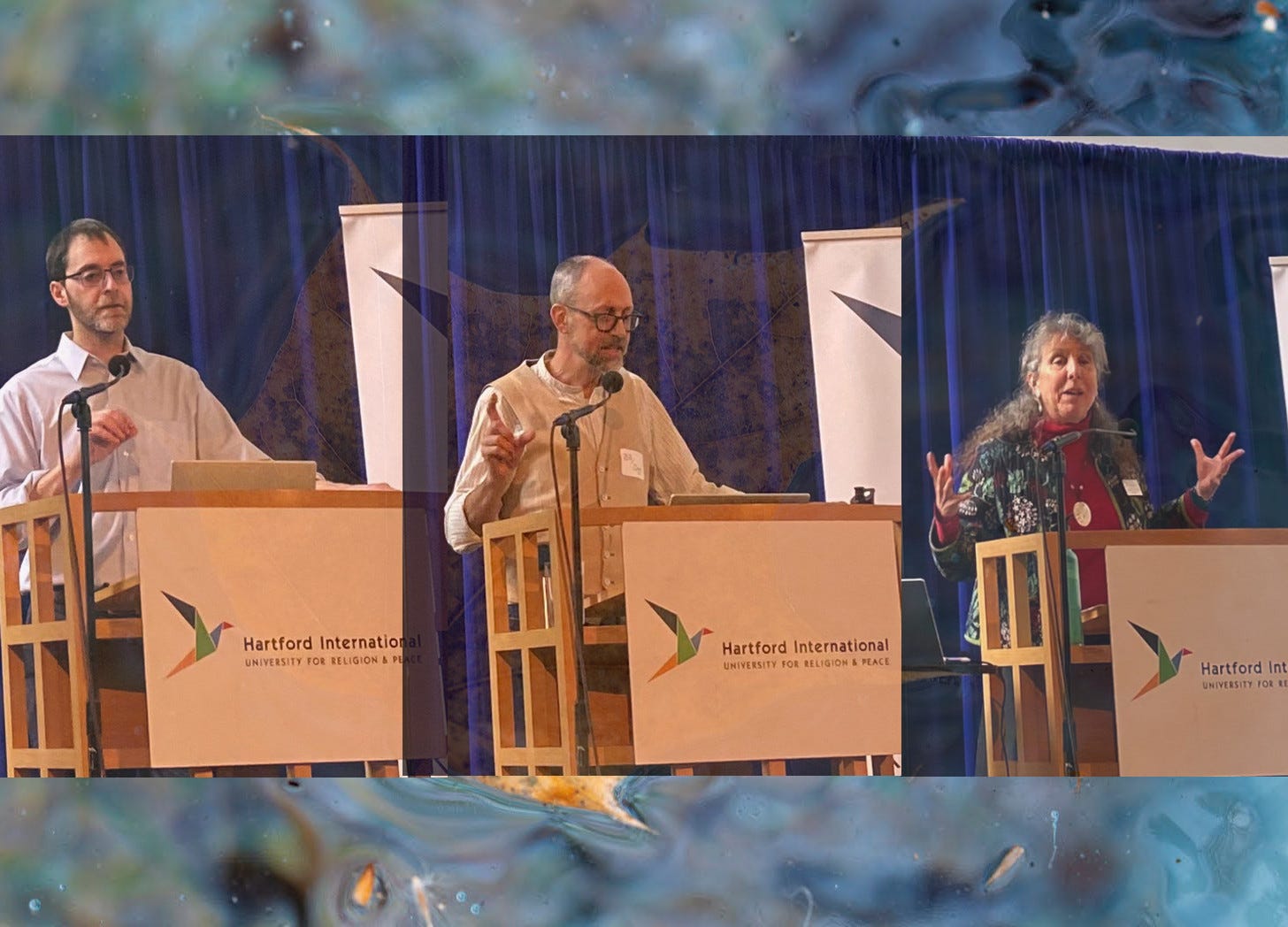
Expanding our perception of the world’s sacredness is essential in meeting the current moment of climate crisis, said Lisa Dahill at the “Spiritualities of Resilience: Aligning with Earth” symposium sponsored by the Center for Transformative Spirituality at Hartford International University for Religion and Peace (HIU) on May 30.
Dahill is the Miriam Therese Winter Professor of Transformative Leadership and Spirituality at HIU and director of the Center for Transformative Spirituality. Her presentation, “Loving the Wild: Earth-Centering Spirituality,” was one of three keynote addresses featured throughout the day.
The symposium opened with a welcome from HIU president Sherry Turner, who emphasized that humans’ relationship to creation implies “a profound connection but also a profound responsibility.” Humans are “not to dominate nature, but to be in relationship with it,” she said.
Dahill followed Turner’s remarks by framing the intentions of the symposium. “Human insanity is threatening the health and future of life on the planet,” she said, stressing the need for “a deeper sanity” and “a resilience and spirituality in this liminal time.” She offered a centering prayer whose language opened from the particular “inter-elemental space” to the universal “great reciprocity” of life.
Living in Earth’s Capacity
Erik Assadourian, founder and director of the eco-spirituality organization the Gaian Way, gave the opening keynote, “What Are We to Do? Deny, Delay, or Embrace the Collapse.”
Assadourian began with quote from Miyamoto Musashi’s The Book of the Five Rings: “For each thing there exists an instant in which it collapses. A house, a person, an adversary collapses over the course of time following discordances in cadence.” He then asked, “Can there be an instant where that civilizational house collapses?”
Assadourian spoke of complexity of the “polycrisis,” or numerous intersecting crises, that trigger a societal breakdown. He noted that it is hard to go back to a previous state after a civilizational shift.
Defining collapse as when “the ecological systems which human civilization depends on to survive and thrive are changing to a degree that they cannot sustain the current (or even a large) human population,” he stated that “a collapse period is not an instant but a long, long process.”
“Collapse is a real issue,” he said. “We’re absolutely in the process of collapse.”
“This collapse was not inevitable,” he continued. He pointed to the explosion in world population from 3.7 billion in 1970 to over 8 billion today and cited Paul Ehrlich and John Holdren’s equation to measure the impact of humans on the environment through population, affluence, and technology.
The root cause of ecological devastation and collapse is growth beyond the earth’s limits alongside patterns of overconsumption and consumerism that are “being replicated around the world like a plague,” he said.
“We’ve long transcended the world’s ecological footprint,” he added. The result is that the earth “can no longer handle” our overuse.
Assadourian introduced three possible responses to collapse: denial, delay, or embrace.
Denial “can be insidious,” he said, amounting to “a war on reality” where governments and corporations renege on ecological promises in favor of increasing profits.
Delay involves making some ecological changes but leaving the underlying systematic and structural problems of overconsumption in place. An example is “shifting to renewable energy” to maintain a hyper-consumeristic society, an adaptation he termed “a nonstarter.”
The alternative, Assadourian affirmed, is “getting back to living in earth’s capacity.” This means “we have to reduce pretty much everything that is standard” within our consumer culture and “really focus on economic degrowth.”
He compared and contrasted the consumption patterns of wealthy nations, where societies use the resources of three planets, with the “fair earth standard” of “one-planet living.” The current average daily intake of 3,383 calories per person in wealthy nations would have to be reduced to 2,424 calories to be proportional to one-planet living, for example.
Assadourian characterized the third response, embracing collapse, as “an opportunity to begin shifting how we live now” by developing mutual aid networks, altering our habits of food production and consumption, and making other lifestyle changes.
“It’s not that far away in our shared collective history [to have] a simpler way of living,” he said.
He stated that humans are not giving enough attention to what comes after the post-polycrisis period and asked how “we [can] prioritize initiatives that reduce suffering now” and in the post-polycrisis period.
Assadourian projected a slide showing a quadrant of responses to the post-polycrisis period arranged by order of effectiveness in 1) making the polycrisis less bad and 2) setting up a better post-polycrisis period. The most effective responses on both counts included economic degrowth, regenerative agriculture, and reducing nuclear arsenals.
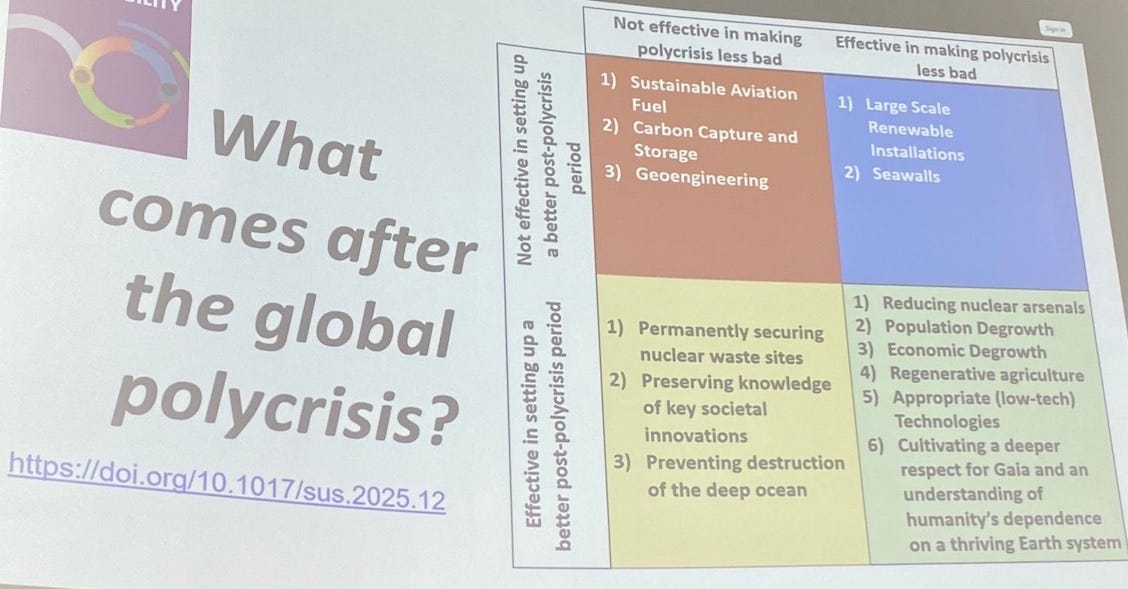
Additionally, “cultivating a deeper respect for Gaia and an understanding of humanity’s dependence on a thriving Earth system” is an effective and necessary response to collapse, he said. He shared how practices of fasting and daily meditation in nature have helped him “reflect mindfully and with gratitude” on the food he consumes.
Overall, he said, the project of “extracting the human out of the center of the passage of time” and “planting foundational seeds for an earth-centric culture” will help humanity navigate the polycrisis and bring about a better reality in the post-polycrisis period.
Between Nature and Culture
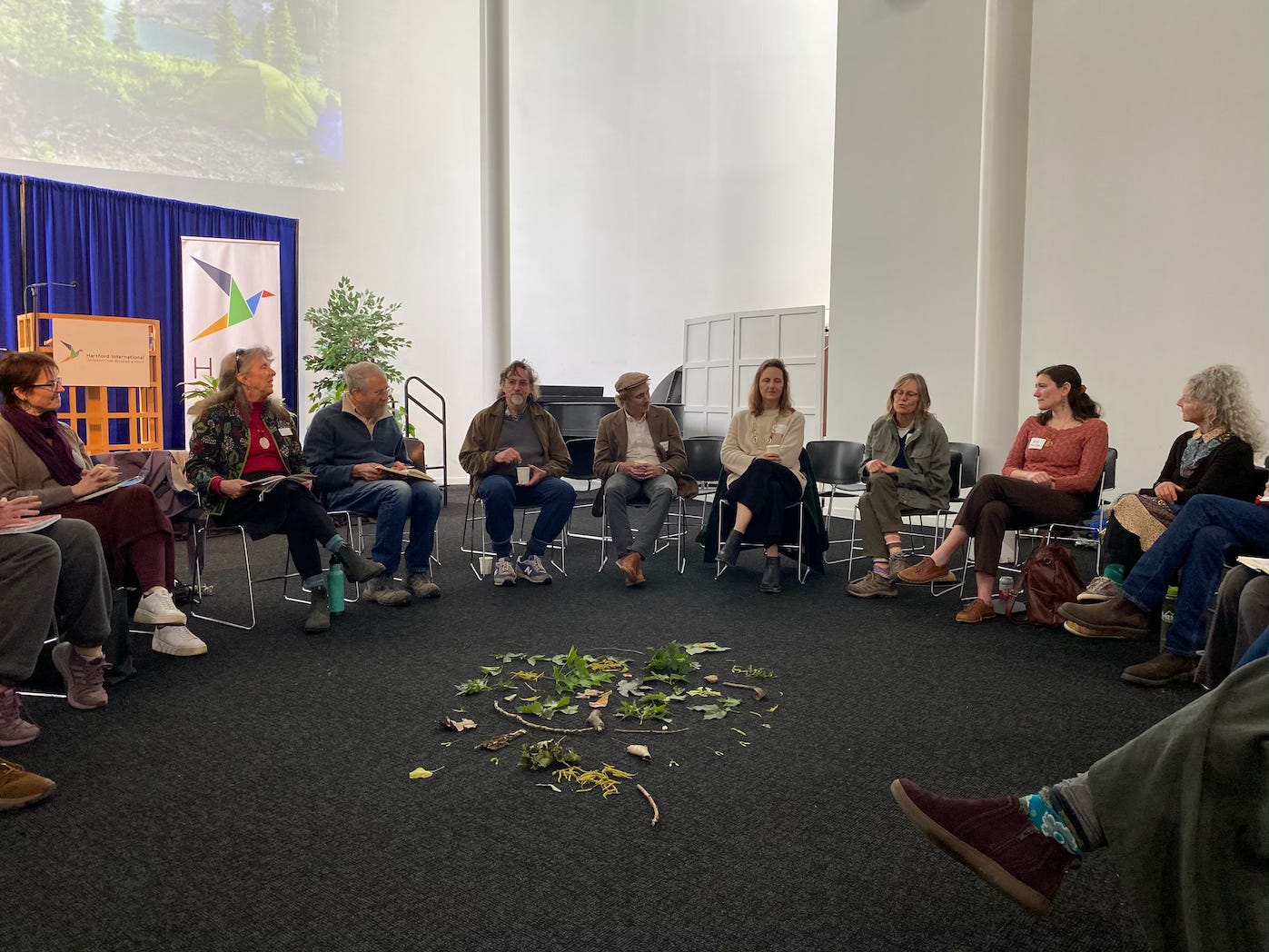
Following a break for small-group sharing and reflection, Bill Baue of the global nonprofit platform r3.0 presented the second keynote, “Bioregional Relationality and Regeneration as Collapse Resilience.”
Baue looked at the phenomenon of collapse as a “dynamic over a broader swath of history” and shared the scholar Luke Kemp’s notion of the “morality of states.” The average lifespan of a state is 326 years, according to Kemp. Baue said that this shows that “the social systems we live within” and that produce collapse “are not necessarily new.”
Baue explained how civilizations concentrate power through “top-down obedience enforced through threat of violence,” thereby extending human control over nature. He defined civilizations as “a collection of hierarchies” and said that “hierarchical power is what dooms civilization to collapse.”
The concept of “civilization” has been weaponized over time against cultures deemed “uncivilized” but that are nonetheless more sustainable, he said. He gave the example of cultures in Oceania that have persisted for over 60,000 years.
“All large-scale complex societies experience periodic waves of political instability,” he noted. He credited this to cycles of production, in that “levels of political violence are high when well-being is low and elite overproduction is high.”
Baue defined resilience as “the capacity of a system to absorb disturbance.” He explained how “collapse is actually part of natural systems,” but the collapse occurring now “is on a planetary scale” as the earth experiences “a cascading effect between systems.”
Baue laid out the various stages of what he termed the “collapse response continuum”: ignorance, awareness, denial, avoidance, acceptance, resilience, and transcendence.
The problem with the “avoidance” strategy of countering climate collapse is that corporate paradigms that privilege profit over all other concerns ultimately block the potential for sustainable changes, he explained.
Baue introduced a core theme of his keynote, the concept of “bioregionalism.” This “correlation between nature and culture” has been defined by Peter Berg of the Planet Drum Foundation as “a geographic terrain and a terrain of consciousness.”
As an example of “how cultural and biological diversity” are intertwined, Baue shared a scientific study showing how three distinct genetic groups of grizzly bears in British Columbia correlate closely to the geography of three Indigenous language groups in the region.
Baue articulated four “basic thresholds” for determining a bioregion: a land and water territory whose limits are defined by the natural realities of a place and the communities within them; a territory large enough to be self-reliant and maintain the integrity of its biological communities; a territory based on the location of a watershed or drainage basin; and a territory where inhabitants determine what stewardship frameworks make sense for the area.
Related to bioregionalism is the idea of “relationality,” or “the radical interdependence of everything that exists,” in anthropologist Arturo Escobar’s formulation. Baue drew a parallel between relationality and the African philosophy of Ubuntu, “I am because we are.”
As scientist Riane Eisler and others have pointed out, humanity has shifted over time from feminine “partnership” to masculine “dominance” systems. Partnership systems are more sustainable, Baue said, and clarified that the intention of bioregional relationality is not to replace patriarchy with matriarchy but to seek “a more balanced mindset between masculine and feminine ways of being.”
Baue drew on economist John Fullerton’s definition of regeneration as a “process that delivers sustainable living systems as the outcome of that process,” adding, “Regeneration is part of the systematic evolutionary process of how life creates conditions conducive to life.”
Citing regenerative educator Daniel Christian Wahl, Baue explained that we need to understand regeneration as “a coming home, as a listening, as a being more humble again, as a return to a kin-centric worldview.”
Baue concluded by summarizing bioregionalism as “an alternative modality to uncivilized behavior” that invites people into relationality, not dominance. He offered pathways to participate in the bioregional movement through organizations such as the Northeast Woodlands Bioregional Collective (NEWBC), the upcoming r3.0 conference, and the Turtle Island Bioregional Congress convening in Oregon in September.
To Live in the Living World
Dahill opened her afternoon keynote with a quote from Ian McEwan’s novel What Can We Know, which is set in the 22nd century. Relating that novel’s theme of living after ecological catastrophe, she asked, “How can we possibly speak of spirituality when our hearts are shutting down?”
Dahill shared an experience of seeing Interstate 70 in Pennsylvania “from below” while on a cycling trip. She described an environment “teeming with life” that is missed from the perspective of the highway overpass. She termed this feeling of disconnect or distance from contemporary human life “perpendicularity.”
Another example of such “perpendicularity” is the Los Angeles River, she said, which flows beneath the overpasses of that overbuilt environment. She invited participants to ponder what it might mean “to learn to live in the living world,” starting with a spirituality she defined as “one’s personal relationship with the more-than-human world, in all its fullness.”
“The world transcends us,” she continued. In the “perceptual and transcendent reality that we all share,” there are moments of “the world glimpsed in all its immaculate is-ness.”
Quoting Thomas Berry, the Passionist priest and pioneer of contemporary eco-spiritual thought, Dahill affirmed that “the universe is the primary sacred reality.” She specified that Berry spoke of incendence, not transcendence—a small linguistic shift that signals that humans are not on the planet to control life but to become integral with it.
An earth-centering spirituality is a central element of climate resilience, she said. She spoke of a “soul resilience” that navigates “crises, upheavals, and reimaginings” and has the capacity “to create and rebuild in whole new ways.”
The discovery of “radical new futures” requires asking “what kinds of humanity we need to cultivate” in the present moment, she said. Additionally, humans need to begin asking what kinds of religious and spiritual leadership and what new religious forms and practices might best foster a necessary “soul depth” for our current time.
Drawing on the thought of “new materialists” Jane Bennett and Donna Haraway, she elaborated on the “entanglement and inseparability of all that is” and contrasted the dualistic nature of much religious thinking with the idea of “interrelationship” that is intrinsic to Indigenous thought.
New forms of thought and prayer should be allowed to emerge from “our sensorial bonds” with the living world, she added. As a catalyst for such emergence, she introduced “four facets of spirituality to inhabit the more-than-human world,” beginning with “facing and feeling the huge range of emotions” accompanying the loss of biodiversity and planetary life.
“Emotion is at the heart of climate response,” she said. She compared these emotions to seeds whose energy, power, and creativity humans block through suppression.
Creating safe spaces through ritual and sacrament to “allow the seeds of grief to soften and break open” is the “task of religion,” she said. Additionally, religion can facilitate “what is most needed to come alive in people to come alive.”
She described the second facet, expanding the perception of the world’s sacredness, as uncovering “this deep wild love that has been there all along.”
“The splitting of the holy from the world is the foundation of the chaos we have unleashed on the planet,” she continued. She suggested participants ponder the question: “Where does God end and the world begin?” By “falling in love again with that wild divine,” she said, one comes to see each creature—even “a toad with its delicate skin”—as an “icon of God.”
The third facet, attending to “kinship networks” of the more-than-human world, involves moving beyond human pluralism to a kind of “interspecies pluralism” where one “listen[s] to those who are not human” and embraces “the humility of encountering the rest of the world.”
Recognizing that our places “are tangled up in trauma,” “we persevere in loving because there is no untraumatized place” and “every place deserves to be loved,” she said.
These practices culminate in the fourth facet, stepping into one’s own vocation of creating a “generative future.” Dahill shared a personal experience of a vision fast she undertook in Colorado in 2021, including a sacred moment in a deer-birthing ground, and the ways it prepared her to apply for her current position at HIU.
She concluded on a note of invitation: “What gestates in you when you lie down where deer give birth? To what larger love for the life of the world is the world summoning you?” ♦
Michael Centore is the editor of Tomorrow’s American Catholic.