


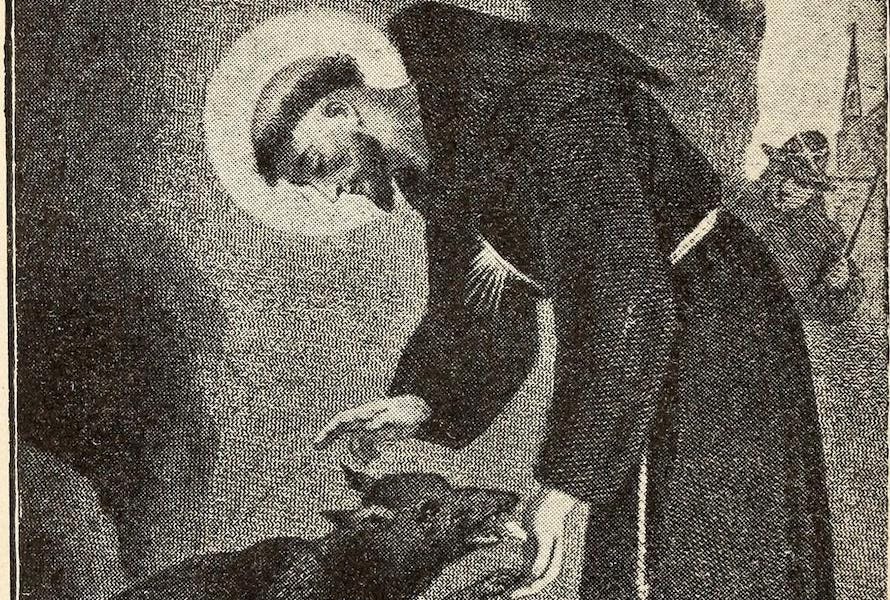
Christians today are mistaken to reduce St. Francis (1181–1226) to merely a wanderer who talked to birds and negotiated peace with a wolf. The essence of his life was a cultural and deeply spiritual critique of his society, a critique that pertains even more so to today.
The world’s Catholic bishops, meeting at Vatican II between 1962 and 1965, affirmed our modern ambitions and achievements, specifically noting advancements in commerce, technology, and research. Our bishops then raised poignant questions: What is the meaning and value of this feverish activity? How should all these things be used? Toward what goal are the strivings of individuals and societies heading?
St. Francis dealt with these questions dramatically. The title to a 1979 biography by Adolf Holl captures Francis’s stance: The Last Christian. Holl begins by noting the introduction of public clocks in Europe, including the first mechanical clock in Italy. The mercantile economy of St. Francis’s time and of our own capitalist economy need the minute-by-minute precision of clocks, watches, mobile devices, and other inventions. St. Francis foresaw where such emphasis on efficiency was heading. “One man looked into the motivating thrust behind the whole modern thing and decisively rejected it,” Holl declares.
St. Francis valued solitary prayer. But, unlike a hermit, he did not withdraw from the world. Nor was he a monastic, living in a gated community inside a larger town. St. Francis was “out and about.” His religious order of mendicant friars had a mission to the world.
St. Francis preached the raw gospel, though more by using gestures than words. His interaction with animals, for example, was meant to teach his followers, including ourselves, that we are interrelated with all creation, that we participate in God’s desire to reestablish Eden and to enjoy a preview of heaven here on earth.
Francis’s compassion toward lepers and beggars calls attention to those left behind in our busy society. A fellow friar once told St. Francis about a beggar looking for an offering. However, the friar found nothing of value in their modest dwelling. “Go to our chapel,” St. Francis instructed. “Give this beggar a cherished vessel. Our Blessed Lady is more pleased with our care for the poor than with our care for her chapel.”
St. Francis’s father was in the textile trade. No surprise, then, that he was attuned to fashion. However, in keeping with his skepticism of the latest fads, he suggested a simple garment for the friars, what people today call a hoodie. Rather than an expensive belt, he instructed the friars to use a piece of rope. With exceptions, the upwardly mobile of his time dismissed St. Francis. Young people, however, caught his countercultural spirit and joined his community.
It is difficult to live the gospel of poverty in our land of plenty, to separate sanity from the chaos around us. But we can push back against the alienation of our culture and model an alternative. For most, that does not mean imitating St. Francis in all his gestures. We can, however, make our daily encounters personal, instead of mediated on mobile devices. We can add visits to the homebound to monetary donations we make to St. Vincent de Paul or other charities. We can affirm the edginess of young adults rather than judge their lifestyles.
During this Year of St. Francis, I recommend reading Reluctant Saint by Donald Spoto, an accessible biography. It would also be beneficial to obtain (or reread) Pope Francis’s Laudato Si’, whose legacy includes his insistence that care for the earth is linked to our option for the poor. Subtitled On Care for Our Common Home, Laudato Si’ explicitly draws upon St. Francis’s concern for those two related challenges. ♦
William Droel is editor at National Center for the Laity (PO Box 291102, Chicago, IL 60629).