


Over the past few years, clergy, academics, and the media have been talking about the growing number of Americans who no longer identify with any religious tradition—those whom pollsters identify as “nones,” because they answer survey questions about their faith with “None of the above.”
Between 1998 and 2000, 8 percent of Americans indicated no religious affiliation; by 2025, this had grown to 27 percent—over a 300 percent increase in just 25 years. The percentage of those with no, or who no longer have, any religious affiliation is even higher among younger Americans.
According to the Pew Research Center’s Religious Landscape study conducted in 2023–24, 44 percent of 18- to 29-year-olds are nones—the highest percentage of any age group—compared with a national average of 27 percent. Other national surveys by the General Election Survey (GSA) and Cooperative Election Study (CES) in 2025 analyzed by Ryan Burge of the Center for Religion and Politics at the University of Washington indicates that there is a growing tendency among these younger Americans in Gen Z to be raised in families with no religious affiliation.
If this trend continues, the families that these younger nones create will carry on the practice of not identifying with any religion. This presents a serious challenge to organized religious institutions going forward who rely for their future viability in attracting young families and their children.
The recent uptick in church attendance reported by media recently may not be permanent. There have been surges of interest and participation in religion throughout American history. Several Great Awakenings occurred in the 18th, 19th, and into the early 20th centuries. There was a significant increase in church attendance after 9/11 in 2001. However, these past surges did not produce permanent new church memberships, and participation ebbed when the fervor declined.
According to the Pew Research Center’s Religious Landscape study, for every convert to Catholicism today, eight who have been raised Catholic leave the church. It will take a very long time using traditional evangelization methods to make up for these losses despite recent upticks in conversions. In addition, nearly three-fifths of nones (58%) indicate they do not feel they need to belong to a church in order to pursue spiritual and moral lives and will resist formal efforts to get them into the church.
Many Nones Are Privately Religious
Research has shown that perhaps up to a quarter of nones (approximately 25 million Americans) continue to exhibit some religious values and behavior apart from membership in organized religion. Burge has termed this group of nones “ninos”—namely, nones in name only.
While these nones don’t affiliate with any faith institution, they display some religious characteristics. Twenty percent are sure that God exists; 31 percent believe in a higher power. More than three-quarters (78%) of Gen Z nones (ages 13 to 25) claim to be spiritual, and 45 percent say that they pray. There does seem to be potential for religious believers to engage nones if more creative strategies than formal evangelization methods are used to reach them.
In my recent book, Reaching the Religiously Disaffiliated: Comparative Strategies to Engage the Nones (Bloomsbury Academic Publishing, 2025), I describe strategies of the Nuns and Nones movement that seeks to accompany nones in their respective spiritual journeys rather than proselytize them.
The Nuns and Nones Movement
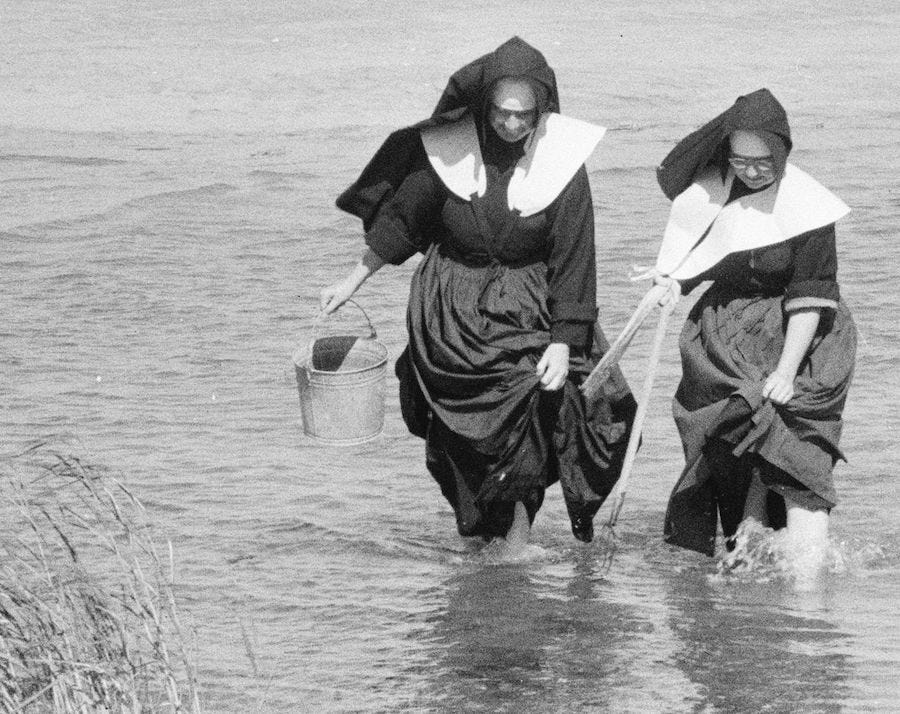
One of the most creative strategies to engage the religiously disaffected is the Nuns and Nones movement, a national organization that includes several hundred Catholic sisters and younger nones. The sisters invite nones to meals in their communities to explore the aspirations nones have to deepen their spirituality and discuss the moral values that motivate them.
These nones show interest in learning meditation techniques from the Catholic sisters and ways to create meaningful community experiences. Some have participated in shared living experiments in convents for months at a time, conversing over meals and meditating with the sisters while maintaining their work routines.
The sisters have discovered common values with these nones in areas of social justice for the poor and migrants and protection of the environment, resulting in hands-on projects such as the Land Justice Futures project that turns vacant convent land into ecologically sound farming communities eventually restored to Black, Indigenous, and other peoples who have been historically dispossessed.
The theology underlying these efforts by Catholic sisters is one of accompaniment, not proselytization. They affirm for nones signs of the Holy Spirit already at work in them, witnessed in their moral and spiritual lives and their desire to promote justice. This approach is less threatening to many nones who want to explore spirituality and meaningful community but are turned off by efforts to get them into churches.
The sisters see in these younger nones reflections of their younger selves, when they entered religious communities with lofty ideals for service to others. The nones, who may have had negative experiences of organized religion, are pleasantly surprised by positive interactions with faith-filled women who value and support them in their life journeys.
Sister Anne Curtis, RSM, from Madison, Connecticut, attended one of the first dialogues. She described her experience as having “this amazing sense that it was like listening to our younger selves in many ways.” Sister Carol Zinn, SSJ of Philadelphia has remarked that she was immediately impressed that the nones were creating organizations “right out of the Gospel and Catholic Social Teaching . . . I was just absolutely awed.” Sister Mary Dacey, SSJ, also of Philadelphia and the former president of the Leadership Conference of Women Religious (LCWR), remarked, “Certainly not the same, but the basics and the desires are there.” She affirmed: “We have so much more in common here than ever could divide us.”
Sister Judy Carle, RSM, who participates in the Bay Area gatherings of Nuns and Nones in San Francisco and is now on the national advisory committee for the movement, indicates that the meetings usually “start out with just a question that’s coming up from your heart and your experience, and that kind of sharing gets deep rather quickly.” She sees this work as a shifting of the concept of missionary conversion to “finding the spirituality of people and to live and serve in that particular milieu.” For her, these engagements between nuns and nones are new ways of how the church can work in the world.
A Possible Way Forward
In her 2014 book Belief Without Borders, a study of the spiritual but not religious, Linda Mercadante suggests that churches create “outer rim” communities for dialogue with nones on spirituality and shared moral values to serve society. Most megachurches already have developed small-group communities to deepen the spirituality of members, and these could be expanded to follow some of the strategies of the Nuns and Nones movement. Other denominations, including Catholic parishes, could also adopt some of the strategies of the Nuns and Nones movement to reach the vast majority of nones who have thus far expressed no interest in joining a house of worship in order to pursue spiritual and moral lives.
This may or may not eventually lead some to become adherents of organized religion, but it would plant the seeds in preparation for their doing so in ways that are not as high-pressure as those of formal evangelization efforts. Moreover, spiritual accompaniment might build bridges between those on the “edge of the inside” of organized religion with those on the “edge of the outside” (to use terms coined by the Rev. Richard Rohr) who are looking for ways to explore spirituality, discuss their struggles with faith, and experience communities that take their spiritual journeys seriously.
This approach of accompaniment of nones also has been endorsed by an influential theologian in Eastern Europe, where secularization and disaffection from religion has been even more rapid than in the United States. Fr. Tomáš Halík is a Catholic priest who has worked with young agnostics in Czechia for many years, an experience he has written about in his recent book, The Afternoon of Christianity: The Courage to Change (University of Notre Dame Press, 2024).
Halík believes those who wish to spread their faith must “follow Christ outside the Church where he awaits among those who say they do not believe.” He is convinced that Jesus is at work beyond the church, and the church’s mission is not to push nones into its existing structures but rather to “open and enrich . . . [the Church] by the experiences of those seekers who have much to tell us.” He adds, “We cannot just come to them with our apologetic arguments, but we should embrace those experiences of the silence of God and give it a broader context.”
Like the nuns in the Nuns and Nones movement, in his ministry on the “edge of the inside” of religion, Halík is building bridges to those on the “edge of the outside” of religion. This strategy may become an effective way for people of faith to engage nones in many regions as the world becomes more secular in the future.
There is a saying attributed to St. Teresa of Avila that “God works straight through crooked lines.” There are some “crooked lines” today in the way many nones are pursuing spirituality. Pressure to make them follow more traditional straight lines of church membership may interfere with God’s plan to collaborate gradually with them where they are. ♦
Brian H. Smith is professor emeritus at Ripon College where he taught courses in religion and ethics for 33 years (1987–2020). He has advanced degrees in theology, ethics, and political science, and has published several books on religion and politics in Latin America with Princeton University Press and University of Notre Dame Press. He was a member of the Jesuit Order for 21 years (1958–1979) and served as a priest for nine years, including one year in Chile as a pastor in a small Christian community (comunidad de base) in 1975.