


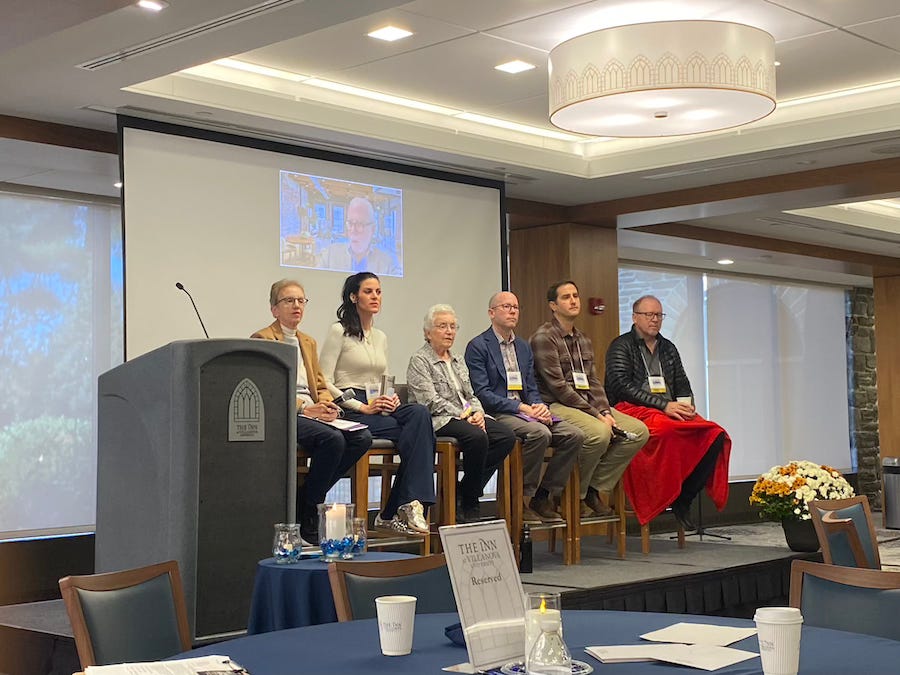
The third and final day of the World Institute for Science, Religion, and Culture (WISR) conference opened Wednesday morning with a keynote address from Daniel Horan, an author, theologian, and professor at Saint Mary’s College in Notre Dame, Indiana.
Horan used the metaphor of “digging and mining” from theological tradition to characterize his presentation, “The Difference Love Makes: What the Incarnation Can Teach Us About Living in Community with All Creation.” He likened this metaphor to the paleontological work of WISR’s guiding figure, Teilhard de Chardin.
Horan introduced two main schools of thought about the incarnation of Christ found within the theological tradition: the infralapsarian and the supralapsarian.
The infralapsarian (“within the fall”) school believes that Christ entered the world because of human sin. The incarnation can be thus be treated as an instrument or response to the felix culpa (“happy fault”) of human fallenness.
In contrast, the supralapsarian position (“above the fall”) holds that God’s intention in entering creation through Christ was to draw closer to humanity in love. This “alternative understanding for the reason of the incarnation” is a “minority opinion” within the tradition, Horan explained, though “there is nothing minor about its cogency, its orthodoxy, and its compelling power.”
Horan noted a key distinction between the two schools is that the infralapsarian position makes humans the protagonists of their salvation, while the supralapsarian position centers the actions of God.
He unpacked the argument by tracing the lineage of the supralapsarian position, beginning with scriptural and patristic sources. He noted how Genesis 1:2 describes the breath or Spirit of God “hovering over the waters,” implying that the gift of God’s self—or what Christians might call grace—was present from the dawn of time.
Horan said that there is “no evidentiary support for infralapsarian Christology” in scriptural sources such as the prologue of the Gospel of John, which states that the Word became flesh without adding any qualification of sin. Pauline passages including Colossians 1:15-20 and Ephesians 1:3-10 affirm the “creational exemplarity” of the incarnation and the unity of all creation in Christ, he added.
Horan demonstrated how Paul’s notion of Christ as head of creation was developed during the patristic era by Irenaeus of Lyon, who wrote, “In God’s measurable love, God became what we are in order to make us what he is.”
Several theologians contributed to the development of the supralapsarian position in the medieval period. Horan shared a stirring insight into the nature of the incarnation from Robert Grosseteste (d. 1253): “God would not withhold that highest good that creation is capable of receiving.” An infralapsarian view makes this gift of the “highest good” both “conditional and contingent” on human sin, Horan explained.
Contemporary figures who have advanced a supralapsarian understanding include Teilhard, who held that the incarnation “was not primarily a divine remedy necessitated by human sin” but “the very goal in consummation of creation itself.”
Citing theologian Dennis Edwards, Horan said that Teilhard’s view of the incarnation reveals “a God who is radically involved with matter.” Horan brought Teilhard into conversation with the work of another contemporary figure, Thomas Merton. Merton “does not artificially separate creation from the fall of humanity and sin,” Horan said. “For Merton, Christ is the blueprint for creation.”
Horan concluded with some reflections on the implications of the supralapsarian view of the incarnation on faith, life, and relational community. He referenced the concept of “deep incarnation” pioneered by theologian Niels Gregersen, which articulates how God enters into the “very tissues” of nature. Deep incarnation is a “vehicle” to help remind humans that “we are not the center of the story” nor the sole protagonists of creation, Horan said.
Horan classified the concepts of anthropocentrism and anthropomonism—the latter a technical term for the belief that God only cares about the salvation of homo sapiens—as wrong “and perhaps even sinful.”
He also looked to what he called “the practical implications of pietas,” or piety, drawn from the ancient Roman civic virtue of kinship. Saint Francis of Assisi demonstrated this type of piety when he recognized his relationship to the more-than-human world, Horan said.
He suggested that humans assent to their “intrinsic kinship with all creation” and set aside the metaphorical language of domination, such as having stewardship or lordship over creation.
“We need to be more pious,” he said. “We have pedaled in the false narrative of human separation, human distinction, human apartness for far too long.”
Author and scientist Gregory Stock followed Horan with his keynote address, “AI as Agent of Human Transformation: Toward a Post-Truth World?” Stock addressed the conference remotely via Zoom.
Stock’s talk centered on the exponential, “explosive” growth of artificial intelligence—what he called “a fundamental transition in the history of life”—and how it will transform human experiences of purpose, spirituality, dignity, and relationships.
At present, the “mimicry of human interaction is so high” with AI, he said. He shared an example of an AI-generated email that displayed a sophisticated use of language and the ability to ask thoughtful questions. Such a development “amplifies the importance of human-to-human connection,” he said.
Stock noted that children born within the last few years will never know a world where the environment isn’t “intelligent,” or where one goes to a human “expert” to seek knowledge or information.
“The pace of change is so rapid that it creates a veil of ignorance,” he said.
Stock named three “easy escapes” humans might employ when responding to AI: denying it with “willful blindness”; “catastrophizing” it by conjuring doomsday scenarios; or “futurizing” it with a kind of techno-optimism.
Stock shared a calculation that some 400 million people are involved in generating a single response from AI models such as Grok or ChatGPT, a number which includes all those who mine, manufacture, and transport the components of the machines on which these models run. This makes AI a “planetary expression,” he said.
Large language models make collective human knowledge available in an instant, which changes our sense of how we see ourselves in relation to other people and to the world, he said.
The idea of a “planetary superorganism” brought about by such a paradigm shift “is not a metaphor. It is a real biological creature,” Stock said. He explained how technology is not outside of this superorganism, but is rather part of in in the same way calcium phosphate is part of the skeleton of the human body.
“We’re embedded in this,” he added.
Stock pivoted to some of the “profound” changes to human life that he believes will arise as a result of AI, including the “dethroning [of] the expert class” as AI “collapses the differences in human performance capabilities.” He speculated as to whether future generations will learn to navigate, speak foreign languages, or even read or write when AI technologies are available to them.
Stock predicted that AI will bring about an “erosion of the sense of our individuality” and that humans “won’t feel as unique as we have in the past.” He also predicted that humans will have “deep relationships with AI,” including companions and therapists that are available to give sustained attention. He compared these AI avatars to relationships people develop with other nonhuman entities, such as dogs.
He said that AI will bring “material abundance,” and that changes in labor patterns and practices will alter the sense of “meaning, dignity, purpose, and who we are.”
“Ultimately there will be material abundance,” but the transition period will be “very chaotic and difficult” with displacement and social upheaval, he said.
Characterizing AI as “a journey of absolutely profound transformation” and “the mother of all paradigm shifts,” Stock said that it is difficult for humans to understand the post-shift environment from a pre-shift perspective.
He reiterated a quote from biologist E. O. Wilson: “We have paleolithic emotions, we have medieval institutions, and we have godlike technology.”
On the evening of November 10, WISR presented Sister of Saint Joseph Kathleen Duffy with its Award for Excellence in Teilhard Studies. Duffy presented a paper, “The Promise of Paradox,” upon receiving the award.
Duffy’s paper examined the role of paradox, contradiction, and personal crisis in shaping Teilhard’s life and thought, including his ability to grasp “how his own story is like the emerging story of the universe.” She looked closely at the dialectical processes he used to “develop a synthesis that would deal with the dualisms that were keeping the church and humanity from moving forward” and suggested that his approach of “learning something from the tension” might benefit our society today. ♦
Michael Centore is the editor of Tomorrow’s American Catholic.