


I had as my initial model for this book a beautiful little volume by the Mexican poet Octavio Paz called Itinerary. This long essay, sharpened like a knife on the whetstone of dialectic, is essentially a résumé of the author’s political education: how a person forms a politics and wagers a place for himself within the world of political activity. I wished to provide a similar résumé, accounting, as Paz does, for the development of both my personal political outlook as well as that of my generation; I wished to show how the individual and the collective are always in dialogue, the double movement of historical circumstance between the many and the one.
For the moment, though, I can only identify what Paz’s experience has that mine does not, and to isolate within this deficiency the seed of a political worldview. This is, in a word, action. Paz’s book is filled with conversation, of talk and exchanges with others at the crossroads of history—revolution, communism, Stalinism, the Spanish Civil War. There is an authentic grappling with history and political systems as he and his colleagues map out the world they wish to make. They believe they have a hand in shaping their destiny and the destiny of their nation with something so small as an essay in a little magazine. They mean to effect change; they see something better on the horizon, and they will pursue it, even at the risk of their solitude, their silence.
I did not have such obvious entry points into history. If you asked me where history was happening in 1998, the year I was eligible for the franchise, I would have told you in a textbook; if you asked me where politics was happening, I would have told you on television. These were the waning years of the decade in which we went so far as to proclaim the “end of history,” as if centuries of theft of Promethean fire had cured us of Heraclitan flux. The prevalent sense was that the great social movements had all happened in the past. I could not, as the adolescent I was then, envision participating in a political reality; though I recognized some of their names, politicians were a caste apart. You could complain about them, you could vote for or against them on staggering schedules of two, four, and six years, but you couldn’t fundamentally alter the caste. It was always there, like the weather, and like the weather its internal movements were ill-defined until suddenly they were not—unleashing, in a flurry of laws as powerful as a gust of wind, a series of immaterial codes that could reshape the material conditions of life. Like the weather, you could try to propitiate it with sacrifice in the way of the ancients, but this was no guarantee of justice or mercy.
Here is where my youthful experience diverges with Paz’s—and, if I may be so bold as to extrapolate, where a soul that came of age in the heart of twentieth century differs from one that came of age on the cusp of the twenty-first. Paz and his cohort felt like their opinions mattered; I did not. I was but one voice in a flattened choir, and the idea that I or anyone who shared my political inclinations could influence the upper echelons of policy seemed farfetched at best, delusional at worst. I was told to be the change I want to see in the world, and over and over that one person can make a difference, but these sentiments had hardened into bromides that had no bearing on reality as I saw it. The government seemed to operate independently of the people of which it was comprised, an almost mystical entity that hovered above the rhythms of daily life to wage war or police the outer limits of empire or work in collusion with multinational trade organizations to destroy the livelihoods of subsistence farmers in the Global South in the name of that stealthiest and most pernicious of organizing principles, efficiency. By the time I was old enough to develop the dimmest outline of a political consciousness, government had become less a participatory instrument to improve the lot of people’s lives and more a corporate handmaiden, shielding and protecting capital as it was moved from place to place.
My response was to transpose any latent feelings of social solidarity onto the world of nature. This is to say I felt more attuned to the plights of the trees and the rivers than those of my fellow humans. They filled me with a sense of majesty and peace and calmness and beauty that the anthropocentric world, with its chaos of a million souls at cross purposes trying to meet their immediate needs, did not. I felt most fully human alone, on the solitude of the trail, watching ice spider into spring freshets that conveyed the first of the last season’s leaves into golden eddies of the sun; when it came time to register to vote the spring I turned eighteen, I joined the Green Party almost instinctively, by virtue of the eco-poetical associations that clustered around that color, as a synesthetic might be drawn to the visual qualities of a symphony. I had not yet heard Zbignew Herbert’s immortal line that “Eternal greenness speaks to the imagination better than eternal light,” but if I had, I would have recognized its truth immediately, and I followed the name of the party well in advance of its platform. If I was going to participate in a political project, it would have to account for the hollow and the glen, the willow sweeping the surface of the river, the dappled forest corridor.
Like almost every other decision with purported political valence at this moment in American history, my joining the Greens was soon revealed to be just another consumer choice. Its most significant bearing on my life was its effect on my self-perception and, in turn, the way I hoped to be perceived by others. Perhaps this was partly circumstantial: the autumn after I registered, I was off to college, and the congressional midterms held absolutely zero interest for me as I struggled to adjust to life away from home. It didn’t occur to me to request an absentee ballot—I was registered in a different state from where I was attending school—and I don’t recall following the results with any alacrity, if at all. In fact, I relished that the collegiate experience was becoming something of a Faraday cage that insulated me from the political currents of the time; the entire year’s news cycle had been dominated by a particularly lascivious presidential scandal, and I was grateful not to have to pay it any more of the even scant attention I had given it previously. I disappeared forthwith into history—the history of art, where I stood stock still beside the ancient Grecian kouros, my left foot in front of my right, biding my time for beauty; of the European fin de siècle, where I huddled tête-à-tête with Robert Musil in Viennese cafes; of American literature, where I joined John Burroughs in tracking chipmunks around the perimeter of Slabsides, his cabin in West Park, New York. I felt at home among these scenes, which seemed to promise a harmony, a seriousness, a fine simplicity out of step with the spectacle that was the fin of my own siècle.
Burroughs’s work, especially, made a lasting impression, more for what it promised than what it delivered. Lately described by Eugene McCarraher as a blend of “vivid and sensitive observation, paeans to rural life, and moral and theological reflection,” it maps with visual acuity—I was about to write “peerless visual acuity,” but no, Burroughs is too avuncular, too much the Whitmanesque democrat, for the diamantine blade of such a designation—the lifecycles of his little corner of the world. He writes expertly of flora and fauna, of birdsong and streams and lichened rocks, but there is some part of the total man held back: he is all eyes, performing the noble work of an icon reflecting back to the Creator his creation, yet we do not feel, as we do in Thoreau, a writer wagering himself in language. It is not necessary, or even advisable, that every writer make this wager, nor is it a necessary criterion in judging the value of a given piece of writing; I merely make the distinction by way of explaining why I go to Burroughs to understand a landscape, but to Thoreau to understand myself.
The writer Verlyn Klinkenborg once indicted Wendell Berry, himself a spiritual son of both Burroughs and Thoreau, for being “on the trail of a metaphor” in a passage evoking the spiritual qualities of soil when he, Klinkenborg, felt that Berry ought to have stuck to describing its “microbial and mineral contents.” The error Klinkenborg ascribes to Berry is precisely what I value most in Thoreau, in whose work Roderick Nash discerned a writer “following Emerson’s dictum that ‘the whole of nature is a metaphor of the human mind.’” There is little internal wilderness in Burroughs. West Park differs from Walden in that, in the former, there is a disproportionate emphasis placed on “Where I Lived,” much less on “What I Lived For,” whereas the latter is a laboratory of self-interrogation in which the subject is continually positing and repositing himself with and against the “masses of men,” his solitude becoming the negative image of his place in society that reveals it and refines it:
Wherever a man goes, men will pursue and paw him with their dirty institutions, and, if they can, constrain him to belong to their desperate odd-fellow society. It is true, I might have resisted forcibly with more or less effect, might have run “amok” against society; but I preferred that society should run “amok” against me, it being the desperate party.
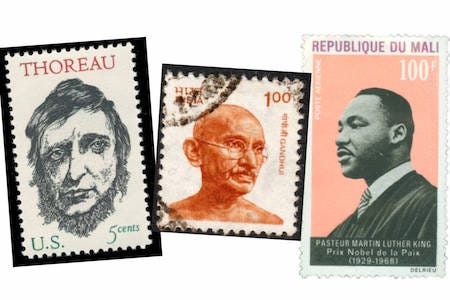
These lines from Walden come immediately after Thoreau has related his detainment by local authorities for not paying his tax in support of “a state which buys and sells men, women, and children, like cattle at the door of its senate-house”—a gesture of radical solidarity that puts paid to all those notions, dusted off in think-pieces and critical reassessments that arrive like clockwork every few years, of Thoreau as prickly egoist who can teach us nothing about our duties to the community. Thoreau’s is a community cultivated across time, and there is no greater evidence of this than the fact that there is a direct line—I envision it like the line connecting an arc of stars in a representation of a constellation—from his most fully realized piece of political writing, “Civil Disobedience,” through Tolstoy to Gandhi to Martin Luther King. That this hermit of Concord would have a hand in liberative efforts across multiple continents in multiple generations up to and including today—an influence which shows no signs of abating—is a sign of hope upon which I never tire of meditating. It revivifies the ossified bromide about one person’s life making a difference.
Michael Centore
Editor, Today’s American Catholic
This is very good. As a suggestion, it would be helpful to know where you were in 1998. And some point, it would be good to compare yourself against your peers.
beautiful piece