


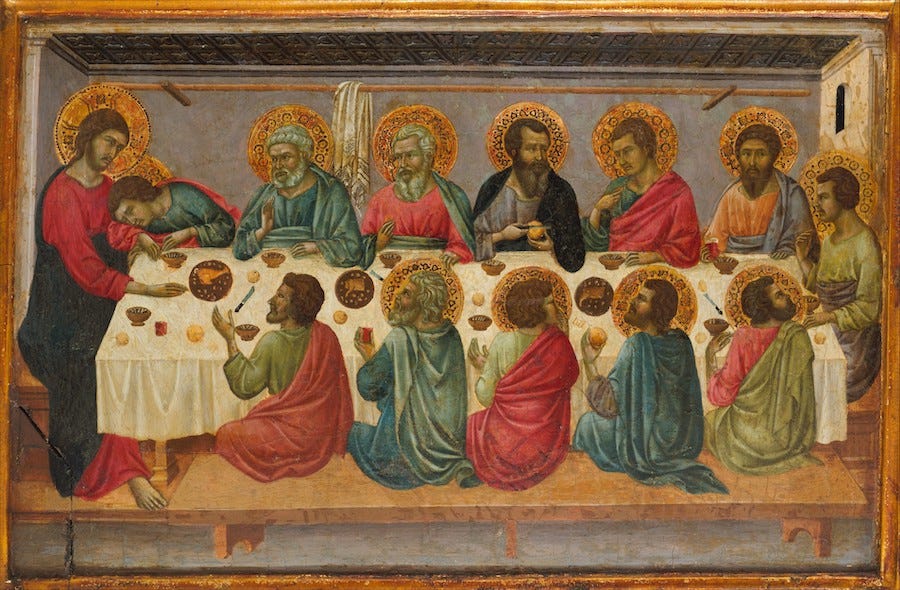
Do this in memory of me
– Luke 22:19
Jesus constructed parables to guide the deeds of his listeners: “Go and do thou likewise” (Luke 10:37). Actions speak louder than words, without the limitations of language and literacy. They also convey meaning in ways that are both complementary to, and beyond, words. So how would a spiritual genius like Jesus deliver core messages to ensure his followers across the ages would “do [what] I commanded . . . always . . . until the end of time” (Matt 28:20)?
Jewish tradition emphasizes deeds over creeds, and the Passover meal (seder) is the traditional ritual meal to recall how Yahweh’s deeds liberated Jewish people from bondage. Thus the seder provided a perfect setting for Jesus’s last and lasting lessons to his Jewish disciples. When Jesus concluded his last seder (commemorated by Christians as the Last Supper) by asking his disciples to “Do this in memory of me” (Luke 22.19)—note Jesus says “do this,” not “say this”—did he intend that his deeds during the ritual meal would serve as a pragmatic model for the faith community?
In this essay, we review the imperative verb “do this” in the gospel accounts of the Last Supper to reflect on Jesus’s deeds. We reflect on how these deeds embody the central themes of his ministry, and whether and how they have been emulated by his followers. We explore how his Last Supper deeds resonate with interfaith expressions of other mystics and spiritual masters. If we read Last Supper as a parable for all places, people, and periods, we can apply its last(ing) lessons to guide our spiritual practice on our faith journey.
Reading the Last Supper as a Parable
Jesus’s parables share elements—message, medium, method, mission—that we can apply to reading the Last Supper as a parable. The message or moral of the story is at the core of the parable. The medium conveys the message through relatable entities and everyday activities. The method unfolds as a series of events to demonstrate attitudes and actions that align with the message. The mission (or take-home lesson) is the actualization of the message in the life of the learner. Let us apply these elements to guide our reading the parable of the Last Supper.
Message: “I give you a new commandment: love one another. Just as I have loved you, so must you love one another” (John 13:34)
When Jesus endorses the commandment of the Torah to “love God with all your heart, soul, strength; love your neighbor as yourself” (Luke 10:27, citing Deut 6:5; Lev 19:18) as the keys to eternal life, he immediately reinforces the need for deed: “do this and you will live” (Luke 10:28). He then follows up with the beloved parable of the Good Samaritan (Luke 10:29-37) as a model for living the Torah. Carlo Carretti, in Letters from the Desert, writes of how Jesus’s new commandment extends our work of love from “love . . . neighbor as yourself” to a new benchmark modeled after him: “love one another, just as I have loved you.”
Medium: Water, Bread, Wine
The use of water for cleansing and purification are part of Jewish rituals. The seder meal includes washing of hands before eating. Eating matzah (unleavened flatbread) after offering a b-r-k-h (berakhah, thanksgiving blessing over the meal) and drinking wine are all part of the ritual. In this essay, we see how Jesus used these seder meal staples to convey his message to all of us, even if we are not familiar with Jewish tradition and rituals.
Method: Serve, Give, Forgive
At the beginning of the Last Supper parable in John’s gospel (13:1), Jesus “knew that his hour had come to pass from this world to the Father.” So how did Jesus demonstrate “just as I have loved you” attitudes and actions congruent with his new commandment? He enacted the message with a series of memorable deeds so that his disciples could “do this and . . . live.”
Jesus set the tone even before the seder meal. Instead of washing hands as usual, he began by pouring water into a basin and washing his disciples’ feet! (John 13:4-6) In Jesus’s time, these tasks would normally be performed by servants for their masters; it was unheard of that any of these tasks would be performed by the masters for their servants. No wonder Peter was confused: Jesus’s actions were an unprecedented act of humility and service in the Jewish tradition, as they were considered the lowliest of tasks, performed by “a handmaid, a servant to wash the feet of servants” (1 Sam 25:41). He continued with radically egalitarian acts of service during the seder meal by serving bread and wine to his disciples (Luke 22:20). Thus, the entire seder meal became a demonstration that Jesus “did not come to be served, but to serve” (Matt 20:28).
We read in the synoptic gospels that Jesus followed the Jewish tradition of offering berakhah—thanks and blessings—which is an important part of the seder ritual. By giving thanks and blessings over the meal, Jesus consecrated and celebrated heaven’s gifts on earth, making life on earth a blessing from heaven, and all life-giving work sacred “on earth as it is in heaven” (Matt 6:10).
Jewish tradition commemorated how in the desert, Yahweh gave bread daily to be gathered by the people, each for their family (Exod 16:16). Jesus took a different approach during Last Supper: instead of gathering, he distributed bread and wine to all his disciples gathered around the table (Matt 26:26). In doing so, he gave of his own food and drink and included everyone as members of one family.
Judas and Peter are mentioned by name in the Last Supper, and the other disciples are gathered around the table. Soon after the Last Supper, the first betrayed him out of greed, and the second denied him three times out of fear. All the disciples deserted him when a lynch mob showed up with lethal weapons (Matt 26:55-56). We read that at the Last Supper, Jesus was well aware of their intentions and knew what to expect from them. And yet he washed Peter’s feet, gave bread and wine to Judas, and served his disciples all evening long, even at his final meal. Jesus’s kind deeds to those who were unkind to him are sublime acts of forgiveness and a testament that “he loved them to the end” (John 13:1).
Mission: Do this in memory of me (Luke 22:19)
Now we can proceed to the mission statement that follows the Last Supper parable. So how do we remember to “do this in memory of me”? As “members one of another” (Eph 4:25) we remember by doing, and do in order to re-member the dis-membered Body of Christ. As followers of Jesus, his deeds at the Last Supper provide us a “to-do” list so that we may do this while we live and do it to the end:
1. Living the new commandment entails humble service of all and by all, with no exceptions for rank or task.
2. Living the new commandment includes giving thanks and blessings for the fruits of both the earth’s womb (bread, wine) and human wombs: all of us who are placed on earth to “care and cultivate” (Gen 2:15) the garden.
3. Living the new commandment means giving rather than gathering, selfless sharing rather than selfish stockpiling, treating all humankind as kin, and trusting that Yahweh will “give us each day our daily bread” (Matt 6:11).
4. Living the new commandment requires the willingness and ability to “forgive from the heart” (Matt 18:35).
Reflections on Last(ing) Lessons
When Jesus taught large groups using parables, his disciples questioned his approach (“Why do you speak to them in parables?”). Jesus explained, “They see but do not perceive, they listen but do not comprehend” (Matt 13:13). Yet it was often the disciples who neither perceived nor understood Jesus’s words and needed private explanations. Moreover, since Jesus used familiar words and phrases, that he spoke a different language was not readily evident to even his closest followers: “How do you not comprehend that I was not talking about bread?”(Matt 16:11); “I have food to eat about which you do not know”(John 4:32); “You are a stumbling block to me; for you are not setting your mind on the things of God, but the things of men”(Matt 16:23). It is not surprising that Jesus would choose a complementary way to communicate key messages if and when his words were communicated or interpreted differently by future generations due to changes in language or literacy, culture, or context.
So if the pragmatic lessons of the Last Supper parable—serve, give, forgive—are intended to be both last and lasting lessons that define Jesus’s ministry, let us reflect on how they are included elsewhere in his choice of phrases, prayers, and parables. We note how Jesus defined the food “about which you [the disciples] do not know” as “my food is to do the will of the one who sent me and complete his work” (John 4:34). As we saw earlier, Jesus emphasized humble service to all humanity (“serve, not be served”) as the way to live the Divine Will on earth.
When he taught the disciples to pray, Jesus composed three verses that remind us how the last(ing) lessons of Last Supper are modeled after the Divine: “Thy will be done on earth as in heaven; give us this day our daily bread; forgive us our trespasses as we forgive those who trespass against us” (Matt 6:10-12). In various parables and gospel events, these prayers and Last Supper themes are demonstrated with models of behavior we can emulate: selfless service (Good Samaritan); an attitude of gratitude for life’s blessings (healing of the Samaritan leper); universal sharing (wedding at Cana, multiplication of loaves and fish); heartfelt forgiveness (Prodigal Son).
Resonance of Last Supper Lessons Among Faith Traditions
If we consider that Last Supper lessons are intended for all humankind, one would expect to find resonance between interfaith expressions of Last Supper lessons. Here are a few to ponder and whet one’s appetite for “food about which we do not know”:
Serve: Selfless service, or seva, is the cornerstone of karma-yoga (karma is the Sanskrit word for both deeds and destiny), one of the three main spiritual paths in Hinduism. Karma-yoga maps well to loving with one’s strength, bhakti-yoga (devotion) to loving with one’s heart, and jnana-yoga (knowledge) to loving with one’s being/mind. Thus, the greatest commandment of the Torah resonates very well with both Hindu spirituality and the Last Supper lesson of service. The Hindu poet and mystic Rabindranath Tagore offers us this poem that links life, service, and joy:
I slept and dreamt
Life was joyI awoke and saw
Life was serviceI acted, and behold,
Service was joy!
Give: We reviewed how Jesus gave thanks in celebration of the gifts of life and shared bread and wine at the Last Supper. The American poet Walt Whitman sings in Leaves of Grass: “I celebrate myself, and sing myself. What I assume, you shall assume. For every atom belonging to me as good belongs to you.” In a similar vein, Jalaluddin Rumi writes, “You are not a drop in the ocean; you are the ocean in a drop.” Kahlil Gibran, the Lebanese-American poet-artist, writes in The Prophet: “You give but little when you give of your possessions. It is when you give of yourself that you truly give.”
Forgive: In Luke’s gospel, Jesus’s first words on the cross echo his Last Supper lesson on forgiveness: “Father, forgive them, for they know not what they do” (Luke 23:34). In the Buddhist tradition, avidya, or ignorance, is the reason behind unkind and hurtful actions that are due to lack of “right knowledge,” one of the eightfold “rights” of the Fourth Noble Truth. Both Jesus and Buddha concur that forgiveness is the way to “loose the bonds” of self-imposed suffering. Among contemporary teachers, a quote by Robert Muller summarizes how forgiveness benefits the one who forgives: “To forgive is the highest, most beautiful form of love. In return, you will receive untold peace and happiness.”
At the Last Supper, Jesus emphasized how doing and blessing go together: “If you understand this, blessed are you if you do it” (John 13:17). So we conclude our reflections on the last(ing) lessons of the Last Supper with a last(ing) blessing:
May our serving, giving, and forgiving be so complete that the message of the Last Supper and promise of Jesus’s parables are fulfilled in us: “I have spoken these things to you so that my joy maybe in you and your joy be complete” (John 15:11). ♦
O'Neill D'Cruz retired once from academic clinical practice as a pediatrician and neurologist, a second time from the neuro-therapeutics industry, and now spends his time caring, coaching, and consulting from his home in North Carolina, known locally as the "Southern Part of Heaven." He is a wounded healer who works to heal the wounded, in order that All Shall Be Well.