


Barbara Mariconda writes: “A number of years ago I was asked to present a reflection during morning prayer on Good Friday at the church where I’d served as music director. As life would have it, my mother died on Tuesday of that week. And that changed everything. This is the talk I ended up presenting.”
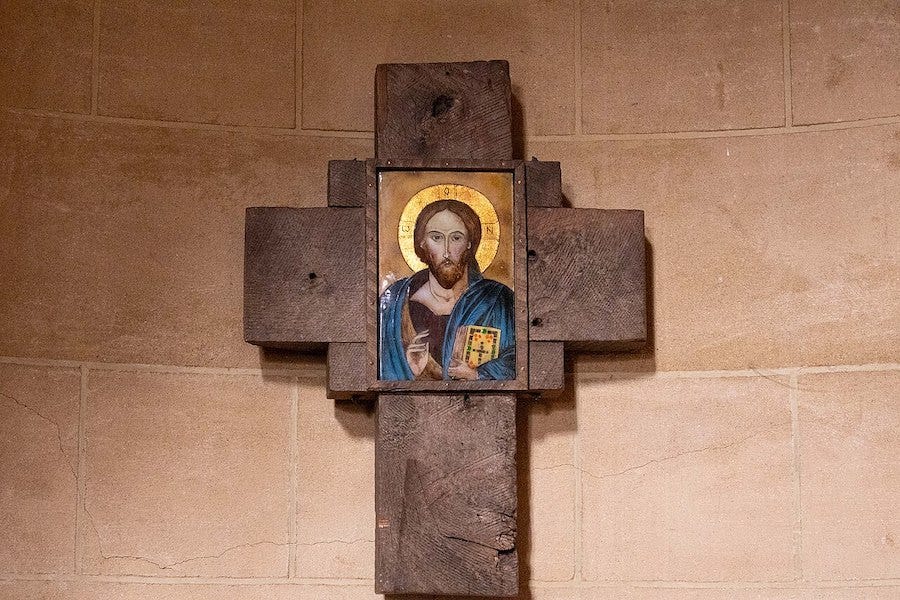
The image of the cross is inextricably connected to the observation of this second day of the Triduum—to the Friday we call Good. I’d planned on talking about the crosses we bear, and how the example of Jesus carrying his cross can help us to better carry our own. But then everything changed . . . My mother, who’d been in decline for several years, was admitted to the hospital with a bowel obstruction. She spent the last week suffering greatly, and after an unsuccessful, last-ditch emergency surgery, my mother died, throwing Holy Week into a more personal perspective for me.
The complexity of emotions I experienced throughout this ordeal revealed something to me: The heaviest crosses we bear have little to do with the actual challenges, losses, and disappointments that occur throughout our lives—the loss of a job, a dream, a relationship. An illness. A death. These are all inherently part of the human condition. I came to understand that the real cross of my life was the lens I inherited through which I viewed these challenges. The lens that colors every life experience, that either distorts or brings into sharp focus how I came to see myself and the world.
My mother had carried her own heavy cross, on very narrow shoulders. The youngest of three children, she was the invisible child, growing up in the shadow of a high-spirited sister. While I don’t know all the reasons for it, my mother always saw herself as less-than. She had a pervasive sense that she wasn’t as good, as smart, or as lucky as other people. My mother believed that you couldn’t really affect the course of your life—that life was just something that happened to you. She was always waiting for the other shoe to drop. Never wanting to draw attention to herself, because she didn’t feel she deserved it. Terribly insecure, uncomfortable with people she didn’t know. She only felt safe in a rigid routine, and resisted change of any kind. This painful cloak of inferiority was the cross she carried every day of her life. It was the lens that colored her world. And through the years, as she clung to her cross, she became exhausted from it, angry at it, resentful at how it weighed her down. But she could never really see it. She only felt its weight.
And her cross became my cross.
People know me as outgoing, confident, always ready for the next challenge. Assertive to a fault. Strong. Independent. Opinionated. A world traveler—I’d even camped and hiked in the Outback in Red Center, Australia. Started my own company, published many books. Made many dramatic changes in my life. Who could possibly see that I carry the same cross as my mother? That, beneath the surface, at the core of who I am, I often see myself as less than, as invisible, inferior? Who would guess that I’ve taken all my mother’s fears, anxieties, and beliefs about the nature of the world and just turned them upside down and inside out? That I’ve clung to that cross just as resolutely as my poor mother did hers? That my impatience and resentment at her fears and anxiety was, more than anything, the denial of the cross we shared—what I never wanted to see and acknowledge in myself, she continually placed right in front of me. And never more than in these final years of her sickness, dying, and death.
I constantly fought the urge to correct her, to chastise her for her negativity, to point out a better approach or attitude toward a situation, a different stance in life. But often, instead of helping her carry her cross, I actually drove in the nails. Because you can’t heal in someone else what’s still wounded in yourself.
Across the years, a place I took refuge was in music—it had always been a balm for me. It’s what drew me to become a music minister in a large vibrant parish. Songs, particularly sacred songs, had a mysterious power to touch into a deeper level of consciousness, a different kind of interior knowing. From the words and melodies rose a pre-cognition, a resonance that moved me into the shadowy mysteries of myself and my faith. Music was where I felt closest to God, where I knew that God spoke to me and through me.
When the demands of mom’s life and my own became too great, I reluctantly left my position as parish music director. It had been a tremendously difficult decision, and in the absence of my music I experienced a small, dark depression. It wasn’t the singing or the playing that I missed. It was the power of a song that somehow chose me, that spoke to me in ways I could feel but not understand. Selecting music for liturgy had pulled me out of myself and into myself, at the same time. It was this sort of precognition, this revelation of God’s presence through song that had slipped through my hands. I felt bereft. Prayerless. Ungrounded.
Throughout this dark time the song that grabbed and stayed with me was the old Evangelical Methodist hymn titled “The Old Rugged Cross.”
I couldn’t figure out what it was about the song that resonated so powerfully for me—and this line in particular: I will cling to the old rugged cross . . . ’til my trophies at last I lay down . . .
When I sang those words, I knew, at the core of my being, that they carried an important truth for me that was just beyond my conscious grasp—the key to unlock something in my soul. I couldn’t let go of that line: I will cling to the old rugged cross . . . ’til my trophies at last I lay down . . .
“My trophies” . . . what a strange word choice. What were my trophies? The things I felt I’d earned, worked hard for, won? My work, my writing, my musical ability, addressing my insecurities in ways my mother hadn’t. My trophies were the things I used to convince myself that my mother and I were different. The things that disguised what I couldn’t ever reveal to the world. The generational cross and inherited lens I shared with my mother.
I have a dear friend who says, “Life will continue to hand you that which you have not yet learned.” I’ll rephrase it: You will continue to choose that which has not yet been healed. When I think now of the ways I’ve continually rubbed salt in my own wounds I could almost laugh—I spent 25 years in a marriage with a man who couldn’t see me. I began a small business—statistically, an endeavor with a 95 percent failure rate in the first year. I struggled for 30 years as a writer—a profession in which rejection is commonplace and only 1 in 10,000 submissions are accepted for publication. I immersed myself in an institutional church that would not fully appreciate and acknowledge the gifts women bring to the table. Over and over and over again I placed myself in situations where I had to struggle, endure, and persist. I experienced rejection and disregard again and again, and even when I overcame it—when I left the marriage, when the business succeeded, and when the books were published, the pervasive feelings associated with that lens my mother gave me remained. I held my trophies close, but because I hadn’t earned those trophies freely, they just added weight to the cross. You will continue to choose that which has not yet been healed.
As I watched my mother take her last breath I held all of this close. And I saw how the cross we shared had prevented us from being able to love each other as freely as we might have throughout our journey together. That has been the source of my grief.
I will cling to the old rugged cross . . . ’til my trophies at last I lay down. For my mother, laying down her trophies meant giving up her life itself. And it calls to mind the last line in the song: I will cling to the old rugged cross . . . and exchange it one day for a crown. I know that as my mother laid down her life, she became free. She exchanged the cross for a crown, finally healed, and made whole. With God’s healing grace I hope the process of healing will continue and allow me to unburden myself before my own death. That God’s ability to love, to heal, to forgive, to renew, displayed as he carried his cross along the road to Calvary, might give me the strength to freely lay my trophies down, one at a time.
So, I ask you: What are your trophies? What defines you? What do you think you can’t live without? What do you see as your greatest accomplishments? What do you continue to choose which has not yet been healed? What bit of a song or Scripture won’t let you go? Look closely at your trophies and ask yourself: Why this particular collection, Lord? What invisible cross might they reveal?
Only when we lay our trophies down can we begin to control less, judge less, inflate ourselves less, let go of all ideas of our absolute rightness that cast others as absolutely wrong. Only then can we stand, stripped down, naked, vulnerable and free, accepting our cross in a spirit of gentleness toward ourselves and others. And it can only be done through the transformative power of Jesus Christ. ♦
Barbara Mariconda is a co-facilitator of the Tomorrow’s American Catholic podcast and a co-founder of Journey of the Soul Ministry, an organization committed to empowering others toward a higher level of consciousness, deepening their faith, and leading them toward the insights necessary for inner transformation.