


Holding up a work of art depicting the women lamenting beneath the cross surrounded by portraits of female saints, Michelle Sherman said that one of her roles as program director for nonviolence and campus outreach at Pax Christi USA is “constantly reminding people in the church and outside of the church that women have been the ones who have stayed.”
Women have always been a part of the “Jesus movement,” she continued, referencing the Samaritan woman in the reading for the Third Sunday of Lent along with women who have served as “seeds of regeneration” within the church for centuries, such as Mother Cabrini and Catherine of Siena.
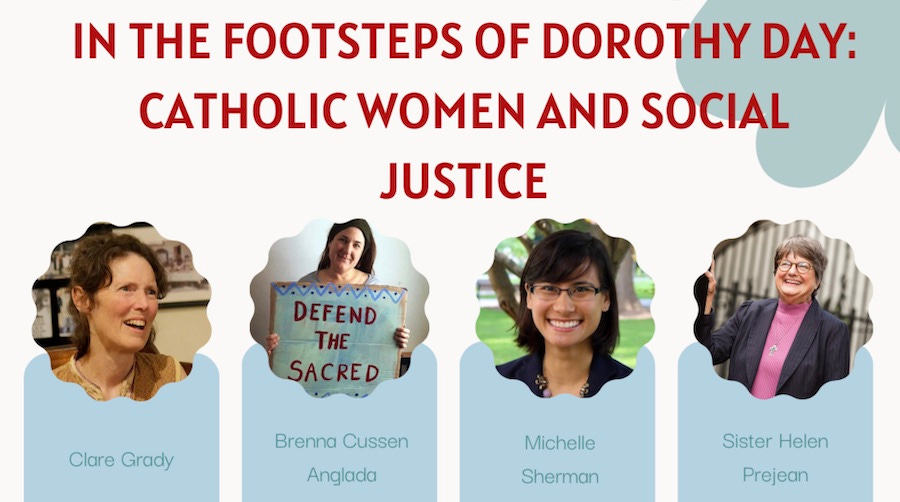
Sherman’s comments came as part of a webinar hosted by the Dorothy Day Guild in honor of International Women’s Day on March 8. Joining her to discuss how Dorothy and the Catholic Worker movement have shaped their activism were Sr. Helen Prejean, Clare Grady, and Brenna Cussen Anglada. The conversation was moderated by 2025 Dorothy Day Guild Graduate Research Fellow, Magdalena Muñoz Pizzulic.
In her introduction, Pizzulic spoke of “commemorating” rather than “celebrating” International Women’s Day, as 133 million girls still do not have access to education and 137 women and girls are killed every day by partners or family members.
Though Dorothy did not identify herself as a feminist, she was nonetheless “an example of feminist struggle” in the way she recognized everyone without distinction and maintained the strength of her faith convictions, Pizzulic said.
Rayhana Bouhara, a student at the University of Notre Dame, formally introduced the panelists. Bouhara said that she has become interested in the Catholic Worker movement for bringing together “justice and radical care for others.”
Waking Up to Justice
Sr. Prejean is a member of the Sisters of St. Joseph of Medaille and a leading advocate for the abolition of the death penalty. She shared that the year she awoke to the idea of social justice as being integral to the gospel was 1980, the same year Dorothy died.
“The waking up to Dorothy was the waking up to justice,” she elaborated.
Sr. Prejean recalled growing up in Baton Rouge, Louisiana, during the Jim Crow era of the 1940s and ’50s. Her parents helped the local African American population, including people who worked in their home, but did not question the underlying system that caused racial injustice.
In the early years of her religious life, Sr. Prejean had grandiose ideas about how to “win the world for Christ.” She was steeped in the prayer of the church “but didn’t know about justice,” she said, claiming, “I needed to be grounded.”
A turning point was a conference with Notre Dame Sister Marie Augusta Neal, who reinforced for her the reality that “Jesus preached good news to the poor.” Sr. Prejean left the suburbs and moved to the city of New Orleans to live among the African American community. “That’s where the grace was waiting,” she said.
While living at the St. Thomas housing projects, she began reading Dorothy Day and other teachers of nonviolence. At the invitation of a friend, she entered into correspondence with a death row prisoner, Patrick Sonnier. She was present at his execution on April 5, 1984, when she told him: “Look at me, I’ll be the face of Christ for you.” Their story is recounted in her book Dead Man Walking.
“I got set on fire because I witnessed it,” she said. “What the eye doesn’t see, the heart can’t feel.”
In response to Pizzulic’s question about the differences between accompanying men and women on death row, Sr. Prejean said that women are naturally sensitive and have to endure very harsh, male prison environments. They are made to wear men’s clothes, and experiences such as being subjected to strip searches can make it difficult for them to maintain their dignity.
“People are worth more than the worst thing they’ve ever done,” she continued, adding that this is what the gospel means by “inviolable dignity.”
Quoting Dorothy, she said, “We have to build a society where it’s easier for people to be good.” She specified the practices of dialogue and sharing experiences as one of the gifts of the Catholic Worker. “We’re just ordinary people that the gospels woke up, and then we connect with each other,” she said. Such connection “makes us know we’re alive.”
The change in Catholic teaching on the death penalty in 2018 was the result of “1,500 years of dialogue,” she said. The church had previously upheld the right of the state to take life, but Pope Francis formally declared capital punishment “inadmissible” in all cases.
Sr. Prejean praised Pope Leo XIV for continuing the path of dialogue, as it brings people into encounter and fosters empathy.
The Work of Resistance
For Clare Grady, it was a matter of “imbibing” Dorothy’s teachings through the example of her parents. Both were inspired by Dorothy and her Catholic Worker co-founder, Peter Maurin.
“I definitely have been accompanied by Catholic Workers my whole adult life,” she said. She described experiencing this accompaniment though hospitality in Catholic Worker houses and in “the work of resistance.” Grady is a member of the Catholic Worker community in Ithaca, New York, and participated in antinuclear Ploughshares actions in 1983 and 2018.
Grady noted that Dorothy’s canonization cause has “legitimized the work of justice” in Catholic circles. Her witness is a reference point throughout the church, even among people of different political and social persuasions, and helps to “put the justice back in the gospel,” she said.
Referencing Sr. Rosalie Bertell’s 1986 book No Immediate Danger, Grady noted that the effects of low-level nuclear radiation affect everybody. Women are particularly vulnerable as they “carry the next generations” and “every little embryo” is “highly sensitive to radioactivity,” she said.
In addition to radioactivity, Grady was also concerned with the effects of mining and weapons testing on Indigenous land when she first became involved with the antinuclear movement. She said that Indigenous people are on the “front line” of weapons testing and radioactivity, and commended the work of Indigenous Women’s Initiatives to clean up the West Valley nuclear waste site south of Buffalo, New York.
Grady also expressed admiration for her mentor, the Buddhist nun Jun San Yasuda, who was close with the Ojibwe leader and co-founder of the American Indian Movement (AIM), Dennis Banks. Yasuda has walked thousands of miles for the cause of peace and always insists on introducing others to the Indigenous people where they live, Grady said.
Grady referred to her own history of antinuclear action as “a manifestation, not a demonstration” and “a sacramental act.” After witnessing her brother and sister do a Ploughshares action at Electric Boat in Groton, Connecticut, in 1982, she saw clearly that “the role of the courts was to protect the weapons” and felt compelled to act herself.
Speaking about her Ploughshares actions at Griffiss Air Force Base (now Griffiss International Airport) in Rome, New York, and Kings Bay Naval Submarine Base in St. Marys, Georgia, she said that the process of forcing entry and “bringing an indictment” against weapons of mass destruction “change[s] your relationship to the weapon and to the systems that those weapons enforce.” After the Kings Bay action, she learned to appreciate whistleblower and activist Daniel Ellsberg’s image of nuclear weapons being used daily as “a cocked gun.”
Grady was a co-defendant with Martha Hennessy, Dorothy Day’s granddaughter, in the trial following the Kings Bay action. She described “an internal spiritual adjustment” that came from her time in prison, where she learned “to experience what it’s like to be treated less than human.” This experience translates to a “better relationship with my sisters who are in prison,” she said.
Solidarity and Spiritual Repair
Brenna Cussen Anglada is a founding member of the St. Isidore Catholic Worker farm community in Wisconsin and has been involved with the Catholic Worker movement for over 25 years. She first became interested in the Catholic Worker in college, where she began to notice incongruities between US foreign policy and what she was reading in the gospels.
“The [Catholic Worker] movement brings together so many beautiful things,” including the ministry of hospitality and focus on the poor, she explained. She expressed gratitude for the “profound impact” that Dorothy Day and the Worker have had in shaping her life, adding that she might not have remained Catholic were it not for the Worker’s influence. She also praised the movement’s intergenerational aspect, where “elders” can advise younger people on performing the works of justice and mercy.
Cussen Anglada has made several trips to the West Bank, including one with other Catholic Workers in 2004. Her most recent trip in October 2025 was done in coordination with the International Solidarity Movement, a Palestinian-led movement that resists the oppression of the Palestinian population through nonviolent direct action.
Witnessing Palestinian communities who identify with the land that they love and are willing to defend it “at great cost to themselves” had a powerful effect on Cussen Anglada. Their connection to the land inspired her to relocate from a Catholic Worker house of hospitality to St. Isidore farm, where the community’s focus is on care for creation, daily prayer, land restoration and repatriation/rematriation, and publishing initiatives.
During her last visit to the West Bank, Cussen Anglada and others monitored Israeli checkpoints to ensure that Palestinian students were getting to school. They reported these numbers to the United Nations, which would use them to evaluate whether the occupation was affecting students.
Cussen Anglada told the story of a Palestinian woman from Hebron, or Al-Khalil, where there is an Israeli settlement in the heart of the city. The woman’s husband, who was involved in resistance efforts, was killed by the Israeli military. Despite death threats and offers of money to leave, she remains in this restricted area where she has raised three children. Cussen Anglada said that the Palestinian watchword for this kind of resistance is “steadfastness.”
October 2025 saw the highest amount of violence against Palestinians on record, Cussen Anglada reported. She related the story of a nine-year-old boy named Mohammad who was killed that month while playing soccer in his village. Cussen Anglada and her colleagues mourned with the boy’s family, who asked her to share their story.
During a Q&A portion at the end of the event, Cussen Anglada said that the Doctrine of Discovery has “wreaked five hundred years of destruction and havoc” by separating people from the land and turning it into a commodity that could be taken and sold.
Though Pope Francis repudiated the Doctrine of Discovery in 2023, his words alone could not undo its generational damage, she said. She praised the decision of a group of Franciscan sisters to return their land to Indigenous people in northern Wisconsin as a positive step forward.
Remaining and Regenerating
Sherman opened by noting that the week of March 1 included both the anniversary of her baptism and entrance into the Catholic Church as well as her becoming a US citizen. She identified Dorothy Day as an “accompanier who encapsulates these identities,” including “the responsibility of commitment to peace” and what it means to be a woman in the church.
Reading Dorothy’s memoir The Long Loneliness in her early twenties “really made an impact” on her, she said. She observed that society is currently in “an epidemic of loneliness and isolation because we’ve forgotten that we belong to each other” and identified the remedy for this as “love realized through community.”
Dorothy “can bridge so much of the polarization we see in the church” because she was “deeply committed to all of these areas of Catholic Social Teaching” while also drawing from the ritual and liturgical life of the faith, Sherman said.
Asked how she balances working for peace within an institutional church that has historically been unjust toward women, Sherman held up the image of the “women who stayed” at the foot of the cross.
Eileen Egan, Dorothy Day, and numerous other prophetic women “are part of our tradition,” she said. She emphasized that women have founded and led many religious and lay intentional communities with solidarity, subsidiarity, and creativity.
She defined Pax Christi as a movement rather than an institution. It exists in a “liminal space,” she said, where it is part of the church but led by the people. It is “not necessarily tied to the hierarchy” yet calls upon the hierarchy to reclaim the commitment to gospel nonviolence.
Pax Christi directly and indirectly addresses “militarism as an expression of patriarchy,” she said. She followed with a quote from the International Women’s Network Against Militarism: “Genuine security requires the following guarantees: that the environment can sustain life; people’s basic needs are met; human dignity is respected; people’s sovereignty is assured; and society is organized so as to prevent avoidable harms.”
Sherman feels called “to stay and continue to show up,” she said. “The church, meaning the people of God, have encouraged me to stay.”
Cussen Anglada reiterated this during the Q&A. Rather than leave the church, she said, “we can stay and say we need to be part of the repair that happens.” ♦
Michael Centore is the editor of Tomorrow’s American Catholic.