


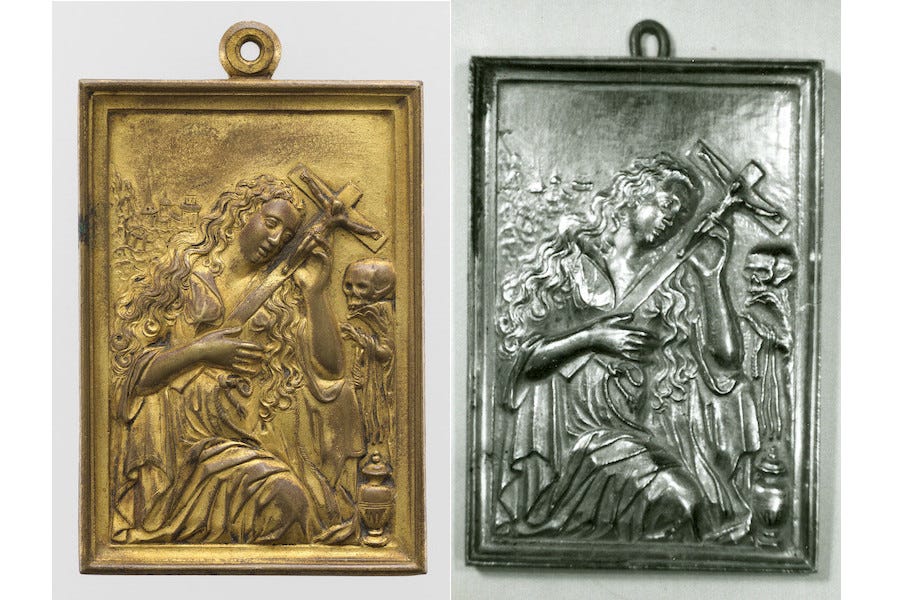
Since the rise of feminist biblical scholarship, women from all religions and nationalities have been witnessing to the different forms and degrees of oppression in patriarchal religious institutions, the academy, and society. The unconditional devotion to feminism has given many silenced women a chance to finally take responsibility for their own lives. Each woman and man who has contributed to feminism has done their share in carrying the torch for their female ancestors, so many of whom kept this metaphorical flame alive secretly for far too long.
Positively speaking, it could be stated that we are in the last gasp of a male-dominated society. On the other hand, when considering how the awareness of the importance of women has penetrated so much of biblical scholarship, it is appalling to find that the Catholic, Orthodox, and Apostolic churches have not budged an inch on the issue of apostolic succession. Apostles have been strictly male for two thousand years, and the mere hint of including a woman would break the foundation of the Christian churches, according to these institutions. The famous “Twelve” were male, the conversation goes, and there is no negating that whatsoever. This is possibly the most overt form of subordination of women in the church, and clearly exemplifies the androcentric view of biblical texts. The time must come for women to be allowed to take on ordained positions of leadership in these denominations, and with enough women working in the field of feminist biblical scholarship, there is hope on the horizon for such a change.
This essay, the first part of which appears here, will focus on the women in the Gospel of Mark (with parallels to the other three canonical gospels) and how these female followers have complemented the meaning of exemplary discipleship in a way that could be used to promote women to official positions of clergy in the Catholic, Orthodox, and Apostolic churches. The essay will not touch upon all the women in Mark per se, but will shed light on those discussed in this unique manner. The source of the problem lies in the tradition of male apostolic succession. The goal is not to exclude males or even eliminate any of the chosen “Twelve,” but to find the silenced and marginalized women who may well have been chosen by the Jesus of the gospels as apostles and include them in the tradition, thus allowing them an equal voice within these churches. Until that is done, true equality will never be established.
Reading Against the Grain
Since the rise of postmodernism, feminist biblical scholars have had an opportunity to read the canonical gospels “against the grain.” A resistant reading of the Gospel of Mark allows the reader to experience this text from the point of view of the women in it. There is no doubt that this type of reading will show that since the beginning of Christianity, women have been acknowledged as playing a significant role in the church, and passages from the canonical Bible have been used to assist women in their fight for equality. Unfortunately, it has only been within the 20th century that issues raised by the women’s movement have brought to light the possibilities for women to assume greater responsibility in the church.
The bare truth is that the Jesus of the canonical gospels welcomed women and their involvement in his mission. In every encounter with a woman in the gospel, the author of Mark addresses the major issues of the day. The writer talks about the laws of purity, marriage and divorce, motherhood, and family. Women were associated with physical issues, such as the laws of purity related to food, sex, pregnancy and birth, contact with blood or with the sick and the dead, and anything at all relating to the body. A woman who had become unclean, according to Leviticus 15:25-30, could make others unclean by physical contact, and was therefore an outcast from society.
It is difficult to imagine the effect of this stigma of sin and uncleanness on the women in Mark and early Christianity. The rules were such that women in general were regarded as unclean, with greater frequency and for longer periods than the males. In Hisako Kinukawa’s book Women and Jesus in Mark: A Japanese Feminist Perspective, she summarizes the restrictions imposed on women but not on men as follows: 1) though they are biologically healthy, different functions are treated differently; 2) uncleanness is treated more harshly in the case of women; 3) a woman contaminates and defiles a man, but not vice versa; 4) a woman herself is declared to be impure, while a man is never called unclean except if his discharge is unclean; 5) the sphere of activity is more limited for a woman than for a man.
Mark 7:20-23, however, counteracts this societal view: “And he said, ‘It is what comes out of a person that defiles. For it is from within, from the human heart, that evil intentions come: sexual immorality, theft, murder, adultery, avarice, wickedness, deceit, debauchery, envy, slander, pride, folly. All these evil things come from within, and they defile a person.’” In Esther DeBoer’s Mary Magdalene: Beyond the Myth, she writes: “Jesus spiritualizes physical uncleanness, and this makes the starting point for men and women in principle equal not only in religious but also in social matters, in contrast to what was customary in the time of Jesus.” By removing the bodily sins from the woman, the Jesus of Mark has attempted to redeem her image as an equal to that of men.
“The praxis and vision of Jesus and his movement is best understood as an inner-Jewish renewal movement that presented an alternative option to the dominant patriarchal structures rather than an oppositional formation rejecting the values and praxis of Judaism,” Elizabeth Schussler Fiorenza states her book In Memory of Her: A Feminist Theological Reconstruction of Christian Origins. At that time in history, after a marriage, the initiative for divorce lay above all with the husband. A woman could be sent away for all kinds of reasons, and this made her social position uncertain.
Here, too, the author of Mark takes another line. In 10:2-12, the creation story is referenced in stating that a husband may not send his wife away. The husband leaves his father and mother to attach himself to his wife and be one flesh with her. Moses allowed divorce only because of the hardness of people’s hearts: “Therefore what God has joined together, let no one separate” (10:9). The responsibility of the union of marriage both the husband’s and the wife’s: “Whoever divorces his wife and marries another commits adultery against her; and if she divorces her husband and marries another, she commits adultery” (10:11-12). The wife no longer becomes subject to the whims of her dominant husband: Both bear equal responsibility for their marriage. This is how men and women as individuals could be addressed on equal terms.
“I Have Seen the Lord”
If there truly was no intention to include women in the picture, then there would never have been occasion for the writer of the Gospel of Mark to add 15:40-41 at the end of narrative: “There were also women looking on from a distance. Among them were Mary Magdalene, and Mary the mother of James the younger and of Joses, and Salome, who followed him when he was in Galilee and ministered to him, and there were many other women who had come up with him to Jerusalem.” These women enter the story here at the end of the gospel after the flight of the male disciples. They appear to be the only group of faithful followers in Mark.
Even though the general consensus among scholars is that Mark’s gospel ends at 16:8, the longer ending, verses 16:9-20, is still part of the canon. This section is known to many scholars as a later insertion written by another author than the original writer of Mark. It is one of the better passages to use as an example of the possibility of Jesus having chosen female apostles to spread the Good News. Verses 15:40-41 mention Mary Magdalene as one of the women who were present with Jesus and cared for him during his ministry, and she is the first person to believe the Good News in 16:9-14:
Now after he rose early on the first day of the week, he appeared first to Mary Magdalene, from whom he cast out seven demons. She went out and told those who had been with him, while they were mourning and weeping. But when they heard that he was alive and had been seen by her, they would not believe it.
After this he appeared in another form to two of them, as they were walking into the country. And they went back and told the rest, but they did not believe them.
Later he appeared to the eleven themselves as they were sitting at the table, and he upbraided them for their lack of faith and stubbornness, because they had not believed those who saw him after he had risen.
It has been debated as to why the author chose the end of his gospel to mention the female followers of Jesus “looking on at a distance” (15:40), almost as an afterthought. Nevertheless, the central role of women in the final episode of the gospel has raised the question of importance of women throughout the narrative. Parallel passages in the other canonical gospels help support the significance of female witnesses of the Risen Christ. In Matthew 28:1-10, for instance, Jesus appears to Mary Magdalene first:
After the Sabbath, as the first day of the week was dawning, Mary Magdalene and the other Mary went to see the tomb. . . . But the angel said to the women, “Do not be afraid, I know that you are looking for Jesus who was crucified. He is not here, for he has been raised, as he said. Come, see the place where he lay. Then go quickly and tell his disciples, ‘He has been raised from the dead, and indeed he is going ahead of you to Galilee; there you will see him.’ This is my message for you.” So they left the tomb quickly with fear and great joy and ran to tell his disciples. Suddenly Jesus met them and said, “Greetings!” And they came to him, took hold of his feet, and worshiped him. Then Jesus said to them, “Do not be afraid; go and tell my brothers to go to Galilee; there they will see me.”
And in John 20:1, 11-18, Mary Magdalene is again the first to see the Risen Christ:
Early on the first day of the week, while it was still dark, Mary Magdalene came to the tomb and saw that the stone has been removed from the tomb. . . . But Mary stood weeping outside the tomb. As she wept, she bent over to look into the tomb, and she saw two angels in white sitting where the body of Jesus had been lying, one at the head and the other at the feet. They said to her, “Woman, why are you weeping?” She said to them, “They have taken away my Lord, and I do not know where they have laid him.” When she had said this, she turned around and saw Jesus standing there, but she did not know that it was Jesus. Jesus said to her, “Woman, why are you weeping? Whom are you looking for?” Supposing him to be the gardener, she said to him, “Sir, if you have carried him away, tell me where you have laid him, and I will take him away.” Jesus said to her, “Mary!” She turned and said to him in Hebrew, “Rabbouni!” (which means Teacher). Jesus said to her, “Do not touch me, because I have not yet ascended to the Father. But go to my brothers and say to them, ‘I am ascending to my Father and your Father, to my God and your God.’” Mary Magdalene went and announced to the disciples, “I have seen the Lord,” and she told them that he had said these things to her.
These passages are unfortunately overshadowed by the way in which the Gospel of Luke chose Peter instead of Mary as the first person to meet the Risen Christ. The writer of First Corinthians takes this tack in 15:3-5: “For I handed on to you as of the first importance what I in turn had received: that Christ died for our sins in accordance with the scriptures and he was buried and that he was raised on the third day in accordance with the scriptures and that he appeared to Cephas (Peter), then to the twelve.” According to Hans von Campenhausen, “Peter acquired his most vital significance primarily as a witness to the Risen Christ, and in this capacity originally took precedence even over the ‘Twelve,’ thus meaning that it was with Peter that the Easter faith in the Risen Christ began, and therefore the history of the Christian church as a whole.”
Peter is the apostle whom the Catholics declare as their first pope. The papacy has always traced its origin to the unique commission reported to have been given by Jesus Christ to Peter, the chief of the apostles. Yet it is worth noting that the Gospel of Mark portrays the Twelve in a negative light. Peter’s position is of utmost importance for the Catholic Church, but this “rock” on which the church stands falters under the test of faith at the end of the gospel. The writer of Matthew clarifies this by having Jesus name Peter as the foundation of the church (16:18), but this does not change the fact that Peter is fallible like all the others: He denied Jesus three times and followed him at a distance during his passion. “Presumably a stronger disciple would have drawn nearer to Jesus at these critical moments of trial,” Elisabeth Struthers Malbon hypothesizes.
Equal Sharers of the New Covenant
The author of Luke overshadows Mary Magdalene with Peter’s witness of the resurrection, but at the same time introduces her as an important character in the first half of the gospel (8:1-3)—unlike the author of Mark, who only mentions her at the very end. The interpretations of the Lukan passage vary greatly from scholar to scholar. In light of the discomfort with the characterization of Mary as an apostle in the early church, it is not the least bit surprising that a false rumor conflated her image into a prostitute, a notion which stems from the Lukan passage in question:
Soon afterward he went on through one town and village after another, proclaiming and bringing the good news of the kingdom of God. The twelve were with him, as well as some women who had been cured of evil spirits and infirmities: Mary, called Magdalene, from whom seven demons had gone out, and Joanna, the wife of Herod’s steward Chuza, and Susanna, and many others, who ministered to them out of their own resources (8:1-3).
Mary Magdalene is assumed here to have some kind of wealth like the other women, since she is in a position of service and patronage. She is never labeled as Mary, the wife, daughter, mother, or even sister of any man, in this text or any other under discussion, thus creating suspicion as to where her “means” came from. Much speculation has risen over this unknown piece of her history, all of which is extraneous. The Scriptures telling us that she is a sinner, and the fact that she is not associated with any male named in these texts, does not mean that she gained her wealth by prostituting herself. Although it could have been a possibility, it is highly unlikely.
According to the late biblical scholar Jane Schaberg, “The tradition of Mary Magdalene as a sinner was developed in orthodox Christianity primarily to displace the apostolic authority claimed for women through her name.” Schaberg’s article “How Mary Magdalene Became a Whore” enumerates the details surrounding this false tradition. She admits that there are still biblical professors who cast Mary Magdalene as a prostitute:
At a meeting of scholars where I recently gave a paper on this subject, a professor of New Testament suggested that this passage proved that the Magdalene was a whore: “How else could a woman be wealthy?” He said that women should be regarded as prostitutes simply because they had resources reflects the same kind of mind set we find in those who somehow conclude from Jesus’ exorcism of seven demons from the Magdalene that she had been a whore. There is simply no reason to connect this healing with previous prostitution—or immorality, for that matter.
Schaberg goes on to show how Mary Magdalene is depicted as an “anointing figure,” since she is the one who anoints the dead body of Jesus. Her role as anointer was later projected onto the figure of the unnamed woman who anoints Jesus in Mark 14:3-9 and in Luke 7:36-50. Some scholars read Luke 8:1-3 the same way Mary R. Thompson does in her book, Mary of Magdala: Apostle and Leader:
The woman, then, are just as much a part of Jesus’ band of disciples as are “the Twelve.” It is immensely interesting that the expression “Twelve” is used instead of “apostles,” since these terms are often used interchangeably. The significance of “the Twelve” as a sign of the new covenant built upon the tradition of twelve tribes in Israel, was seen as central to God’s plan for humankind. By placing the women side by side with “the Twelve,” the redactor achieves the effect of including them in this new covenant and assigning them a role there similar to that assigned to “the Twelve.” Along with some other points the Lukan author wished to make by means of this summary, is the fact that women were expected to minister as equal sharers of the new covenant.
Thompson’s interpretation of the passage from John is similar. She puts Mary Magdalene in the spotlight throughout John 20:1-18, focusing mostly on the last verse where Mary says to the disciples, “I have seen the Lord.” That statement is critically important to defining her role in the early church, for her name remains in every empty tomb narrative. The main reason for Mary’s subordinate depiction in orthodox Christianity is mostly due to “a Christian reaction against female power and the authority of this major witness to the crucial data of Christianity, especially the resurrection.” This type of scholarship negates Saint Ambrose’s interpretation of the same chapter when, in verse 17, Jesus forbids Mary to touch him. Using Paul as his authority, Ambrose stated that because Jesus let Thomas touch him and not Mary, women could not teach in the church. This is clearly an attempt on the part of Ambrose and other church fathers to keep women out of authoritative positions. ♦
Dr. Sarita Melkon Maldjian is a professor of the Core and the English departments at Seton Hall University in South Orange, New Jersey. She is an advocate for Catholic school education and ordaining women in the Catholic, Orthodox, and Apostolic churches. She and her family are active members in the Armenian Apostolic Church, and all of her children have attended Catholic schools from pre-K through grade 12. She and her family are professional classical musicians and have performed all over the tri-state area. She holds her master’s degree in theology and doctorate degree in Biblical studies and music pedagogy from Drew University, Madison, New Jersey.
Of course women should be ordained. For myself, as I've always said, if God had meant for me to be a pastor, He'd have led me to the Episcopalians, not the Catholics, which is what happened. I still don't get it. Then, there's my personality. Definitely not pastoral material. As for all the other women out there, I hope you keep scholaring and preaching and making good trouble but honestly, I think the institutional church will have to fall down before it happens. It will, just not how you think. I also am a Protestant pastor's kid and I have to tell you, the job of pastor is hard, hard, hard. Be very careful what you wish for, for you almost certainly get it. Just not how you thought.