


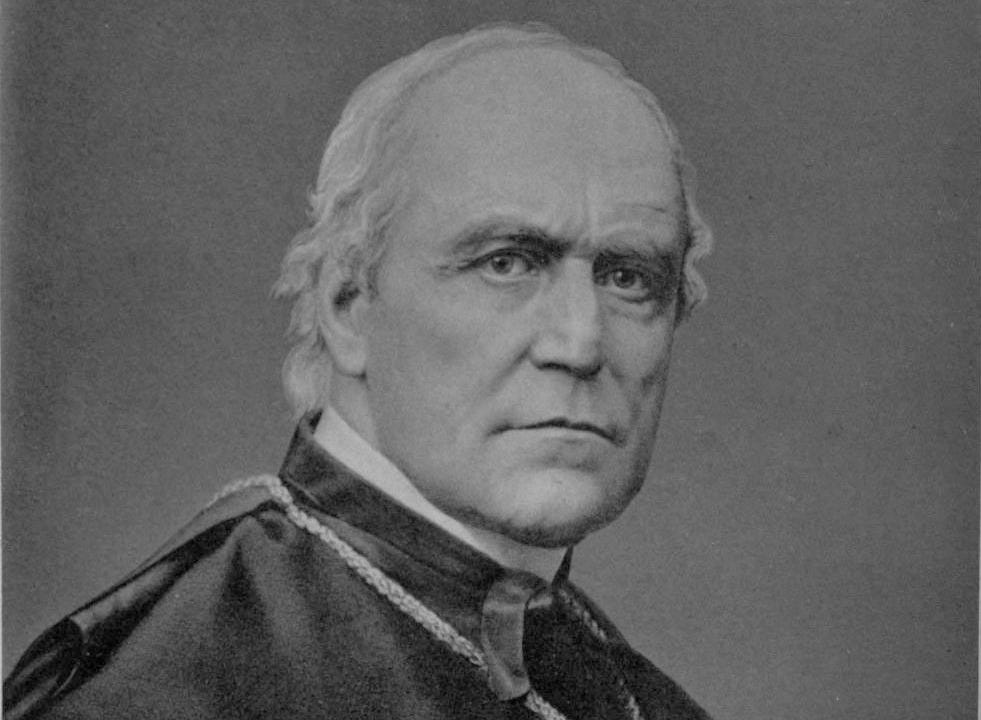
Pope Leo XIV, originally of Chicago, chose his papal name to recall Pope Leo XIII (1810–1903), particularly his May 1891 encyclical that critiqued the Industrial Revolution, On the Condition of Labor. The current Pope Leo is likewise interested in today’s social questions, including the looming effects of artificial intelligence. “In our own day,” says Leo XIV, “the church offers to everyone the treasury of her social teaching in response to another industrial revolution and to developments in the field of artificial intelligence that pose new challenges for the defense of human dignity, justice and labor.”
The downside of the Industrial Revolution was increasingly evident during the 19th century. For example, there was in the early 1800s a movement among textile workers in Great Britain, called Luddites, who rebelled against specific machines that threatened their wages and the quality of their craft. Their protest sometimes included destruction of machines. Soon enough, however, factory owners and law enforcement put an end to the movement.
Social critics Karl Marx (1818–1883) and Friedrich Engels (1820–1895) advocated for a different economic system, most famously in their 1848 Communist Manifesto. Meanwhile, Charles Dickens (1812–1870) portrayed the terrible negatives of the Industrial Revolution in his popular novels. Pope Leo XIII added Catholicism’s voice to the cause in On the Condition of Labor.
Although Leo XIII is credited as the pioneer of modern Catholic social thought, he was not the first. For example, Bishop Wilhelm Emmanuel von Ketteler (1811–1877) of Mainz was an outstanding social, political, and spiritual leader of the 19th century. In highlighting concepts such the common good, employees as stakeholders, and solidarity, he laid the groundwork for a mature Catholic reflection on modernity.
The same year as the publication of the Communist Manifesto, von Ketteler gave his own analysis in six Advent sermons on poverty and inequality. These were refined in an 1864 book, The Laborer Question and Christianity.
Von Ketteler, a member of an aristocratic family, opposed materialistic communism but was deeply troubled by the harsh effects of industrial capitalism. He thought that some state regulation alongside action by labor and charitable groups could temper extreme capitalism. Thus he advocated for the end of child labor, limits on factory working hours, Sunday as a true day of rest, disability and temporary unemployment insurance, state health and safety inspectors, and more cooperative enterprises overall. The key to a better capitalism was to break the belief that an individual is “the absolute master of things that he [or she] owns,” he preached.
Catholicism says that private property is a right. But drawing upon St. Thomas Aquinas (1225–1274), von Ketteler explained that only God has “full and genuine property rights . . . When making use of his [or her] property a person has the duty to bow to the God-given order of things.” It “is a perpetual sin against nature [to hold] the false doctrine that property confers strict rights,” he continued. Catholicism “protects property,” he said, “but wealth must be distributed . . . for the sake of the general welfare.”
Cardinal Henry Edward Manning (1808–1892), the second Catholic archbishop of Westminster, was long interested in family life, education, church-state relations, and issues of the working class. He was ordained as an Anglican in 1833 and later that year married Caroline Sargent (1812–1837). He was only 27 years old when she died. He became disillusioned with the Anglican Church, in part because it was oblivious to the working poor. In 1850 Manning was received as a Roman Catholic.
In 1848, Manning added his objections to the industrial economy. He said that Christians need to be with the “poor of Christ, the multitude which have been this long time with us and now faint by the way . . . in mines and factories.” Manning, like von Ketteler, anticipated Leo XIII.
Manning was sympathetic to the situation among dockworkers. He mediated during the famous 1889 strike at the Port of London, stating that the employers’ refusal to negotiate was not a private matter but a “public evil.” Union members considered the outcome of their job action a grand victory, which in turn gave momentum to the British labor movement and particularly to organizing lower-wage workers.
Manning’s impact on the Catholic social conscience was not limited to the union members. Many Catholics in the middle- and upper class of that time became attentive to urban and industrial poverty because of his influence.
Von Ketteler and Manning were spiritual ghostwriters for On the Condition of Labor. They and others may provide the same service to Leo XIV when, I predict, he soon issues a major document about the condition of post-industrial workers. ♦
William Droel is editor at National Center for the Laity (PO Box 291102, Chicago, IL 60629). It distributes a new edition of On the Condition of Labor by Pope Leo XIII; $8 includes postage.