


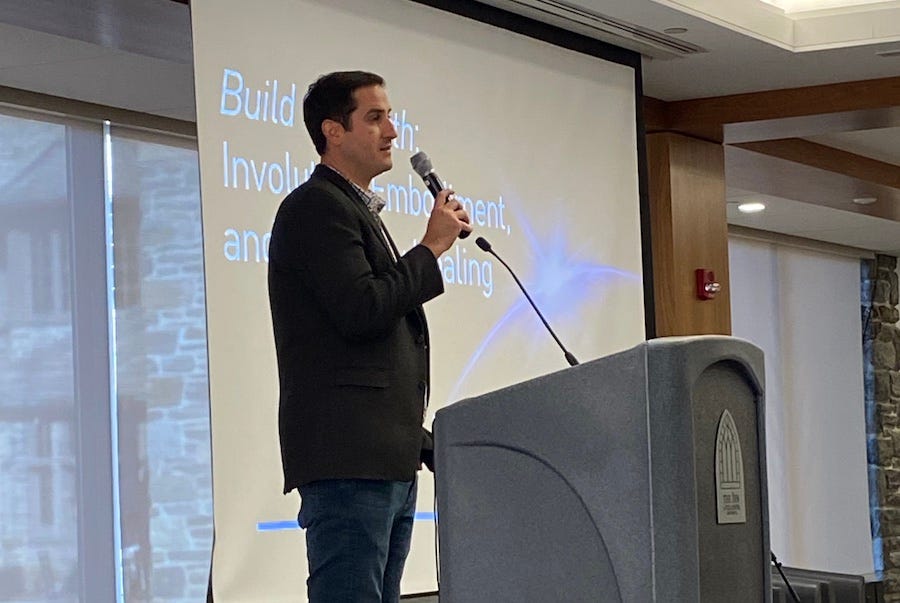
In a presentation he described as a “personal journey,” theologian and philosopher Thomas Jay Oord guided listeners through his process of arriving at a meaning of love by evaluating, comparing, and contrasting several of its most common expressions.
The presentation, “Disruption and the Many Meanings of Love,” was one of two keynotes given on the second day of the World Institute for Science, Religion, and Culture conference. The conference has convened from November 9 through 11 at the Inn at Villanova University in Pennsylvania.
Oord is the director of the Center for Open and Relational Theology and the author or editor of over 50 books. He opened by noting that the definition of love is elusive, given its many varied uses in daily life. The Bible itself “has a lot of different meanings of love,” he said.
The oldest, most influential definition of love comes from Plato, who understood it primarily as a yearning, attraction, or “desire for something beyond myself,” he said.
Oord critiqued Augustine’s “platonic love language of desire” and his framework of proper versus improper desires. He questioned Augustine’s comment that “we can love gold with an evil as well as a good love,” as it conjures the notion of an “evil love” that is not common in the Scriptures.
He also critiqued Augustine’s teaching that God does not “enjoy us” but rather “makes use of us.” This runs counter to the biblical idea that “God so loved the world that he gave his only begotten son” in John 3:16, he said.
Oord then introduced eight common understandings of love and analyzed them from various angles. These included love as desire, energy, choice, union, relationship, feeling, well-being, and God.
Though none of these common understandings is equivalent to love itself, each one has aspects that can be “salvaged” and incorporated into a more precise definition of love, he explained.
In one example, he spoke of how the idea of union is at the heart of love. He quoted theologian Paul Tillich: “Love is the drive toward the unity of what is separated.” Yet unity does not work as a complete definition of love, because people can unite for the purpose of doing unkind or unloving things.
“Love sometimes unites, but other times it unravels,” he said.
Related to the idea of love as union is that of love as relationship. He differentiated the two by stating that when two entities come together in relationship, each one retains its distinctiveness. He noted that the God of the Bible is relational, in that he gives and receives, is affected by humanity, and is intimately involved with the universe.
“There’s something about relationality that’s crucial to love,” he continued, though our relationships themselves are not necessarily loving. He used this insight to further refine his definition of love: “Love is not simply relations but it requires relations.”
A final example was drawn from the First Letter of John: that “God is love” (4:7-8). Oord interrogated the question of whether God is the same as love and made a subtle distinction between the two.
“We love because God first loved us,” he said. God “encourages us” in the process of loving, and our choice is a response to God’s “engaging, inspiring” activity.
“God necessarily loves [but] love is not God,” he clarified. Instead, “God empowers and calls creatures to love moment by moment.”
Oord then offered his solution or synthesis definition of love based on key takeaways from his previous examples: “To love is to act intentionally in relational response to God and others with the aim to promote overall well-being.”
He concluded by asking the framing question of his presentation: “Is love a disruptor?”
Love sometimes “disrupts” whatever undermines well-being, he explained. He named prophetic speech, resistance to oppression, and expressions of compassion and forgiveness as examples of “disruptions” of love.
Fellow theologian Andrew Del Rossi followed Oord with his presentation, “Build the Earth: Involution, Embodiment, and Planetary Healing.”
Del Rossi is the author of Sacred Synergy: Spiritual and Psychological Growth in an Evolving World (Paulist Press) and serves as director of the Spirituality Center at Daylesford Abbey in Paoli, Pennsylvania.
He opened with a “pearl of wisdom” from Teilhard de Chardin: “The age of nations has passed. The task before us now, if we would not perish, is to shake off our ancient prejudices, and to build the Earth.”
Humans are currently living in a time of “meta-crisis” impacting “every sphere of existence,” he said. He reminded listeners that the “big picture of evolution” is not a smooth process, but one that involves periods of chaos, destruction, silence and stillness, and renewal.
Del Rossi invoked Teilhard’s law of “complexity-consciousness,” which states that every increase in complexity has a corresponding increase in consciousness. This law is reflected in the fact that humans are becoming more collectively self-aware.
“Humanity is a porous organism,” he said, meaning that we are open and susceptible to what is happening around us. In prayer and contemplation, we might carry the oppression, suffering, and joys of others within ourselves.
Describing technology as “our fastest evolver,” Del Rossi linked it to an “extension of evolution.” He gave the example of circuitry components that are made from minerals extracted from the earth.
Technology is an extension of complexity-consciousness, just as nature is a highly interdependent operation. The internet “catalogues consciousness” in a way that can overwhelm and even demoralize us, he said. Humans are beginning to embody the “fractal nature of evolution” in that they are now participating a world life, a world soul, and a world community.
In all of these advances, “we are struggling to hold it together as a species,” he continued. He used Teilhard’s term “space-time sickness” to characterize our current moment. This “sickness” can be partially attributed to a lack of “synthesis” within, he said.
Del Rossi provided an overview of Teilhard’s concept of “involution,” or “the radial energy within us.” The process of involution is closely bound to the “consciousness of relationship” humans have with themselves, each other, the earth, and God. He used the image of a molecule or a plant coiling upon itself to further illustrate this process.
“Our relationship with earth is critical to our own evolution beyond it,” he said. “How are we answering the call to embody the spirit of the earth?”
Del Rossi defined humanity as “the planet aware of itself.” An infatuation with technology is diminishing humanity, he said. Humans experience connectivity through technology but less so in the biosphere or natural world. Further, technology leads humans inward, but via the way of narcissism rather than that of reflection or contemplation.
Referencing Paulist priest and self-proclaimed “geologician,” Thomas Berry, Del Rossi said that the “entrancement” with technology requires a “counter-entrancement.” Berry was concerned that “we’re losing sense of a connection through a common story,” he explained.
Berry’s notion of the “ecozoic,” a coming geological era where humans live in concert with the earth’s ecosystems, is one such “counter-entrancement,” Del Rossi said. It represents a movement away from destruction to where humans see the natural world as the “first revelation of God.”
“We might have more equanimity in the world if we had more equanimity within,” Del Rossi said, adding that humans can rise to the challenge of rebuilding the earth by being in greater relationship with it.
Del Rossi offered several suggestions for returning to the “covenant of faithfulness to God and humanity” through “faithfulness to the earth.” At a time when “life is becoming so diffuse” and society reaches a “fever pitch,” he recommended practices to center oneself and simplify one’s life.
Seeing our “first earth” as our body or physical being, humans might begin by attending more closely to their embodied selves, he said. He noted that time spent in natural environments has been proven to enhance cognitive function and mood.
He also suggested developing a relationship with the unconscious so that humanity can “bring a light to the darkness.” Such “shadow work” helps expose the alienated, hidden, isolated parts of ourselves that are reflective of our relationship with the planet, he said.
Our union with the earth is in a way our union with the poor, he said. The work of planetary healing returns us to the “poverty of self” where we become dependent on a higher power or forces beyond our control. ♦
Michael Centore is the editor of Tomorrow’s American Catholic.