


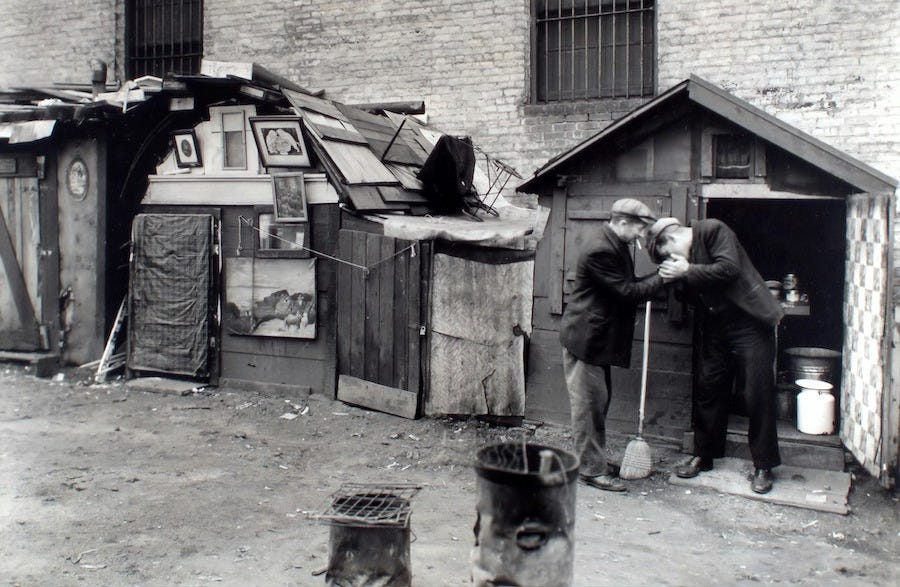
“The millions who are poor in the United States tend to become increasingly invisible.” So wrote Michael Harrington (1928–1989) in his influential 1962 book The Other America. The poor are invisible to others and to themselves because television and advertising present a society that lives decently, if not in luxury, Harrington explains. The common assumption is that the poor are the exception. And in time they “slip out of the very experience and consciousness of the nation.”
Invisibility is also perpetuated by public policy and elected officials. Instead of the word poverty, other terms (sometimes unintentionally) convey that nearly everyone is getting by. Terms like working class, part-time employee, or day laborer are used instead of poverty. A notion prevails: Homeless beggars and the like must have made unhealthy choices; their poverty is self-inflicted.
Rev. William Barber II of Yale Divinity School cites Harrington in his recent book White Poverty. Barber, too, says that poverty is invisible. “It is hidden from us by forces we do not understand,” he explains. Society assumes that anyone who is working cannot be poor, even if the job is hawking wares on a street corner or maneuvering a ride-share vehicle or taking orders in a diner. So, the assumption continues, a truly poor person must be “lazy or suffering the consequences of their own choices.” Society, Barber says, blames poverty on the poor. As if they “are themselves the problem.”
Barber challenges the federal formula for poverty. It ignores too many variables, he says. Instead, several journalists and social scientists consider poverty to be one’s inability to handle a $400 or $500 emergency—a car repair or a medical bill, for example. The emergency cannot be solved by borrowing because that person is socially poor. They do not have relatives or friends who are able to help. Using the $400-to-$500 emergency measure, Barber calculates that 43 percent of people in the US are poor.
Pope Leo XIV extends the themes of Harrington and Barber to the world scene. “Without even realizing it,” he writes in the apostolic exhortation Dilexi Te, we have created a “sometimes well disguised” culture that discards others. Poverty is invisible. What we do see is success and consider it deserving, Leo says.
The cause of poverty is not normally the poor person themselves; it is a culture and politics “that are marked by numerous inequalities,” our pope continues. People who are blind to poverty operate under “the illusion of happiness [which is equated with] the accumulation of wealth and social success.” Yet knowingly or not, they participate in “unjust social ideals and political-economic systems that favor the strongest.” The real challenge is opposition to “the social and structural causes of poverty,” Leo concludes.
“Tax the rich,” a slogan heard these days, names an obvious improvement. Progressive taxation makes sense because today’s wealth gap exceeds imagination. “The world’s wealth has grown in absolute terms, [yet] it is increasingly concentrated in fewer hands, widening inequalities,” Leo XIV notes in his encyclical Magnifica Humanitas. Worldwide, only about 60,000 people control three times as much wealth as the bottom half of the population. But how to institute and then enforce a major change in tax policy?
A practical starting point for opposing poverty requires creativity and dedication. And with effort, our own poverty and that of others will come into view. In time the culture will change from cynical callousness to emphatic gratitude. Genuine change begins with small groups and modest gestures. All of us need to see the poor as they truly are, to create a culture of encounter within our dominant culture of detachment and transaction. Touch the elderly, converse with the poor, smell the sheep. Here are modest starter suggestions:
Implement small, helpful programs. With friends and others, start a fund to help families pay for childcare, which now averages $1,330 per month. Beware of paternalism/maternalism that, for example, requires beneficiaries to attend church services or excludes those who appear ungrateful.
Keep informed on neighborhood and national news. Remember though that exchanging opinions with friends about elected officials can quickly become a hobby; it is not politics.
Participate in a rally, though not merely as a spectator. Use the opportunity to encounter like-minded people.
Participate in a Thanksgiving food drive. It is usually fun. Volunteering at a food pantry every week is better. It is a virtue.
Visit a homebound neighbor or relative. It is never a waste of time. Try to take the conversation a little deeper.
Keep in mind: There I go with the grace of God. ♦
William Droel is editor at National Center for the Laity (PO Box 291102, Chicago, IL 60629).