


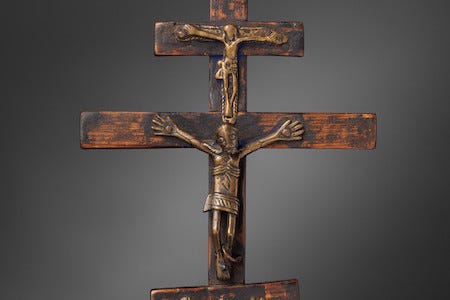
A few weeks prior to Lent, I found myself drawn to meditate more intentionally on the cross. Catholic Christian or not, the cross is something deeply embedded in our collective unconscious as a symbol of trial or inward conflict, manifested in the way the horizontal and vertical axes intersect in two opposing paths—the timeless image of the crossroads or carrefour where a decision must be made.
There is a wrenching quality to the center of the cross, that sensation we commonly describe as being “pulled in many directions.” We can feel paralyzed trying to take one step forward, knowing it means we are turning away from multiple horizons.
The cross in the Christian imagination transforms this feeling not by fighting it, but by fully embracing it. The cross is the world itself, with all of its weariness, violence, and sin—and not sin so much as individual transgression, but as the collective falling short that comes from our human limitations. Our reality as creatures means we can only be in one place at one time, and that no matter how much good we try to do, even more will be left undone.
Part of the life of the cross means entrusting this undone good to God. By way of a metaphor, it means continuing to tend one’s garden even in the knowledge that plants will die, that weeds will grow, that mildew might settle on shiny new leaves—like the orchard keeper in this week’s gospel (Luke 13:6-9), who experienced the cross of a fruitless fig tree for years on end, yet continued to cultivate it with steadfast hope.
To pray with the cross is to enter, through Christ, into another’s suffering. It is to realize that the burdens of the world are shared. There is no getting around them; there is only the daily “taking up of one’s cross” with dispassionate consistency. This is not drudgery, but the pathway to true freedom. A Lenten litany in the Benedictine breviary cycles us through the heart of this practice:
By the cross of Christ, save all who are crushed by the rich and the powerful.
By the cross of Christ, preserve from despair those who are dying in dreadful pain.
By the cross of Christ, help us to bear suffering without bitterness.
By the cross of Christ, sustain us in the struggle of continual conversion.
Reciting this today, I think of the stories of forced deportations these past two months—people ejected from the country without due process, regardless of legal status or evidence of criminal history, in an ongoing militarization of immigration policy. This sets up a constitutional crisis, and just as if not more damagingly affirms that human rights are, as Henry Leroy Finch phrases astringently in an essay on Simone Weil, “at the mercy of power.”
“As [world] governments seek to rigidly define the territories they control and the people allowed to be in those territories, those caught in the middle will be the ones who suffer most,” Joshua Keating wrote in a piece on “territorial ambiguity” and the “right to have rights” in 2019. Pope Francis has consistently reminded us throughout his papacy that the migrant, the stranger, the refugee, is simultaneously the most visible and the most hidden face of Christ in the 21st century: visible, because the suffering of those “between states” has been brought to the surface; and hidden, because they have no recourse, no means of appeal to assert their humanity. Like Ma Yang, a Hmong American mother of five who was deported to Laos—a country where she knows no one and has never visited—earlier this month, they speak as a sign of the cross: “How do I rent, or buy, or anything, with no papers? I’m a nobody right now.”
Michael Centore
Editor, Today’s American Catholic