


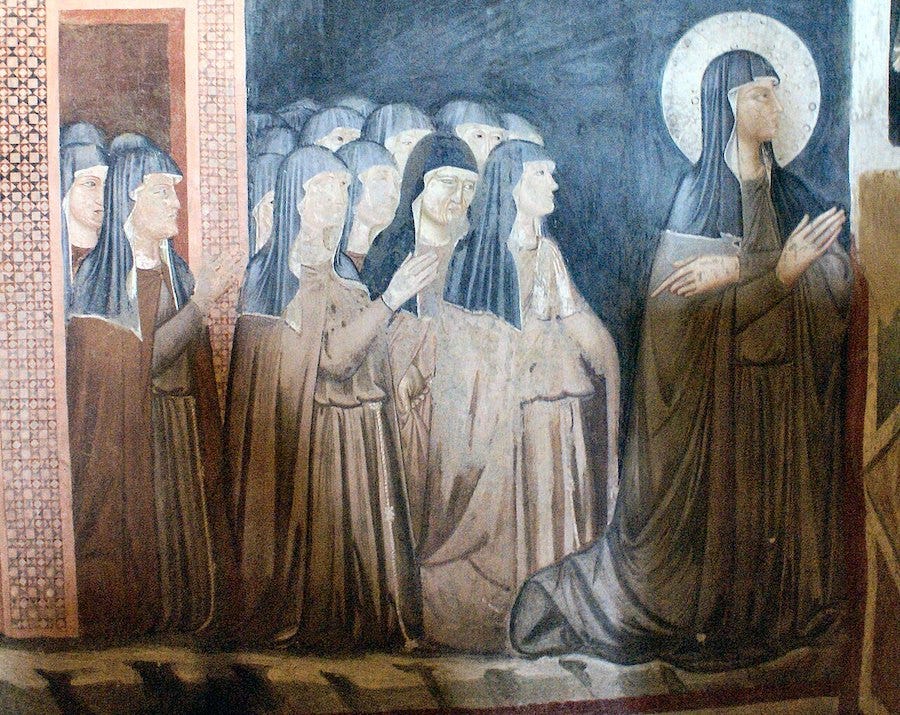
The woman we now know as Saint Clare was born Chiara Offreduccio in Assisi in July 1194. Both of her parents were descended from nobility: her father, Favarone de Offreduccio, from an ancient Roman family; and her mother, Ortolana, from the noble family of Fiumi.
When Clare was a young girl, conflict broke out between the wealthy noble class and the poor merchant class. The merchant class rebelled and drove the noble class out of Assisi. Clare’s family fled to Perugia, which was a sworn enemy of Assisi. There, with other noble families, they spent several years planning to go to war with Assisi so that they could reclaim their homes. In 1207, Perugia and her allies soundly defeated the Assisians at the Battle of Callostarda. This was the same battle that Clare’s future collaborator Francis participated in, setting out to win glory and knighthood by fighting with the army from Assisi. As we know, he failed miserably in this venture and spent a year in a prison cell in Perugia until his father paid his ransom.
Despite her family’s great wealth, Ortolana remained a devout Catholic woman. She made several pilgrimages to the Holy Land and other shrines, would often spend time helping the poor and hungry, and was known to visit and pray with prisoners. Ortolana would have most likely have known Francis’s father Pietro di Bernardone, and it is possible that she could have visited Francis during his year in prison.
Because of her privileged upbringing and was considered to be very attractive, Clare would have had many suitors. However, as was customary for the time, she would have had no say as to when or to whom she was to be married. Her father would have selected a suitor based on his family’s wealth and standing in the community, then arrangements would have been negotiated and the marriage contracted. When Clare was twelve years old, her parents arranged for her to marry a very wealthy young man. In perhaps her first act of defiance against the patriarchy, she refused. She asked her parents if she could wait until she was eighteen to marry.
Clare grew up in a household of holy women, including her mother and her sisters. With her devout Catholicism, Ortolana would have raised her daughters to be not only pious and prayerful but also to care for the poor and the sick. It has been suggested that when Clare’s mother was pregnant, she sensed that there was something wrong, so she went off to pray. While praying, she had a vision in which she heard the words: “O lady, do not be afraid, for you will joyfully bring forth a clear light that will illuminate the world.” In Italian the word for clear is chiara or “Clare”; when the child was born, her mother chose this for her name.
As a teenager, Clare would have heard Francis preaching around Assisi. She would have known that he was the son of the wealthy merchant who gave up everything to live a life of prayer and poverty. Clare became intrigued by what Francis was preaching and wanted to learn more.
At this period in time, young women, especially those of noble birth, were carefully watched by their parents and had little to no voice in their futures. They were either married off to the sons of other noble families or shipped to cloistered convents to spend their lives in penance and prayer. Clare knew that she was soon to turn eighteen and that her father was making arrangements for her to be married off to the son of a rich nobleman. But she had other ideas about her future.
Clare’s cousin Ruffino was one of the first followers of Saint Francis. In 1212, Clare sent word through Rufino that she wanted to meet Francis. This was three years after Francis had received approval from Pope Innocent III to build his religious order. The Franciscan movement was expanding rapidly across Italy and southern Europe, but only men were allowed to join. So, when Francis received word that Clare wanted to meet with him, we can imagine that had no idea what to expect. Perhaps he thought that this young woman wanted to financially support his growing movement.
The two of them met secretly several times. At first Francis tried to convince Clare that she should join one of the cloistered religious orders nearby. But Clare would have none of this. On Palm Sunday, she joined Francis and his followers at San Damiano. A few weeks later, her younger sister, Agnes, joined her. They spent several months living with a community of Benedictine sisters while the brothers rebuilt the living space at San Damiano. The women returned to San Damiano, where together they founded the Order of Poor Ladies, which later became known as the Poor Clares. It was the first order of Franciscan women.
In a time when women, especially women religious, were expected to be under the dominion of men, women’s religious orders had to organize under the direction of a priest or bishop. Clare felt that women should not just be cloistered away praying, but should be out in the world caring for the sick and feeding the hungry. It was also the practice of the time for the Rule of an order to be written by a man and approved by the pope. In a radical departure from this tradition, Clare wrote her own Rule with input from her sisters. The Rule was based on what Francis had developed for men, but with a better understanding of the unique role of women in the religious life.
While acknowledging the authority of the papacy, Clare’s Rule rejected the idea that an order of women religious should fall under the auspices of a man. Pope Innocent III did not accept Clare’s Rule. In 1217, following Innocent’s death, Pope Honorius III had Cardinal Hugolino of Ostia write a Rule for Clare and her sisters. Clare ignored this Rule and the community continued to live by the original Rule they had written. In 1247, Pope Innocent IV had another Rule written for the order. Clare and her sisters again rejected this Rule. It was not until 1253, two days before she died, that Pope Innocent IV approved her original Rule. Clare thereby became the first woman religious to write and receive approval for a Rule for women religious.
During the Middle Ages, there were a number of theologies to explain the birth, death, and resurrection of Jesus and the purpose of the incarnation. Some were centered on the idea that the incarnation was connected to sin: because of sin, there needed to be some form of atonement. Different expressions of atonement included ransom, redemption, propitiation, and substitution. The first of these was developed by the second-century bishop Irenaeus of Lyons, who advanced the recapitulation theory of the atonement. Others like Anslem and Augustine believed that because man had sinned, God had to “make a deal” with Satan to free our souls. The idea was born that God had to pay a “ransom” so that humans could advance to heaven.
All of these theologies agreed that the main purpose of the incarnation was for the Son of God to be eventually sacrificed on the cross. But Francis and Clare believed that the incarnation had nothing to do with changing God’s mind about humanity, as Richard Rohr might say, but rather with changing humanity’s mind about God. They didn’t believe that the birth of Jesus was a simple historical event, or that the incarnation was somehow connected to sin. As the thirteenth-century Franciscan theologian Blessed John Don Scotus explained:
The Incarnation of the Son of God is the very reason for the whole Creation. To think that God would have given up such a task had Adam not sinned would be quite unreasonable! I say, therefore, that the fall was not the cause of Christ’s predestination and that if no one had fallen, neither the angel nor man in this hypothesis Christ would still have been predestined in the same way.
Francis and Clare didn’t believe that God was some being sitting on a throne in the sky judging humanity, in other words; they believed that God was in each and every one of us and in all of creation.
When talking about the spiritual life, Clare would often use the image of a mirror. In her third letter to Agnes, she wrote:
Place your mind before the mirror of eternity!
Place your soul in the brilliance of glory!
Place your heart in the figure of the divine substance!
And transform your whole being
into the image of the Godhead Itself through contemplation!
So that you too may feel what His friends feel as they taste the hidden sweetness
Which God Himself has reserved from the beginning
for those who love Him.
For Clare, contemplation is not just an intellectual exercise, but a transformative indwelling in love. As Sr. Ilia Delio writes in her book Clare of Assisi: “What Clare suggests is that contemplation is not a preliminary step to transformation or imitation but rather that we must drive to be transformed in Christ in order to contemplate the truth of Christ contemplation deepens as we continue to be transformed in Christ by becoming the truth of who we are in God.”
Clare understood that God is not an abstract concept but a living reality of love. She believed that transformation into our Christ-nature is expressed in the language of imitation: “We become what we love and who we love shapes what we become,” she wrote. “If we love things, we become a thing. If we love nothing, we become nothing. Imitation is not a literal mimicking of Christ, rather it means becoming the image of the beloved, an image disclosed through transformation. This means we are to become vessels of God’s compassionate love for others.”
Clare also understood that the incarnation is an expression of God’s love. Jesus didn’t come so that we could worship him; the incarnation, rather, was about showing us how to be Christ. Clare teaches us to be “mirrors” of Christ: If I look at you, she says, I should see Christ, and if you look at me, you should see Christ. If we are not seeing Christ in each other and in every part of creation, we are not following the message of Jesus. Like Francis, Clare believed that in order to be in right relationship with God, we have to first be in right relationship with all creation. Clare taught that to follow Christ, we must see ourselves in the faces of our suffering brothers and sisters. In them, we should see the suffering Christ on the cross. Do we really see the suffering Christ, or do we merely pass by and let Christ continue to hang on the cross?
Today the movement of Franciscan women that Saint Clare founded with her sister Agnes has grown to more than 400 different congregations of approximately 60,000 women. They are active in most countries. They are involved in the work of peace and caring for the poor and sick. They have established schools and medical facilities. They are presidents of universities and hospitals. They stand in solidarity with the poor, the hungry, the migrants, and the sick. They do so in the spirit of Saint Clare. When they see suffering, they see Christ on the cross. And like Saint Clare, they become mirrors of Christ. ♦
Patrick Carolan is a co-facilitator of the Tomorrow’s American Catholic podcast.